By insideSail
Automated technical check · version 2 ·
Engine, rudder and motion: three different relationships
A force changes motion; a command is not a trajectory.
In this guide
An engine does not move a boat simply by existing or by having a particular power rating. In a conventional propulsion system, it supplies energy reaching the propeller through a transmission.
The rotating propeller interacts with water and produces thrust. That thrust participates in the forces acting on the hull.
The rudder adds another relationship with water flow. These functions explain more than treating each control as an arrow of immediate movement.
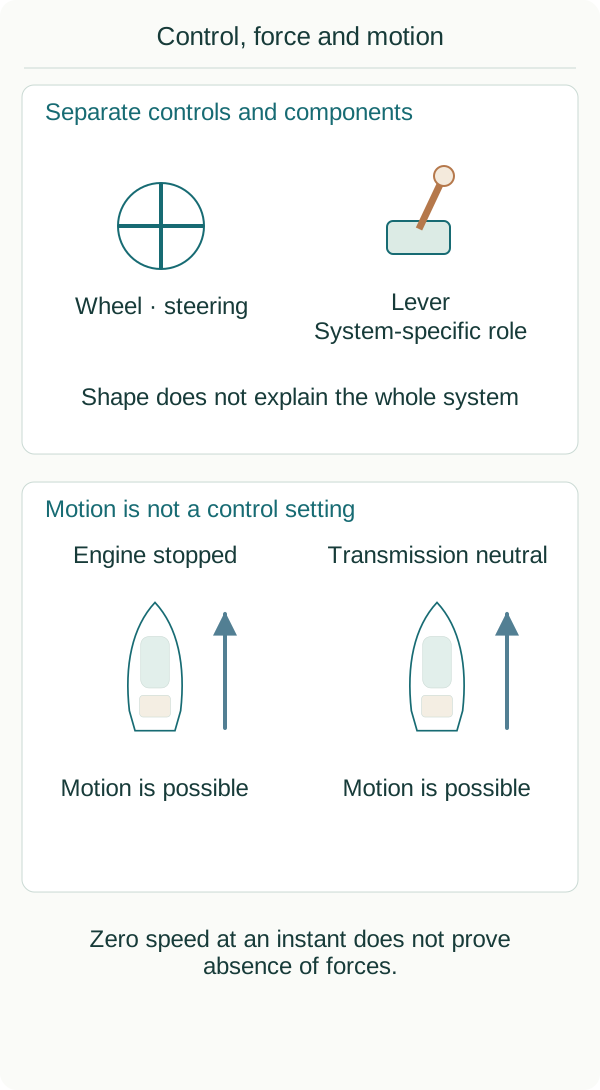
A control setting and the boat’s motion answer different questions.
insideSailOriginal insideSail artwork — all rights reservedEnlarge the diagram
Energy, force and response through time
Power describes a rate of energy transfer; thrust describes a propulsive force. Velocity describes motion relative to a reference frame.
These are different quantities. Greater rated power is neither a manoeuvring speed nor a stopping time.
Propeller, transmission, displacement and flow participate in the relationship between system and boat response. The diesel and transmission lessons develop those components without reducing this relationship to horsepower.
Inertia is associated with resistance to changes in motion. In a simple physical model, a resultant force changes velocity over time rather than instantly replacing the existing velocity.
Removing a propulsive force from the model does not itself remove movement. The remaining forces still determine how motion develops.
This explanation calculates no distance or time for an actual boat, but resolves confusion between control input, force and velocity.
The rudder relates to water flowing past it
The rudder interacts with flowing water to produce forces that can create a turning moment on the boat. A wheel or tiller commands its position through the steering system; it does not directly pull the bow towards a point on a map.
Having a rudder does not itself specify the strength of that response. Geometry, flow and configuration matter.
The schematic explains a physical relationship without predicting response to an input under particular conditions.
Propeller and rudder do not necessarily share the same spatial relationship on every sailboat. Shaft drives, saildrives, twin rudders and different appendage positions create distinct configurations.
The steering lesson retains those component definitions. Here the important point is that a generic explanation cannot assume propeller flow over every rudder or turn a model illustration into a prediction for another owner’s boat.
Heading and movement can diverge
Rotation and translation are two further dimensions. A boat can change heading while continuing to move; it can move sideways over the ground without its bow pointing that way.
A still photograph shows position and orientation at an instant. A time sequence permits discussion of changes when its reference is clear.
This distinction prepares you to read handling explanations without turning one trajectory’s shape into a universal property of a model.
Takeaways
- Engine, propeller and rudder have related but different functions.
- A force change does not instantly remove movement.
- Heading, movement through water and movement over ground need separate descriptions.
The concept in a few words
Inertia
The property associated with resistance to changes in motion; a force change does not instantly replace an existing velocity.
Sources and references
- Glossary — sailing reference frames ↗
B&G · Entries Apparent Wind/AWA; Boat Speed; Ground Wind; SOG.
Only declared land/water/boat reference distinctions used. No instrument configuration, current numeric example, outdated satellite information or other glossary claims adopted.
Checked on - Boat Crew Handbook — Seamanship Fundamentals BCH 16114.4 ↗
United States Coast Guard · Chapter 6, A.9 printed p.6-8; A.11 Propeller Action p.6-10; A.12 Rudder Action p.6-12.
Energy, thrust and water-flow recognition only; no manoeuvre, engine operation or emergency procedure.
Checked on - Rudder — general physical function ↗
Wärtsilä · Opening paragraph: interaction with water flow, transverse force and turning moment.
Introductory physics only. Large-ship arrangements, angles and comparative performance claims excluded.
Checked on
Keep discovering
The next piece of the puzzle
Discuss this concept
Loading the conversation…