
Automated technical check · version 6 ·
Shaft drive, saildrive and propellers
Drive and propeller are part of the propulsion system.
In this guide
From the engine to the water
Explore how rotation is transmitted and how propellers are arranged.
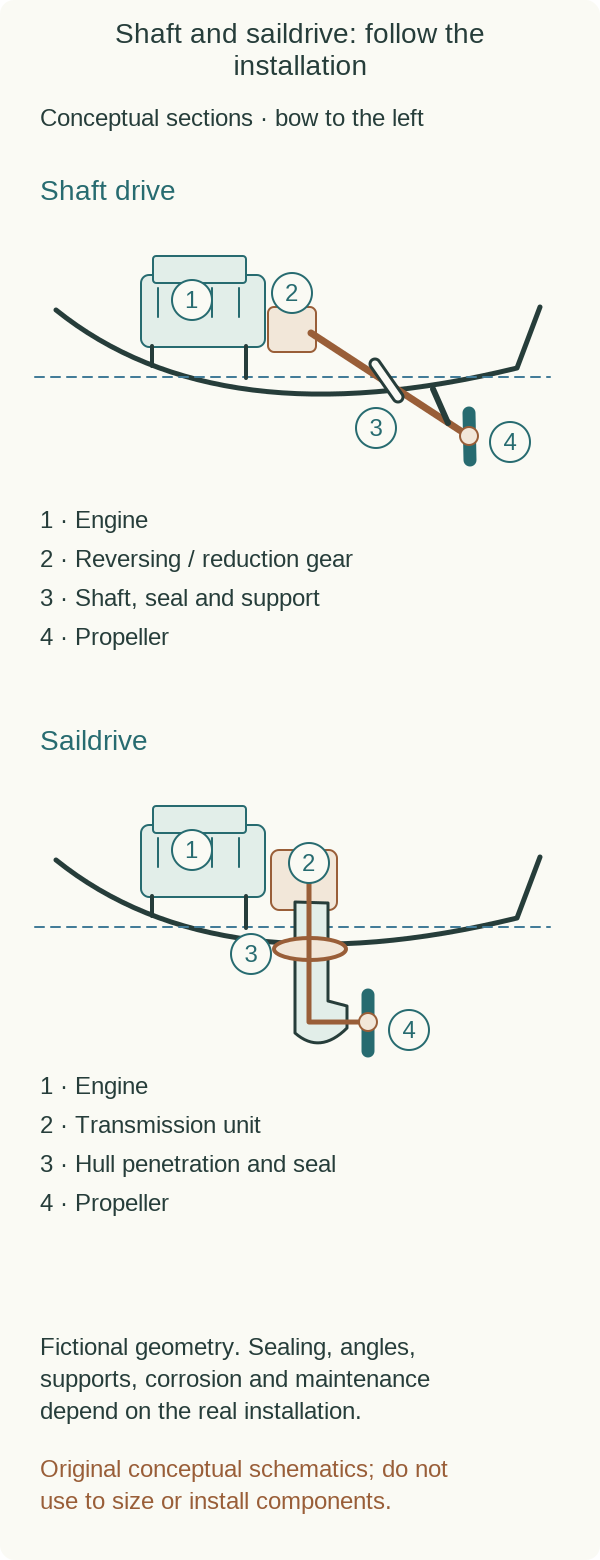
Original conceptual schematics; do not use to size or install components.
insideSailOriginal insideSail artwork — all rights reservedEnlarge the diagram
Shaft drive
A supported, sealed shaft carries rotation to the propeller.
What it offers: Helps identify the shaft, supports and passage through the hull.
What to consider: Access, alignment, seals and maintenance depend on the installation.
Saildrive
A unit passes through the hull and transmits rotation to the propeller.
What it offers: Provides an arrangement distinct from a longitudinal shaft.
What to consider: Seals, corrosion and procedures follow the manufacturer’s documentation.
Fixed propeller
The blades retain a fixed geometry.
What it offers: Makes the mechanism recognisable without blades that fold or turn for sailing.
What to consider: Geometry and drag under sail are installation trade-offs to assess.
Folding propeller
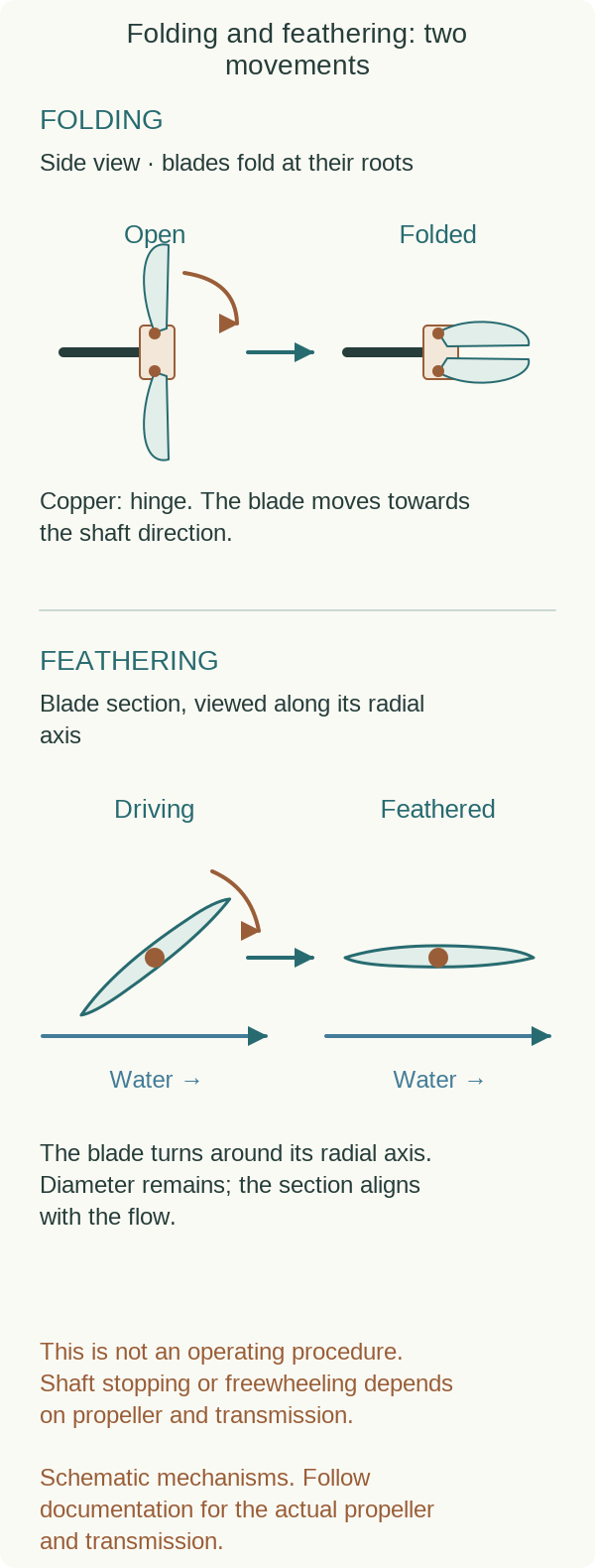
Schematic mechanisms. Follow documentation for the actual propeller and transmission.
insideSailOriginal insideSail artwork — all rights reservedEnlarge the diagram
Blades can fold to reduce exposed area under sail.
What it offers: Aims to reduce drag compared with the open arrangement.
What to consider: Mechanism and operation need specific maintenance and compatibility.
Feathering propeller
Blades can rotate to a lower-drag orientation under sail.
What it offers: A distinct way to reduce the blades’ effective area under sail.
What to consider: Adjustments, mechanism and compatibility vary: check the specification.
Three things to remember
- Shaft drive and saildrive are different drives.
- Folding and feathering describe different blade movements.
- Propeller, engine and reduction need to be compatible.
In plain language
A shaft drive takes rotation to the propeller through a supported, sealed shaft. A saildrive uses a unit passing through the hull to transmit rotation to the propeller.
Propellers may be fixed, folding or feathering; these describe different mechanisms.
How to interpret it
Diameter, pitch, blade count and reduction ratio must suit the engine, drive and boat.
Why it matters
An appropriate propeller helps use available power; some solutions aim to reduce drag under sail.
Limitations
Maintenance, seals, corrosion and procedures depend on the manufacturer. There is no single replacement interval for every installation.
In practice
For a repower, check the complete installation. Reusing the old propeller does not guarantee compatibility.
Further reading
SD25 Operation Manual — propeller selection ↗
Keep discovering
The next piece of the puzzle
The concept in a few words
Shaft drive, saildrive and propellers
Drive and propeller are part of the propulsion system.
Sources and references
- Max-Prop — Easy / Whisper instruction manual ↗
Document dated 26.12.2025; PDF p.13, printed p.11: model-specific shaft handling differs from Classic. Supports omitting a universal gearbox instruction.
Reference for insideSail educational figure ir26-prop-folding-feathering-motion.
Checked on - SD25 Operation Manual — propeller selection ↗
YANMAR Marine · Partial consultation: officially indexed Propeller Selection p.16 and Periodic Maintenance Table p.30. Direct PDF returned HTTP 403; full manual/colophon not consulted. Installation and maintenance remain product-specific.
Checked on - YANMAR — Marine Gears: Technology for Enhancing Vessel Comfort ↗
Technical Review, 26 March 2020, section 2: input/output shafts, forward/reverse selection, reduction and transfer of propulsion to vessel. Generic original diagram, no product-specific layout traced.
Reference for insideSail educational figure ir26-prop-shaft-saildrive-sections.
Checked on - Two-blade Folding Propeller ↗
YANMAR Australia · Historical bibliographic reference: original YANMAR AU page currently unavailable (HTTP 500), not read live. Its indexed mechanism description was corroborated in the accessible official GORI brochure, PDF p.2: https://gori-propeller.com/app/uploads/2022/02/26685_BSI_GORI_Propeller_Produktfolder_12s_210x280.pdf . The GORI source is cited separately.
Checked on - Max-Prop — Classic 2-blade instruction manual ↗
PDF p.9, printed p.9: automatic forward/reverse pitch and feathering. Mechanism drawn originally; no manual illustration copied and no operating steps reproduced.
Reference for insideSail educational figure ir26-prop-folding-feathering-motion.
Checked on - GORI — official propeller brochure ↗
PDF p.2: 2-blade folding mechanism, synchronised blade movement and shaft/saildrive variants. Edition date unknown. Current primary confirmation of the mechanism; historical YANMAR AU product URL returned HTTP 500. Marketing performance claims are not adopted.
Reference for insideSail educational figure ir26-prop-folding-feathering-motion.
Checked on - Flexofold — 3-blade composite saildrive instructions ↗
2024-2 document, PDF p.1: component list, pivot pins and opening/closing blades. Product-specific gearbox stopping instructions are deliberately not generalised.
Reference for insideSail educational figure ir26-prop-folding-feathering-motion.
Checked on
Loading discussion…