By insideSail
Automated technical check · version 2 ·
From tiller or wheel to rudder: steering-system names
The visible control is one part of a system extending to the rudder.
In this guide
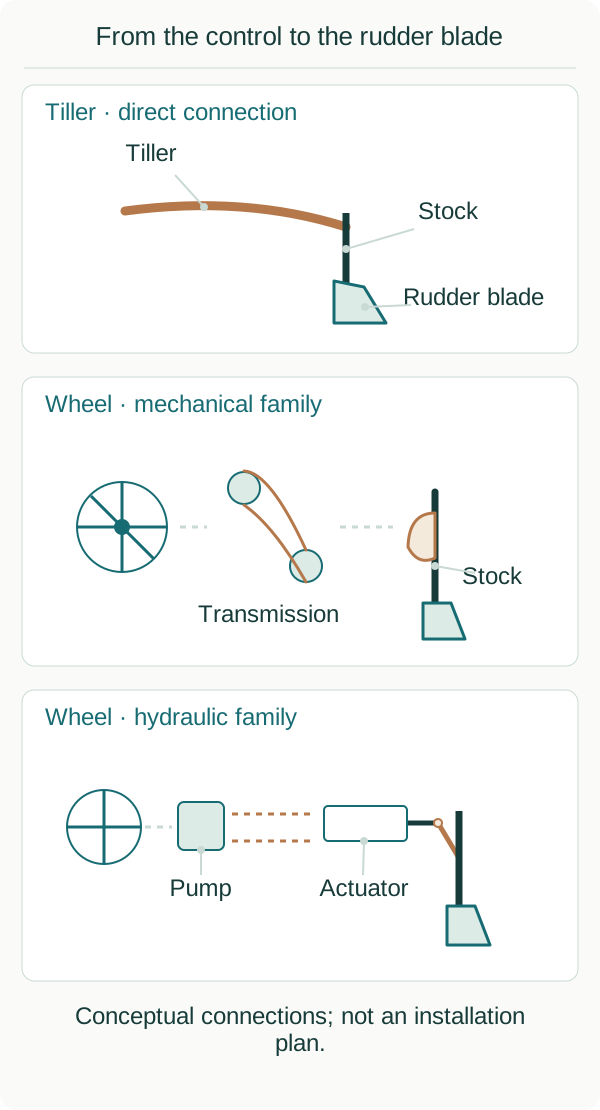
Recognition of steering families; conceptual links, without an assembly plan, tensions or bleeding instructions.
insideSailOriginal insideSail artwork — all rights reservedEnlarge the diagram
In conversations about yachts, wheel, tiller and rudder can sound almost interchangeable. Understanding a boat is easier when the parts are separated.
Wheel or tiller is a control used by a person; the rudder blade is a steering element in contact with water; connections and components may lie between them. The figure organises these levels without providing a complete installation design.
Two ways to relate control and blade
In the simple tiller family, the illustrated arm relates to the rudder stock. The stock transmits rotation to the blade; the tiller is the control rather than the submerged surface.
In the wheel family, movement passes through an intermediate assembly before reaching the stock. That assembly can use different arrangements.
In a mechanical cable architecture, components relate wheel movement to an element connected to the stock. In a simple hydraulic architecture, wheel movement drives the helm pump; fluid transmits the action to an actuator acting on the connection to stock and blade.
These examples explain transmission paths rather than provide parts lists for construction. The same panel can show two wheels related to one blade, making clear why control and rudder count are distinct questions.
A skeg-supported rudder and a rudder without that support can also belong to systems with different controls. Blade support, control and transmission describe three complementary aspects.
Understanding their relationship lets you follow the physical system named in a description without assuming that one visible command represents every component.
Control, transmission, stock and blade
The rudder stock relates to the blade and the assembly transmitting movement according to the design. Steering transmission here means the connection between control and rudder; it is not the engine transmission.
A tiller can relate directly to the stock, while a wheel may use intermediate components. These diagrams explain families rather than every boat’s arrangement.
| Level | What it identifies |
|---|---|
| Control | Wheel or tiller visible at the helm position. |
| Steering transmission | Assembly relating the control to the rudder. |
| Rudder stock | Element associated with blade rotation. |
| Rudder blade | Submerged element represented in the drawing. |
Mechanical and hydraulic describe architecture
A mechanical schematic uses physical components to transmit movement between points. A hydraulic schematic includes fluid-working components and an actuator.
Saying merely “hydraulic” or “cable-operated” does not identify dimensions, condition, maintenance or system response. A wheel photograph can look similar in either case.
Identification improves with documentation of the actual system, its model reference and configuration.
Worked example: two wheels, how many rudders?
Now imagine another advertisement saying “new steering”, accompanied only by a wheel picture. It may use a broad system name or omit the image of the replaced part.
Ask which component was changed. That clarification separates a statement about the control from one about stock, blade or transmission.
Precise language makes an individual boat’s history more useful without requiring remote diagnosis.
A historical document identifies one arrangement, not every boat
The historical Hallberg-Rassy 352 specification includes a Steering section. It identifies the arrangement stated in that document.
An individual boat today may retain it or have alterations. Document reference and owner history answer complementary questions.
A documented architecture is not transferred to every year, option or surviving boat simply because they share a commercial name.
The rudder-type lesson develops blade support and position: spade, skeg, keel-attached, transom-hung or twin. These differ from the control type.
A wheel does not establish support type, and a tiller does not determine system strength. Read each feature at its own level.
Adjustment, repair and emergency steering need instructions and assessment of the actual assembly; this map helps recognise the components named in those documents.
Three things to remember
- Control and rudder are different parts of one system.
- Two wheels do not establish two rudders.
- Architecture, documented configuration and individual-boat condition are different information.
Concepts in this lesson
Rudder stock
The element associated with rudder-blade rotation and connection to the control assembly. It is distinct from a propulsion shaft.
Steering wheel
A control transmitting movement through the installed steering system. One wheel does not automatically correspond to one rudder.
Tiller
A control arm related to the rudder stock in the simple family illustrated. It is distinct from the blade in contact with water.
Sources and references
- Quadrants — steering component identity ↗
Edson Marine · Quadrants introductory paragraph: rudderpost, steering cables and quadrant; related EB380/EB373 document titles.
Component relationships only. No dimensions, installation, adjustment or inspection procedure imported.
Checked on - Hallberg-Rassy 352 — standard specification from December 1987 ↗
Hallberg-Rassy · p.1 Hull / Deck and superstructure / Spars and rigging / Deck fittings; p.3 Accommodation / Steering; p.4 specification/options notice.
Four-page historical specification. The document states From December 1987; publication day is unknown. Not a specification for every surviving individual boat.
Checked on - Hydraulic Steering — component families ↗
Dometic · Which hydraulic steering system is right for you? — helm, cylinder, tube/hose; Finding the right cylinder — helm pump identity.
Generic vocabulary for hydraulic transmission only; not a sailboat-specific product selection or operational recommendation.
Checked on
Keep discovering
The next piece of the puzzle
Discuss this concept
Loading the conversation…