By insideSail
Automated technical check · version 2 ·
Reading a boat record: model, version and individual boat
A model name, factory configuration and owner’s boat tell you different things.
In this guide
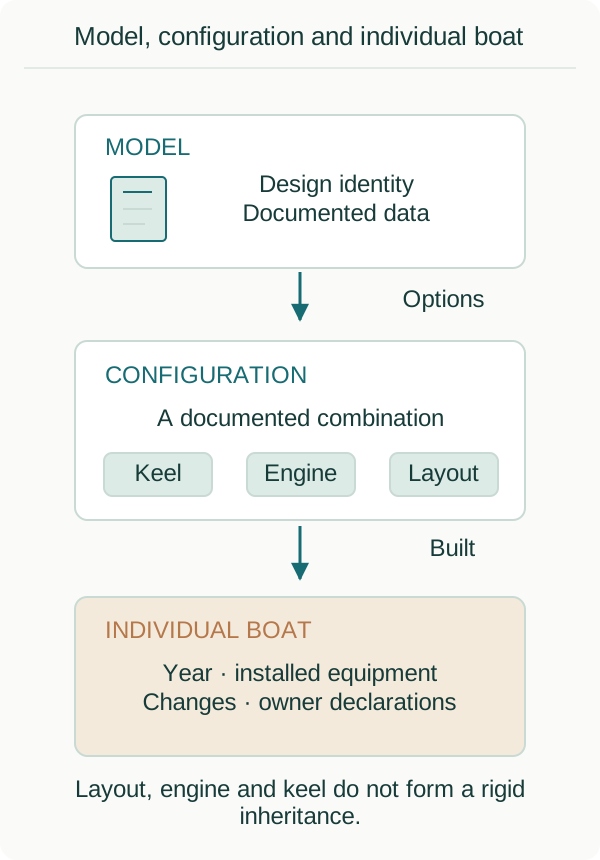
Original identity and documentation diagram. Configuration does not equal the current equipment of an individual boat.
insideSailOriginal insideSail artwork — all rights reservedEnlarge the diagram
When researching a yacht, you meet its name in brochures, advertisements, specifications and owner accounts. They appear to describe the same boat but may concern different levels.
A model identifies the commercial design. A version or configuration groups documented differences.
An individual boat is the actual craft built and subsequently used, equipped or altered. Information becomes more useful when its level is clear rather than when we select the description with the most equipment.
Options do not form one rigid tree
Keel, engine and layout can vary independently. A keel option does not necessarily have one exclusive interior layout.
A brochure may present alternatives while an individual boat combines only some of them. First identify which differences are actually documented.
Do not turn every advertised option into one configuration or assume that each version received every improvement from its first production day.
| Level | Useful question | Information example |
|---|---|---|
| Model | Which design am I identifying? | Commercial name and manufacturer. |
| Configuration | Which option or period does it concern? | Documented keel or layout. |
| Individual boat | What exists on this actual boat? | Declared engine and recorded changes. |
Worked example: three fictional documents
A sound conclusion keeps all three layers. We can say the model had layout alternatives, the boat record identifies one and the owner declared a later alteration.
If the record has no date or version, retain the gap rather than filling it from the newest brochure. More information does not always mean more certainty: a detailed statement may concern another boat.
Asking “which boat and which time?” prevents many misleading comparisons.
A real cabin-access example
Hallberg-Rassy’s 352 documentation describes a rare hardtop option with aft-cabin access from the cockpit, differing from the usual internal passage. It shows why a model name alone cannot fill “internal access” for every individual boat.
The source identifies the option; an owner photograph or declaration must still identify the corresponding boat.
Different figures can have different references
Two length figures may include different elements. A displacement figure may use another loading condition.
Do not immediately discard one value because another appears. Keep its unit, definition, document, date and known scope.
If they remain incompatible, retain the disagreement until it is explained. The dimensions lesson develops these conventions; here the key is that a number without context is not a complete description.
The same principle applies to engines. “Original engine”, “factory option” and “currently installed engine” answer different questions.
A repower account does not change the specification of every model. Community experience concerns the identified individual boat.
It can help frame questions about access and use, but photographs or likes do not give it the status of a factory specification.
Comparing equivalent fields
In a fictional comparison, one column says “engine listed in brochure” and another says “engine declared by owner”. Both descriptions may be correct but do not yet answer the same question.
To compare what is installed today, identify the individual boat and date of each account. To compare original options, identify the relevant factory documents.
An empty cell has a purpose here: it reveals missing information without filling the comparison with an assumption. An editorial observation, such as “insufficient documentation to compare these fields”, can sit separately from the values.
The same discipline applies to tanks, layouts and mast height. A known configuration of a neighbouring boat does not automatically resolve the unknown configuration of the advertised boat.
Identity, scope and time turn a collection of figures into a record another person can check. They also explain why a carefully qualified record can be more useful than a seemingly complete one.
Three things to remember
- Identify the level: model, configuration or individual boat.
- A documented option does not automatically apply to every boat.
- Retain disagreements and missing information before comparing.
Sources and references
- Hallberg-Rassy 352 — historical technical documentation ↗
Hallberg-Rassy · Continuous improvements; Standard and tall rig; Rare hardtop option.
Historical model page; only the documented configuration distinction is used, not promotional evaluations.
Checked on - Hallberg-Rassy 352 — standard specification from December 1987 ↗
Hallberg-Rassy · p.1 Hull / Deck and superstructure / Spars and rigging / Deck fittings; p.3 Accommodation / Steering; p.4 specification/options notice.
Four-page historical specification. The document states From December 1987; publication day is unknown. Not a specification for every surviving individual boat.
Checked on
Keep discovering
The next piece of the puzzle
Discuss this concept
Loading the conversation…