
Automated technical check · version 6 ·
Cabins, galleys and living space
More cabins does not necessarily mean better liveability.
In this guide
Space to sleep or space to live?
Compare circulation and use of the same volume, beyond cabin count.
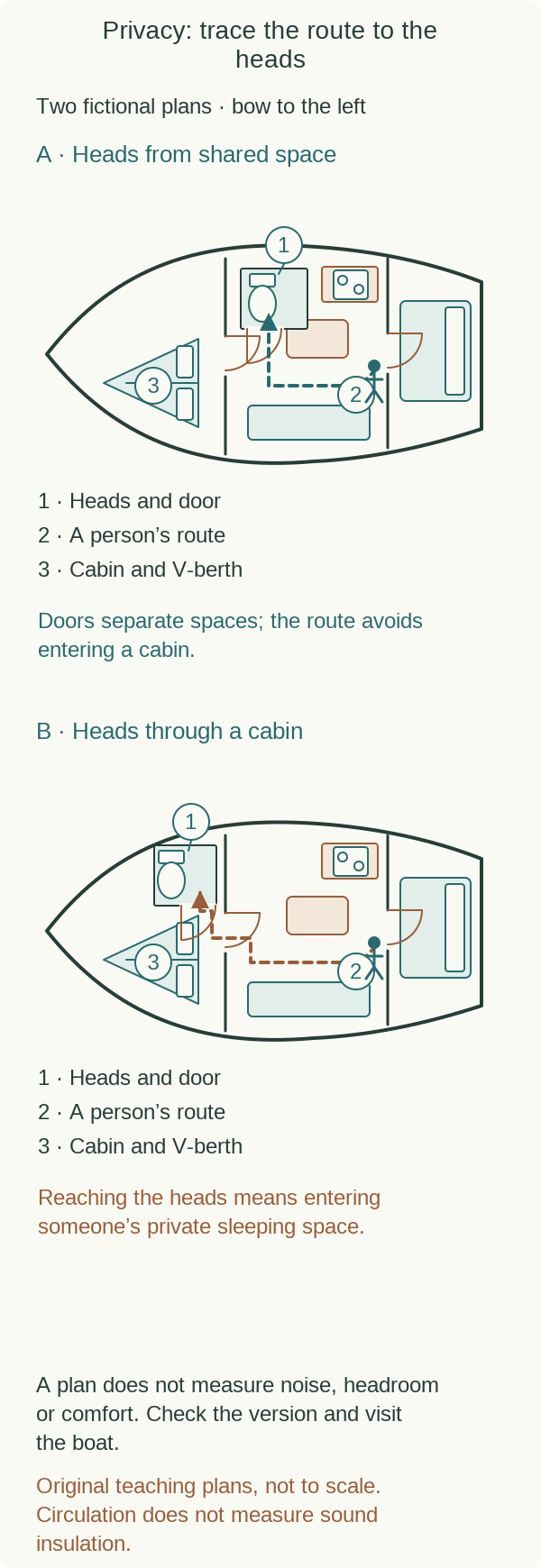
Original teaching plans, not to scale. Circulation does not measure sound insulation.
insideSailOriginal insideSail artwork — all rights reservedEnlarge the diagram
Two cabins
Two enclosed sleeping areas, leaving other areas for living and storage.
What it offers: May suit a small family that values space and an available saloon.
What to consider: Cabin count does not guarantee large berths, privacy or usable volume.
Three cabins
More sleeping areas divide the available interior volume.
What it offers: May give more people or guests their own spaces.
What to consider: The division may reduce individual dimensions, storage or other areas.
The galley
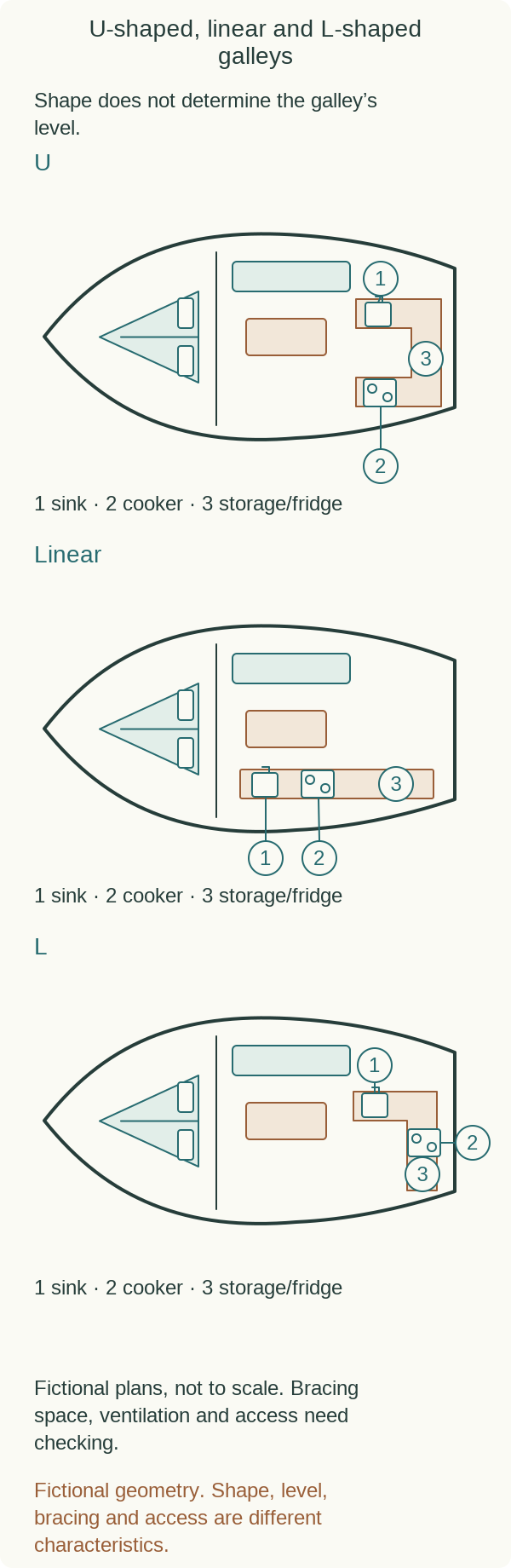
Fictional geometry. Shape, level, bracing and access are different characteristics.
insideSailOriginal insideSail artwork — all rights reservedEnlarge the diagram
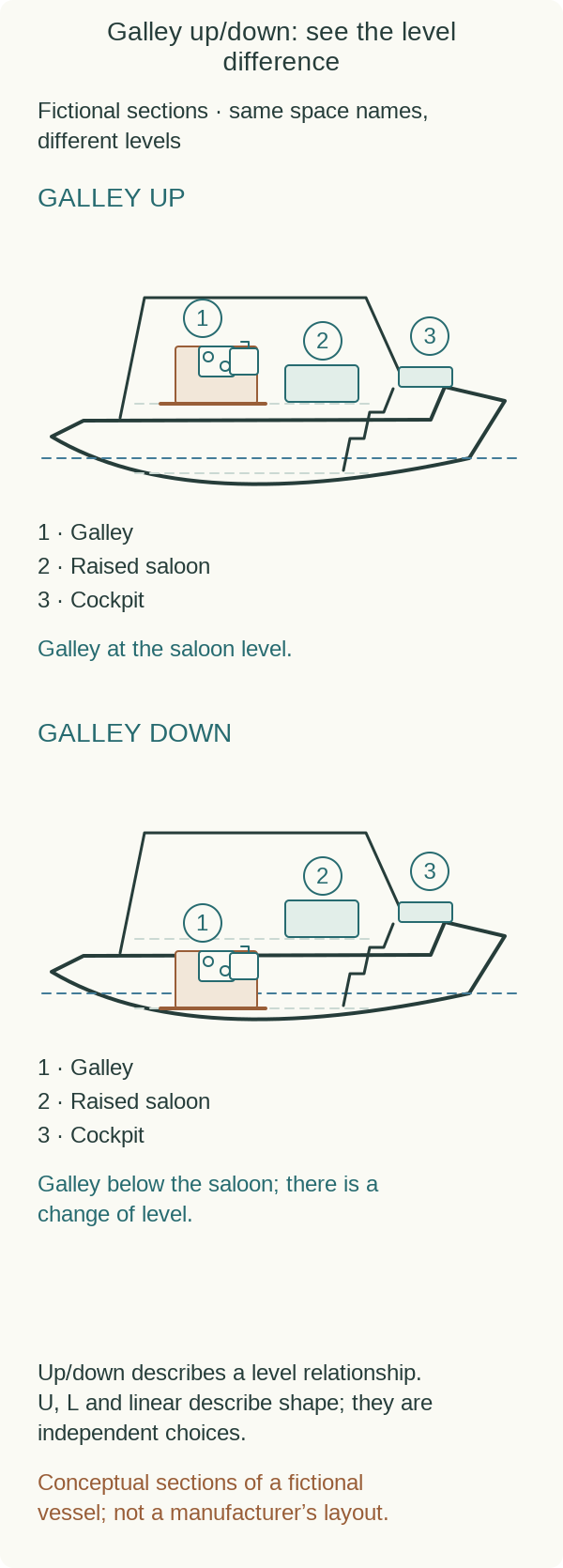
Conceptual sections of a fictional vessel; not a manufacturer’s layout.
insideSailOriginal insideSail artwork — all rights reservedEnlarge the diagram
Linear and U-shaped describe shape; up and down describe level.
What it offers: Understanding the shape helps imagine meal preparation and circulation.
What to consider: Shape does not guarantee ergonomics: check access, support, storage and actual space.
Circulation and privacy
Doors, passages, heads and shared spaces shape how people share the boat.
What it offers: Helps imagine one person resting while another cooks or gets dressed.
What to consider: Noise, ventilation and height are not fully described by the plan.
Three things to remember
- A saloon berth does not create an enclosed cabin.
- More cabins may mean less storage or smaller spaces.
- The plan is a start: check volume and ergonomics aboard.
In plain language
An owner’s version often prioritises owner space; a charter version often offers more sleeping spaces, but labels are not uniform. A forecabin, quarter cabin and aft cabin describe different positions.
A converted saloon berth does not create an enclosed cabin.
How to interpret it
Galley up/down describes the kitchen level; linear and U-shaped describe its shape. Heads, separate showers, passageways and system access share the same limited volume.
Why it matters
For three people, two good cabins and storage may be preferable to three small cabins.
Limitations
Plans do not show all volume, ventilation, noise or ergonomics. Confirm the version and visit the boat.
In practice
Imagine cooking, getting dressed and resting while someone else sleeps. This circulation matters as much as bed count.
Further reading
Jeanneau Yachts 51 — specifications and layouts ↗
Jeanneau two-cabin layout — specification sheet ↗
Keep discovering
The next piece of the puzzle
The concept in a few words
Cabins, galleys and living space
More cabins does not necessarily mean better liveability.
From diagram to sailboat
See it on real boats
These documented configurations illustrate the concept. Open a model page to explore the boat.
Enclosed cabins: 2
Explore this sailboat ↗
Moody 333Fin / Two Enclosed CabinsEnclosed cabins: 2
Explore this sailboat ↗
Moody 34Fin / Two Enclosed CabinsEnclosed cabins: 2
Explore this sailboat ↗
Moody 346Fin / Two Enclosed CabinsEnclosed cabins: 2
Explore this sailboat ↗
Hallberg-Rassy 352Documented reference / Standard WalkthroughEnclosed cabins: 2
Explore this sailboat ↗
Jeanneau MelodyDocumented reference / Two CabinsEnclosed cabins: 2
Explore this sailboat ↗
Sources and references
- Hallberg-Rassy 352 — historical technical documentation ↗
Hallberg-Rassy · Rare hardtop option: documented difference in aft-cabin access. The original fictional plans are not traced from this model.
Reference for insideSail educational figure ir26-boat-privacy-circulation.
Checked on - Seawind — Galley Up, Galley Down ↗
Manufacturer article, 27 May 2021; introductory definition of galley in a hull versus on the main deck. Used only for the level distinction; marketing claims and quoted opinions not adopted. Original generic sections are not Seawind plans.
Reference for insideSail educational figure ir26-boat-galley-level-sections.
Checked on - Jeanneau two-cabin layout — specification sheet ↗
Jeanneau · Jeanneau 64, Specifications and Inventory, October 2019; PDF p.5: 2 cabins/2 heads; pp.6–7: 3-cabin alternatives; pp.11–12: interior. This is a Jeanneau 64 document, not a Jeanneau 51 sheet.
Checked on - Accommodation — separate fields ↗
Offshore Racing Congress · Fundamental Requirements: enclosed heads with rigid door, separated sleeping/living spaces, galley and access. Used to check terminology, not to claim ORC compliance.
Reference for insideSail educational figure ir26-boat-privacy-circulation.
Checked on - Jeanneau Yachts 51 — specifications and layouts ↗
Jeanneau · Official live page HTTP 200; Exceptional Comfort and Autonomy for Complete Serenity / Layouts & Specs: fore owner cabin, aft alternatives and 2/3 cabins. Editorial date unknown; no universal owner/charter definition inferred.
Checked on
And on the boat you are looking for?
Take these ideas to the Boat Finder and discover models that suit your way of sailing.
Find my sailboat ↗
Loading discussion…