
By insideSail
Automated technical check · version 2 ·
Hull and waterline: what are we looking at?
The hull surface and floating condition answer different questions.
In this guide
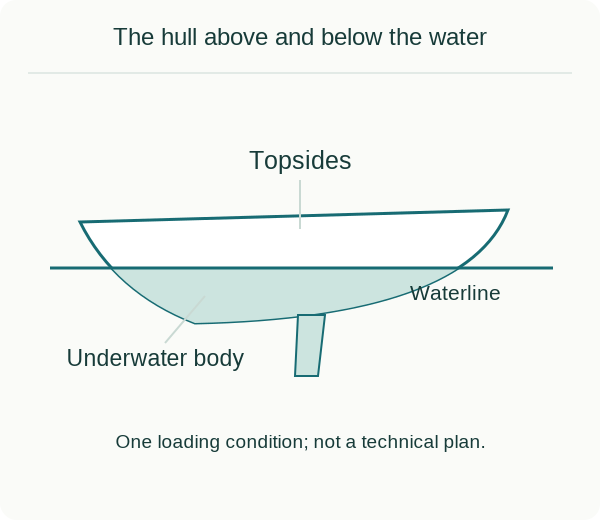
Original schematic illustration. Read the explanation and limitations in the lesson.
insideSailOriginal insideSail artwork — all rights reservedEnlarge the diagram
The hull is the craft’s main body. The waterline represents the intersection between water and boat under an observed or stated condition.
They are connected but different concepts: one describes the object, the other a floating reference. A simple profile makes both visible.
On an actual boat, the water surface corresponds to conditions at that moment, and a photograph records only that situation.
Two photographs and one reference
Imagine two fictional photographs of the same hull: water lies close to a painted stripe in one; more of that stripe is visible in the other. Before comparing them, ask whether they show the same situation, perspective and condition.
A small wave can cover an area momentarily, while an oblique photograph changes the visual reading. The observed difference does not itself identify displacement, weight distribution or the design waterline.
A careful description retains “water beside this mark in this picture”, then looks for the drawing’s reference or an identified measurement to answer the next question. When exploring models you encounter lengths associated with flotation and others associated with the whole hull.
The dimensions lesson distinguishes those quantities. This profile explains why the line to which they belong needs identifying rather than being selected from the most visible paint stripe.
It also shows how a photograph can illustrate a concept without supplying the value recorded in a technical specification.
Above and below the waterline
Portuguese obras vivas and obras mortas organise a description relative to the waterline: below and above it respectively. They are not materials or two independent pieces.
Underwater body helps describe the submerged part in English. Topsides commonly concerns the hull surface above the water; it should not indiscriminately describe the entire superstructure.
Translation should clarify scope rather than impose an equivalence that hides the difference.
Observed, drawn and painted lines
A line in a design drawing may correspond to a specified loading condition. A painted stripe may be a visual reference chosen for the hull.
Water in a photograph is an observation. Identify what each represents before comparing them.
Their coincidence in one picture does not turn them into the same information. Nor does the apparent distance between stripes in an unscaled photograph with unknown perspective give an exact draught.
Worked example: two photographs of one individual boat
Context improves the comparison: dates, loading information and a reference document. A photograph nevertheless remains a viewpoint.
A changed viewing angle can alter the appearance of a distance. Apply the same care as for dimensions: definition and condition first, then value.
A waterline is useful because it makes a reference explicit; it loses usefulness if every visible stripe becomes a universal measurement.
| Term | Question it answers |
|---|---|
| Hull | Which main body are we identifying? |
| Waterline | Where does the water surface meet the boat under this condition? |
| LWL | Which waterline length is stated? |
| Draught | Which immersion depth is stated? |
| Displacement | Which mass and loading condition are stated? |
Profile and section complement one another
A profile shows the longitudinal relationship. A transverse section shows how a shape crosses the water surface at one section.
The teaching section is conceptual: it is not a model’s construction and cannot establish volume or stability. It helps distinguish a surface from its water boundary.
The next lesson adds construction terms, while dimensions and displacement develop their quantities in their own pages.
Recognising a waterline does not assess damage, hull condition or water depth available at a location. Those questions combine other evidence and knowledge.
Here progress means reading a caption clearly: “illustrative profile”, “stated condition” or “individual-boat photograph”. Identifying the information type makes comparison more honest and supports further learning without turning an attractive drawing into evidence it does not provide.
Three things to remember
- Hull and waterline are different concepts.
- The loading condition accompanies the floating reference.
- A photograph or painted stripe does not replace a measurement’s definition.
Concepts in this lesson
Hull
The vessel’s body; the term alone does not identify its material or structural condition.
Waterline
The intersection of water surface and hull under a particular loading condition and attitude.
Sources and references
- NOAA field manual — nautical terminology ↗
NOAA · Historical field manual; terminology only · Table 15: bow, stern, port and starboard
Version: Historical field manual; terminology only. Jurisdiction: International.
Checked on - Cartografia — cartas náuticas ↗
Instituto Hidrográfico · Live institutional page · Chart information and vertical reference
Version: Live institutional page. Jurisdiction: Portugal.
Checked on - Hallberg-Rassy 352 — standard specification from December 1987 ↗
Hallberg-Rassy · p.1 Hull / Deck and superstructure / Spars and rigging / Deck fittings; p.3 Accommodation / Steering; p.4 specification/options notice.
Four-page historical specification. The document states From December 1987; publication day is unknown. Not a specification for every surviving individual boat.
Checked on - Nomenclatura de uma Embarcação ↗
CMAS Europe · Lists: proa, popa, amura, alheta, través; vante, ré, meia nau; obras vivas/mortas.
Portuguese terminology consulted; photographs and navigation-light references are not reproduced.
Checked on
Keep discovering
Loading discussion…