By insideSail
Automated technical check · version 2 ·
What lies between the hull surface and the interior?
Material, construction method and a part’s function are different information.
In this guide
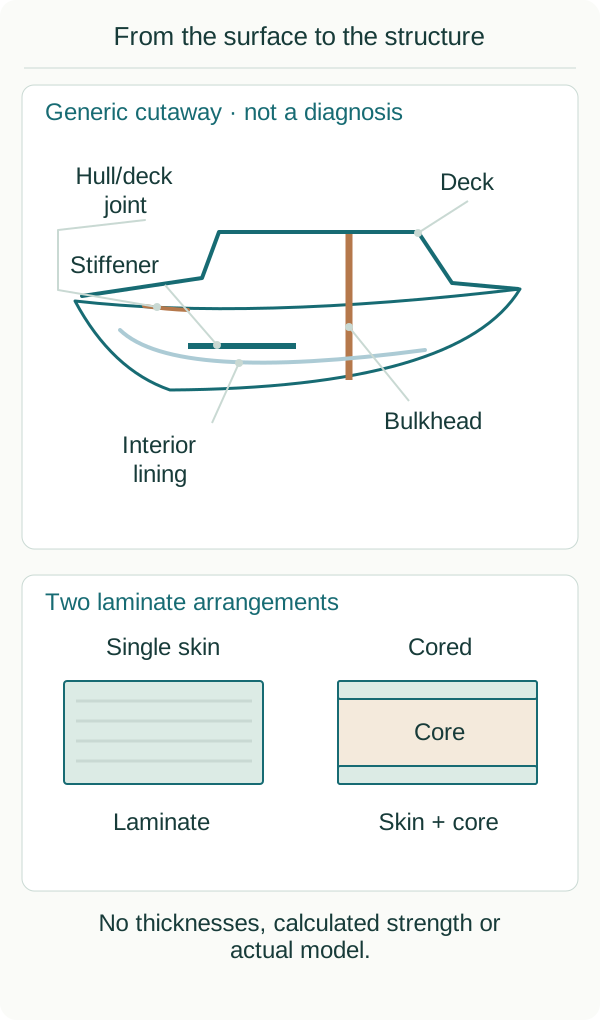
Conceptual cutaway and laminate details. No arrangement is attributed to an actual model; no scale or diagnosis.
insideSailOriginal insideSail artwork — all rights reservedEnlarge the diagram
A yacht’s exterior surface and the finish seen inside do not tell the whole construction story. Between them may be layers, reinforcing elements, joints and linings.
This lesson organises the language used in descriptions. The section is generic, with no thicknesses, reinforcement sizing or attribution to a model.
It helps recognise categories and ask which document describes the arrangement actually used.
Layers, connections and divisions
In a composite panel, a laminate combines fibre reinforcement and resin. In a sandwich arrangement, laminate faces are separated by a construction core.
Composition can vary between hull and deck areas. A bulkhead is a transverse or otherwise oriented division between interior areas; where it has a structural role, connections to neighbouring elements also belong to its description.
A reinforcement supports a region of the assembly. An interior lining can cover surfaces or provide a finish without automatically being structural.
In the figure, the outer line represents the hull, layers represent panel composition and an interior division represents a bulkhead: these are different levels. That panel core is not a rope core.
To make the vocabulary concrete, imagine a locker beside a partition: the locker is furniture, the partition organises compartments and any structural connection belongs to the construction drawing. Recognising these relationships makes a factory construction description intelligible, without turning the conceptual section into a structural assessment.
Material is not a method
A description may name timber, metal or a composite. Different arrangements still exist within each family.
GRP means glass-reinforced plastic; it does not specify every layer, resin, presence of a core or joint arrangement. Material begins the identification rather than completing a description of the design.
Different boat regions may also have different materials.
Laminate and core
Laminate describes an assembly of layers. In a cored construction, the core is an internal material between skins.
Separating the faces contributes bending stiffness in an appropriate arrangement; materials, bonds and sizing belong to that solution. Not every laminate has a core, and core material also varies.
Compare the drawings by arrangement: one shows layers without a depicted core; the other separates skins and core. Neither has an assigned thickness, strength or suitability.
They explain vocabulary rather than provide designs for construction or repair.
| Word | Question it helps frame |
|---|---|
| Material | Which substances or families are described? |
| Laminate | Which layered assembly is identified? |
| Core | Is this region cored and how is that documented? |
| Bulkhead | Which separation and function are stated? |
| Interior lining | What is finish and what lies behind it? |
Worked example: two short descriptions
Now add a cupboard photograph. Its visible lining may conceal the element you want to identify.
It does not become a structural bulkhead merely by looking thick, nor cease to be one because it has decorative finishing. A photograph can help locate a part; its function requires design information.
A better description keeps the two facts separate: what can be seen and what the document says the element does.
Partitions, reinforcement and joints
Bulkheads separate areas; some contribute to structure where the design uses them that way. Reinforcements can limit deformation and transmit forces between areas; joints make that physical relationship part of the assembly.
Structural sizing belongs to the actual design. A hull-to-deck joint connects assemblies rather than promising how every manufacturer makes it.
A builder’s current construction description should not automatically be applied to its older models. Year, region and document accompany the account.
The section also separates contents from their enclosure. Furniture can occupy hull-bounded space without being the hull; a finish can follow its curve.
Reading the correct layer avoids calling a panel “the hull” when only a lining is visible. English skin, core, bulkhead and liner identify different roles.
Translation should follow the element being described rather than whichever word seems closest to a photograph.
Three things to remember
- Material, construction and function are different information.
- A generic section organises terms; documentation identifies the actual design.
- Recognising layers does not diagnose damage or choose a repair.
Concepts in this lesson
Bulkhead
A division between interior boat areas. It may perform a structural role where the design uses it that way; a visible partition or finish does not establish that role alone.
Construction core
Material separating the faces of a cored panel, contributing bending stiffness in an appropriate arrangement. It is distinct from the core of a rope.
Laminate
A layered assembly which, in this lesson’s composite context, combines fibre reinforcement and resin. Different compositions can occur in different boat regions.
Sources and references
- How a hull is built ↗
Hallberg-Rassy · Hull/deck material layers; grid system; structural bulkheads; hull/deck joint.
Current manufacturer process example, not evidence of construction of the historical HR 352.
Checked on - Hallberg-Rassy 352 — standard specification from December 1987 ↗
Hallberg-Rassy · p.1 Hull / Deck and superstructure / Spars and rigging / Deck fittings; p.3 Accommodation / Steering; p.4 specification/options notice.
Four-page historical specification. The document states From December 1987; publication day is unknown. Not a specification for every surviving individual boat.
Checked on
Keep discovering
The next piece of the puzzle
Discuss this concept
Loading the conversation…