By insideSail
Automated technical check · version 2 ·
Recognising the deck and its connections below
Surfaces, spaces and openings have names and functions worth separating.
In this guide
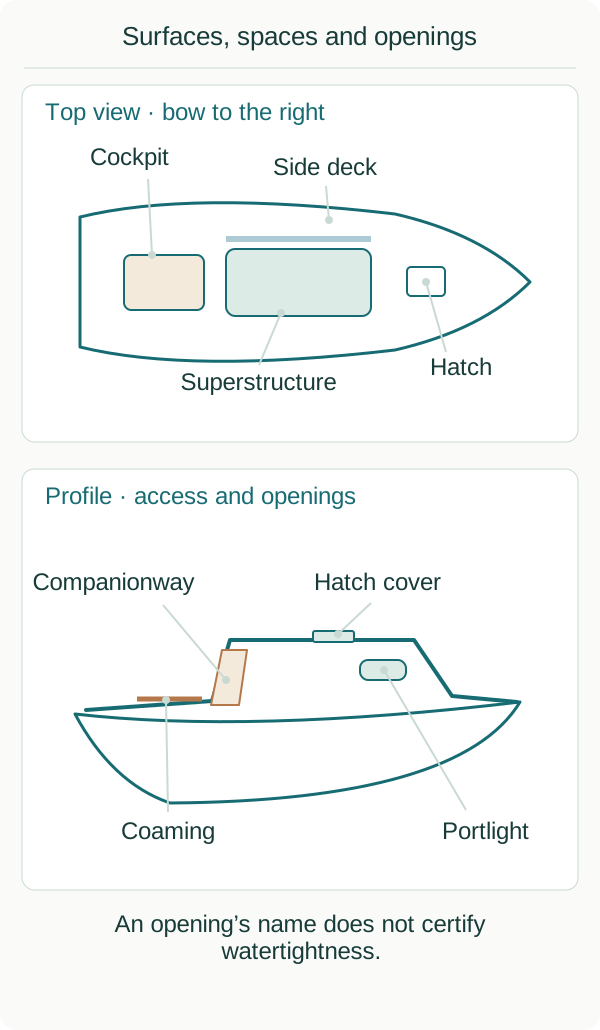
Generic top and side views. Identifying an opening does not determine how it may be used or whether it is watertight.
insideSailOriginal insideSail artwork — all rights reservedEnlarge the diagram
Looking down on a yacht reveals surfaces, spaces and boundaries. The deck belongs to the boat’s upper assembly; the cockpit is an exterior space organised for people and controls; side decks follow lateral areas.
Coachroof and superstructure describe raised volumes. These terms help read the drawing without assuming that every yacht has the same positions, heights or circulation.
From deck to interior
In the plan view, side decks are lateral deck areas alongside the coachroof. The coachroof top is a raised surface relative to neighbouring areas.
The cockpit occupies its own space, bounded by seats, surfaces and, in this example, coamings. A hatch passes through a surface and can have a frame and cover; a portlight relates light and vision between interior and exterior; the companionway provides access between levels.
In section, steps make that level difference explicit. Imagine a cabin beneath the coachroof: the opening above it occupies a different surface from the side window, even if both admit light.
Naming the part helps distinguish location and role. A companionway drawn beside the cockpit connects those areas; another opening above a cabin does not automatically become the main entrance.
Combining plan and section explains this physical organisation before introducing dimensions or properties of a particular equipment product.
A plan shows position; a section adds height
A companionway may look like a rectangle on a plan. A section explains that it connects different levels.
A coaming is a raised boundary around a space or opening; the drawing helps recognise the form without assigning an appropriate height for an actual boat. Compare both viewpoints while keeping the bow marked.
The same element then does not appear to be another simply because the view changed from above to the side.
| Element | How to read its role |
|---|---|
| Hatch | Opening; its cover and use belong to the actual assembly. |
| Portlight | Boat window, with possible differences in opening arrangements. |
| Companionway | Access connection below, often between levels. |
| Coaming | Raised boundary around a space or opening. |
Opening names need context
Portuguese escotilha names an opening in nautical usage. Vigia can name a window, although it has other meanings outside this description.
Gaiuta has documented specific senses, including a structure covering a hatch. It is therefore not used here as a universal translation of hatch.
Product names can vary: a clear description adds location, visible form and stated purpose rather than erasing differences through a convenient synonym.
Worked example: one opening seen inside and outside
The example also shows a caption’s value. “Hatch over the forward cabin, viewed from inside” identifies place and viewpoint.
“Large window” leaves the photographed part uncertain. Language needs only the detail supported by the information.
If documentation identifies a fixed opening, retain that detail; if only an exterior form is visible, do not automatically assign access or ventilation as its use.
Cockpit and cabin access are separate features
Cockpit position organises part of the deck but does not establish an internal passage to an aft cabin. A layout reveals routes.
A door opening onto the cockpit and a passage from the saloon are different connections even if both reach a space called an aft cabin. The canonical centre-cockpit lesson explains the compromises; here the aim is to locate evidence.
Scuppers or outlets may be recognised as drainage-system components when documentation identifies them. A photograph of a hole does not describe the whole path.
Rather than establishing drainage capacity by appearance, relate the part to its system drawing. This functional reading applies throughout: surfaces organise circulation, openings relate spaces and documents explain the actual assembly.
Three things to remember
- Combine plan and section to understand position and height.
- Hatch, portlight, gaiuta and companionway are not universal synonyms.
- Access and equipment features are checked separately from cockpit position.
Concepts in this lesson
Coachroof
The raised cabin-roof area above the deck in this yacht context. Broader superstructure terminology depends on the document and should retain its stated scope.
Coaming
A raised boundary around a space or opening, as in cockpit and hatch examples. Its name describes a form rather than a watertightness guarantee.
Cockpit
An exterior area arranged for people which may incorporate boat controls. Its position is a feature distinct from access to cabins.
Companionway
Access connecting outside and below deck, often between levels. It may bring together an opening, steps and assembly-specific components.
Deck
The upper surface assembly covering and organising boat areas. Side decks, cockpit and coachroof help locate relationships to that assembly in this lesson.
Hatch
An opening in nautical usage; an equipment description may name the assembly with frame and cover. Its function and use depend on the actual assembly.
Portlight
A boat window in this lesson’s context. Position and whether it is fixed or opening concern the actual equipment.
Side deck
A lateral deck area beside the coachroof in the illustrated configuration. The term locates a surface without specifying usable dimensions.
Sources and references
- Escotilha — Portuguese dictionary ↗
Porto Editora · NÁUTICA definition: opening/hatch in the deck, hold or decks of a ship.
Entry directly opened and definition read on 10 October 2026; lexical reference, not equipment certification.
Checked on - Gaiuta — Portuguese dictionary ↗
Porto Editora · NÁUTICA senses 2 and 3: glazed structure over a hatch; light aft housing for steering gear.
Specific senses prevent treating gaiuta as a universal synonym of hatch.
Checked on - Vigia — Portuguese dictionary ↗
Porto Editora · Naval window sense; distinguish from a person keeping watch.
Lexical use in context; no watertightness or operating-status claim.
Checked on - Hallberg-Rassy 352 — standard specification from December 1987 ↗
Hallberg-Rassy · p.1 Hull / Deck and superstructure / Spars and rigging / Deck fittings; p.3 Accommodation / Steering; p.4 specification/options notice.
Four-page historical specification. The document states From December 1987; publication day is unknown. Not a specification for every surviving individual boat.
Checked on
Keep discovering
The next piece of the puzzle
Discuss this concept
Loading the conversation…