By insideSail
Automated technical check · version 2 ·
Current and leeway: different movements
Add vectors in matching frames without counting current twice.
In this guide
A boat moves relative to water, while water can move relative to the ground. Ground velocity is the vector sum of those two velocities.
“Vector” means direction and magnitude count together: 3 knots north plus 4 knots east is not 7 knots in one direction. On an ideal local plane, movement can be separated into north–south and east–west components.
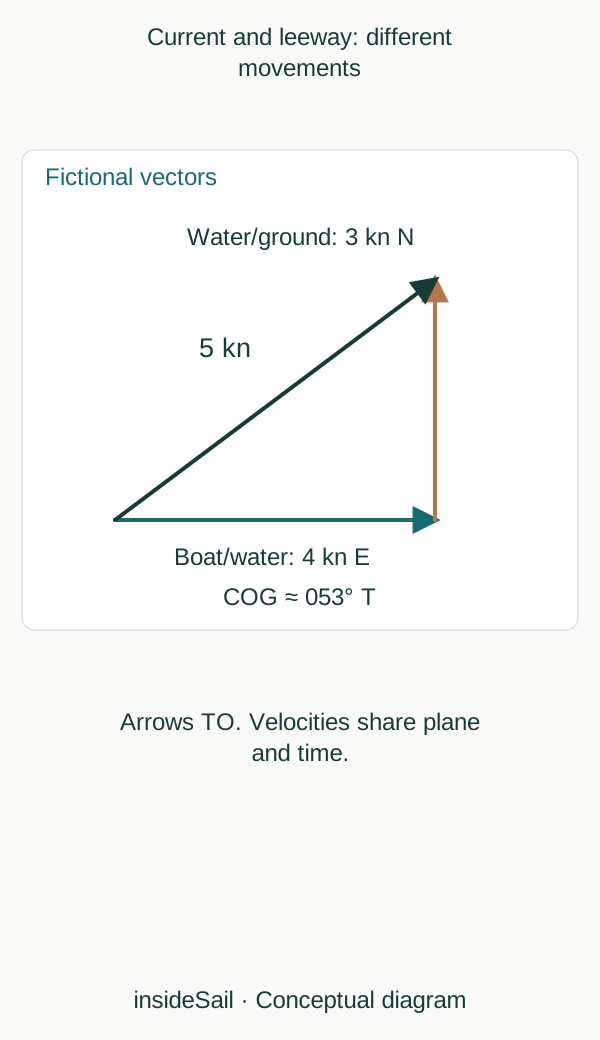
Teaching schematic not to scale; without local data or operational approval.
insideSailOriginal insideSail artwork — all rights reservedEnlarge the diagram
The relationship in numbers
v boat/ground = v boat/water + v water/ground
Velocity vectors in knots; arrows show movement TO.
Where does leeway enter?
Heading identifies the boat’s longitudinal orientation. Movement through water need not follow that line exactly.
Leeway is that angular difference, associated with sideways movement relative to water. If the boat/water vector already includes leeway, it must not be added again as though it were a separate current.
Current is water movement over the ground; leeway belongs to the boat–water relationship.
Wind may contribute forces that change boat movement, but wind speed is not added directly to boat velocity as a third arrow in this equation. Air and water are different media.
A kinematic relationship describes motion; forces explain how it develops. Confusing the two models produces apparently complete calculations that mix different physical quantities.
Components may change through time and space. A constant triangle is a teaching simplification rather than a passage forecast.
Reconstructing actual motion would also require references, times and data origins. The seamanship lesson already explains apparent wind; here we add two-dimensional current geometry.
Solving an applied steering heading for a route needs planning-specific data and context.
An exactly opposing current can reduce ground speed without rotating direction, whereas a sideways component can alter both direction and magnitude. In a fictional example, 4 knots east through water plus 1 knot westward water motion gives 3 knots east over ground.
The same 1-knot current northwards gives √17≈4.12 knots and a different direction. Current magnitude alone cannot choose between these results.
The equation also permits vector subtraction: water/ground = boat/ground − boat/water. Components must share axes, units and time.
If a velocity was measured over another period, subtraction combines different states. This lesson uses a local plane rather than treating Earth as one global flat grid.
The geometry approximates movement in a small region while keeping model scope explicit.
- Add velocities with compatible frames.
- Leeway is not current.
- A motion relationship does not replace a force model.
Sources and references
- Boat Crew Handbook — Navigation and Piloting, BCH16114.3 ↗
United States Coast Guard · Chapter 2 A.29 p.2-16; Chapter 3 E.1 pp.3-78–3-80; E.9 p.3-94; G.9–G.10 pp.3-138–3-140. Chapter 3 C.1–C.2 pp.3-28–3-29; C.6–C.9 pp.3-35–3-49; G.2 pp.3-130–3-131.
Selected line-of-position, range/transit and DR/EP concepts. No US fix frequency, plotting recipe or course instruction adopted. Physical sensor/display relationships only. Historical accuracy, legal carriage and operational claims excluded.
Checked on
Keep discovering
The next piece of the puzzle
Discuss this concept
Loading the conversation…