By insideSail
Automated technical check · version 2 ·
Why does a sailboat move? Air and water work together
Drive, side force and balance in a conceptual model.
In this guide
A sailboat moving with wind arriving from the side seems to contradict the idea that a sail is simply pushed wherever wind goes. The explanation involves two fluids: air and water.
The sail interacts with air, producing force with different components relative to the boat. The hull and appendages interact with water.
Observed movement results from these relationships together rather than from a single arrow placed on the sail.
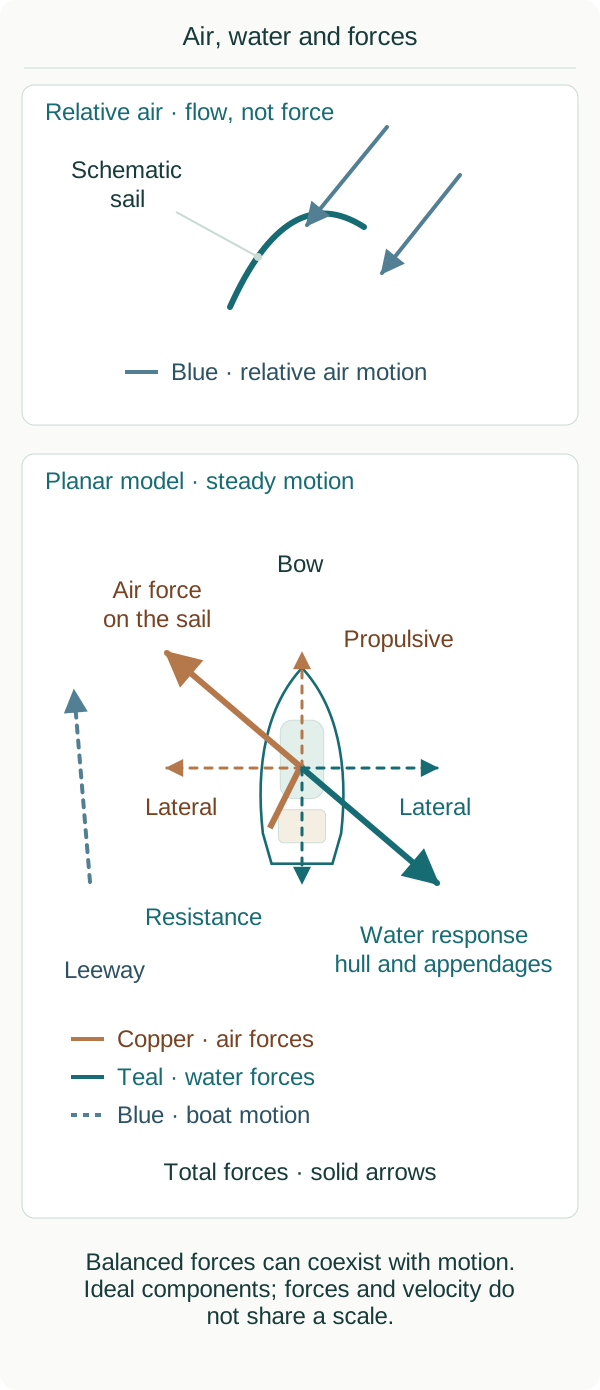
Idealised horizontal model in steady motion. Force and velocity arrows are identified and do not share a scale.
insideSailOriginal insideSail artwork — all rights reservedEnlarge the diagram
Relative flow: fluid as seen by the surface
The air encountered by a sail depends on relative motion between air and boat. Likewise, water passing the appendages depends on relative motion between water and boat.
Interaction with a surface can turn the flow and produce forces. The physical explanation connects pressure, fluid motion and force on the surface; it does not require two parcels of air to follow different paths and reunite at the same time.
Lift commonly names the force component perpendicular to relative flow, while drag names the component parallel to it. These names use fluid flow as their reference.
Lift does not always mean upwards: in a horizontal sail view it can point mainly sideways. An aircraft has a different overall orientation.
Importing a vertical arrow from a wing drawing would hide the very relationship we want to understand on a sailboat.
The same forces can be resolved along boat axes
To understand forward motion, we can describe air force along the boat’s longitudinal and transverse axes. In the sailing scenario represented, it has a driving component and a side component.
Resolving the force does not create additional forces; it is another description of the same relationship. Water’s response can include forward resistance and an opposing side component.
Separating the axes avoids confusing lift with direct forward drive or drag with the boat’s entire resistance.
A keel or centreboard participates in water’s lateral response, according to the configuration. This does not lock the hull onto an imaginary rail: sideways movement relative to water, called leeway here, can occur.
The appendage interacts with flow rather than the seabed, unlike a wheel on a road. Assembly type and geometry matter, but this explanation imposes no single mandatory shape on every sailboat.
Balance does not mean forces are absent
When forces no longer balance, movement can change. This connects with inertia and the distinction between velocity and acceleration.
Real conditions also include waves, rotations, wind changes and other three-dimensional relationships. The chosen model isolates one question: how can air and water simultaneously contribute to forward drive and lateral response?
That question can be understood without promising the speed a sailboat model will achieve.
Takeaways
- Relative flow connects boat motion with air and water.
- Lift uses flow as its reference; drive uses boat axes.
- Constant motion can result from present forces that balance.
The concept in a few words
Leeway
The lateral component of boat movement relative to water in the sailing scenario; distinct from current’s effect on movement over ground.
Sources and references
- What is lift? ↗
NASA Glenn Research Center · Opening paragraphs: force direction, relative flow and flow turning.
General fluid-force concept only, not an aircraft-to-boat performance comparison.
Checked on - Sailing and the physics of lift — response ↗
Physics Today / AIP, Bryon D. Anderson · Response paragraphs: circulation and turning the fluid; correction of path-length explanation.
Critical companion to the February article; no protected figures or extended paraphrase reproduced.
Checked on - The physics of sailing ↗
Physics Today / AIP, Bryon D. Anderson · Wind power; Keels; constant-speed balance discussion.
Read together with the September response. Equal-transit/long-path explanation, universal fastest reach and symmetric-keel claims are not adopted.
Checked on
Keep discovering
The next piece of the puzzle
Discuss this concept
Loading the conversation…