By insideSail
Automated technical check · version 2 ·
Heading, COG and SOG
Orientation, movement direction and speed answer different questions.
In this guide
Heading is the direction of the boat’s longitudinal axis. COG, course over ground, is the direction of movement over the ground.
SOG, speed over ground, is its magnitude. COG is an angle; SOG is a speed.
Neither describes position or sail state by itself. A boat can maintain its heading while having a different COG because of current and sideways motion.
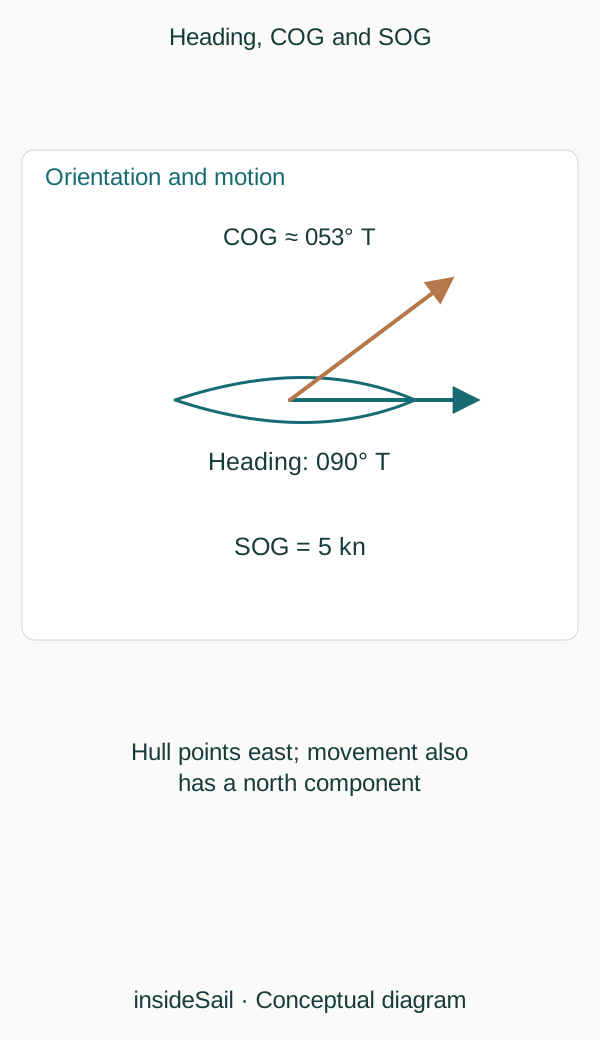
Teaching schematic not to scale; without local data or operational approval.
insideSailOriginal insideSail artwork — all rights reservedEnlarge the diagram
Boat arrow and velocity arrow
A screen boat symbol may be oriented by a heading sensor, COG or another presentation option. Its appearance does not automatically identify the source of its orientation.
The figure keeps hull and motion vector separate to make the distinction visible. Reading requires field identity, angular reference and knowledge of what the system actually represents.
Near zero speed, a small difference between successive positions can greatly change a calculated direction. An exactly zero vector has no defined direction.
A COG number at rest should therefore not be treated as a universal compass. GNSS systems, heading sensors and filtering may supply different information; this lesson promises no specific device behaviour.
Speed through water, STW, belongs to another frame. Subtracting the scalar values SOG−STW does not reveal current when their directions differ: vectors are required.
In the example, 5−4=1 does not recover the 3-knot northward current. This simple contrast explains why adjacent numbers need physical relationships rather than an automatic “more or less” comparison.
COG may describe an instantaneous estimate or motion calculated over an interval, depending on source. A line joining two positions describes displacement without every intermediate curve.
A boat taking a curved path may finish east of its start and have mean displacement direction 090° without maintaining that heading. Mean displacement direction and steering history are different information.
Imagine a north-pointing hull carried south by moving water while its own movement is small. COG can be near 180° while heading remains 000°.
There is no geometrical contradiction. Object orientation does not determine its centre’s movement direction.
This example assumes neither gear, sail configuration nor actual control of a real vessel.
- Heading is orientation; COG is movement direction.
- SOG and STW use different frames.
- Current is not generally obtained by subtracting two scalar speeds.
The concept in a few words
Course over ground
Direction of vessel movement relative to the ground.
Sources and references
- Boat Crew Handbook — Navigation and Piloting, BCH16114.3 ↗
United States Coast Guard · Chapter 3 C.1–C.2 pp.3-28–3-29; C.6–C.9 pp.3-35–3-49; G.2 pp.3-130–3-131.
Physical sensor/display relationships only. Historical accuracy, legal carriage and operational claims excluded.
Checked on - GPS accuracy — archived official explainer ↗
GPS.gov · User accuracy; signal-in-space accuracy; obstruction, geometry and receiver effects.
Archive identifies itself as no longer updated since February 2025. Used for enduring error categories, never a current accuracy guarantee.
Checked on
Keep discovering
The next piece of the puzzle
Discuss this concept
Loading the conversation…