By insideSail
Published without technical review · version 2 ·
Dead reckoning: displacement and assumptions
A calculated point is not a new observation.
In this guide
From an initial position and a movement model, another position can be calculated. Dead reckoning uses direction, speed and time to construct the displacement.
In the conventional distinction used here, DR retains the stated movement without adding wind or current effects; an estimated position (EP) can incorporate those additional assumptions. Everyday terminology can be broader: what matters is declaring what an estimate includes.
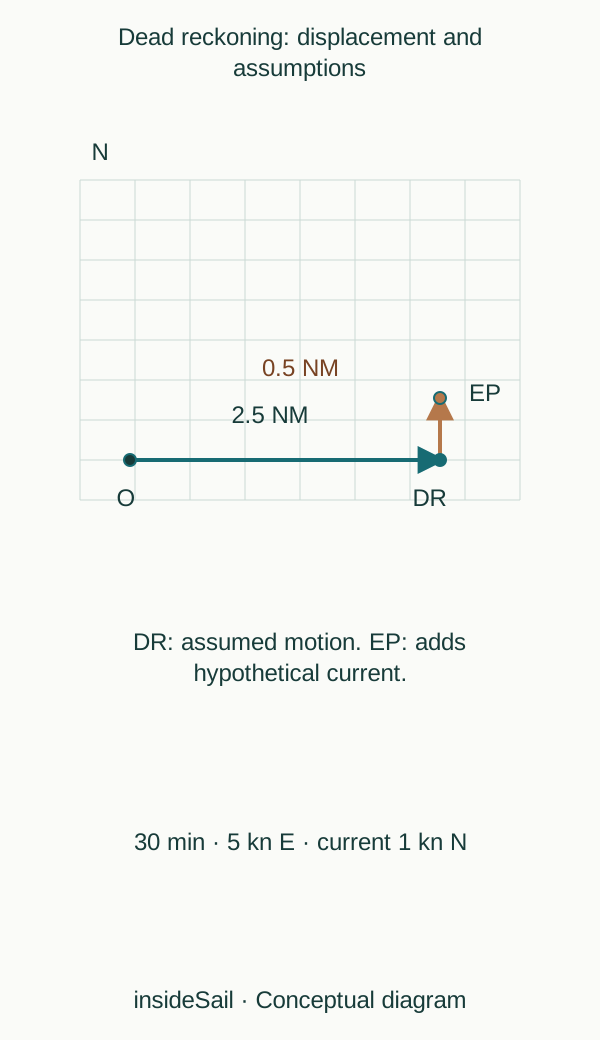
Teaching schematic not to scale; without local data or operational approval.
insideSailOriginal insideSail artwork — all rights reservedEnlarge the diagram
Time accumulates displacement and uncertainty
For constant motion, distance = speed × time. If direction is constant too, that distance can be drawn from the starting point in the stated direction.
Changes in speed or direction can be represented as intervals with different assumptions. The result remains dependent on those assumptions and on the starting position.
Exact calculation with approximate inputs produces an approximate estimate.
A small speed discrepancy accumulates with time. If assumed speed exceeds actual speed by 0.4 knots for an hour, distance differs by 0.4 nautical miles before direction or starting-position errors are considered.
A slightly different direction can create growing lateral displacement. These examples explain accumulation rather than establishing an acceptable time for navigating by estimate.
A later observation allows the estimate to be compared with new information. The difference may suggest incomplete assumptions without identifying the cause automatically: current, speed, steering and position origin can all contribute.
Both positions should retain their type and time. This lesson supplies no response procedure for instrument loss and authorises no approach to hazards by estimation; those uses require appropriate practical training.
An estimate can be reconstructed in stages. On a fictional plane, ten minutes at 6 knots east gives 1 nautical mile east; twenty minutes at 3 knots north gives 1 nautical mile north.
The model endpoint is (1,1), 1.41 nautical miles from the origin, while travelled legs total 2 miles. Total time is half an hour.
Every stage retains direction and duration: using a scalar average while discarding direction loses geometry.
Initial-position error follows the construction. Advancing an initially displaced point through a perfect model retains the displacement rather than correcting it.
New speed or direction errors may accumulate as well. “Recently calculated” therefore does not establish a good estimate.
Age of initial information and model duration are different times, both relevant when comparing the estimate with another observation.
- An estimate carries assumptions through time.
- DR and EP distinguish what the model includes.
- More calculation components do not constitute direct observation.
The concept in a few words
Dead reckoning
Position estimate from direction, speed and time, excluding current or wind in the stated convention.
Sources and references
- Boat Crew Handbook — Navigation and Piloting, BCH16114.3 ↗
United States Coast Guard · Chapter 2 A.29 p.2-16; Chapter 3 E.1 pp.3-78–3-80; E.9 p.3-94; G.9–G.10 pp.3-138–3-140.
Selected line-of-position, range/transit and DR/EP concepts. No US fix frequency, plotting recipe or course instruction adopted.
Checked on
Keep discovering
The next piece of the puzzle
Discuss this concept
Loading the conversation…