By insideSail
Published without technical review · version 2 ·
Fog, convection and storm surge
Different phenomena affect visibility, wind and water level.
In this guide
“Bad weather” groups phenomena with different causes and effects. Fog reduces visibility; convection can produce thunderstorms, precipitation and wind changes; storm surge changes water level.
Understanding mechanisms explains why wind forecast alone does not describe every meteorological hazard. This lesson explains physical mechanisms without supplying operational responses.
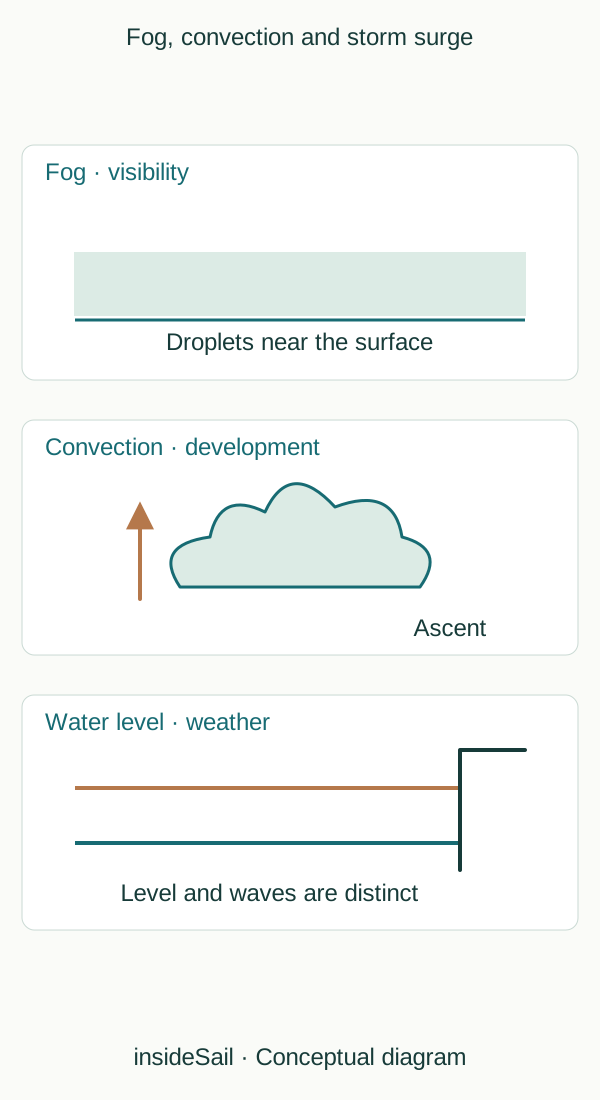
Conceptual schematic not to scale; no local forecast or operational decision.
insideSailOriginal insideSail artwork — all rights reservedEnlarge the diagram
Water in air, vertical movement and water at sea
Fog consists of suspended droplets near the surface reducing visibility. In radiation fog, near-ground air can cool; in advection fog, moist air can cross a colder surface.
A coast beside cold water can therefore have fog when a nearby land location differs. The mechanism supplies no guaranteed formation or clearance time.
Convection involves vertical movement. Moisture, instability and lifting mechanisms can favour strongly developing clouds.
Thunderstorms involve electrical discharges and can coexist with intense rain and rapid wind changes. An area wind average does not reproduce every local phenomenon.
Cloud colour or appearance supplies neither a safe distance nor an electrical assessment of a boat.
A meteorological surge changes sea level through weather, separately from the astronomical component. Wind can accumulate water at the coast; pressure and coastal geometry also matter.
Meteorological level reduction can occur too, while waves add their own surface variations. Timing between tide and meteorological effects changes total level, which cannot be represented by the single word “storm”.
One phenomenon can affect several variables at once. A convective structure can produce precipitation, wind changes and electricity; persistent wind can contribute to waves and coastal water-level change.
Those relationships do not make variables interchangeable. A wave product does not measure electricity, while a visibility warning does not quantify water level.
Reading dimensions separately identifies what a product represents and what remains outside it.
Phenomenon scale changes presentation. Averaging across a broad area can smooth a local event; an hourly grid value may not show variation between times.
This explains why broad products, observations and specific warnings coexist. No immediate sky-based forecast, recommended shelter, avoidance distance or action sequence is provided here.
- Weather hazards are not summarised by mean wind.
- Fog, convection and surge have distinct mechanisms.
- Recognising a phenomenon is not a response procedure.
The concept in a few words
Storm surge
Weather-driven sea-level change separate from the astronomical component; level reduction can also occur.
Sources and references
- Storm surge ↗
Met Office · What causes a surge? Negative surge; coastline and timing effects.
No inverse-barometer local correction, hazard threshold or historical casualty narrative reproduced.
Checked on - What is fog? ↗
Met Office · Radiation/advection/coastal-fog sections.
Formation mechanisms only; no visibility limit, clearance rule or navigation response.
Checked on - Thunder and lightning ↗
Met Office · Opening instability/convective-cloud paragraphs.
No lightning-distance safety test, equipment protection procedure or numerical strike statistic.
Checked on
Keep discovering
The next piece of the puzzle
Discuss this concept
Loading the conversation…