By insideSail
Published without technical review · version 2 ·
From observed bearing to position: a complete construction
Identify objects, reverse direction and retain each observation’s time.
In this guide
A bearing is an observed direction towards an object. Obtaining a plotted position requires relating that direction to the object’s charted position.
This lesson follows three fictional references on a local plan, with true north upwards and axes in nautical miles. Vessel position is initially unknown.
Perfect simultaneous observations are assumptions of the first drawing, not promised behaviour of actual instruments.
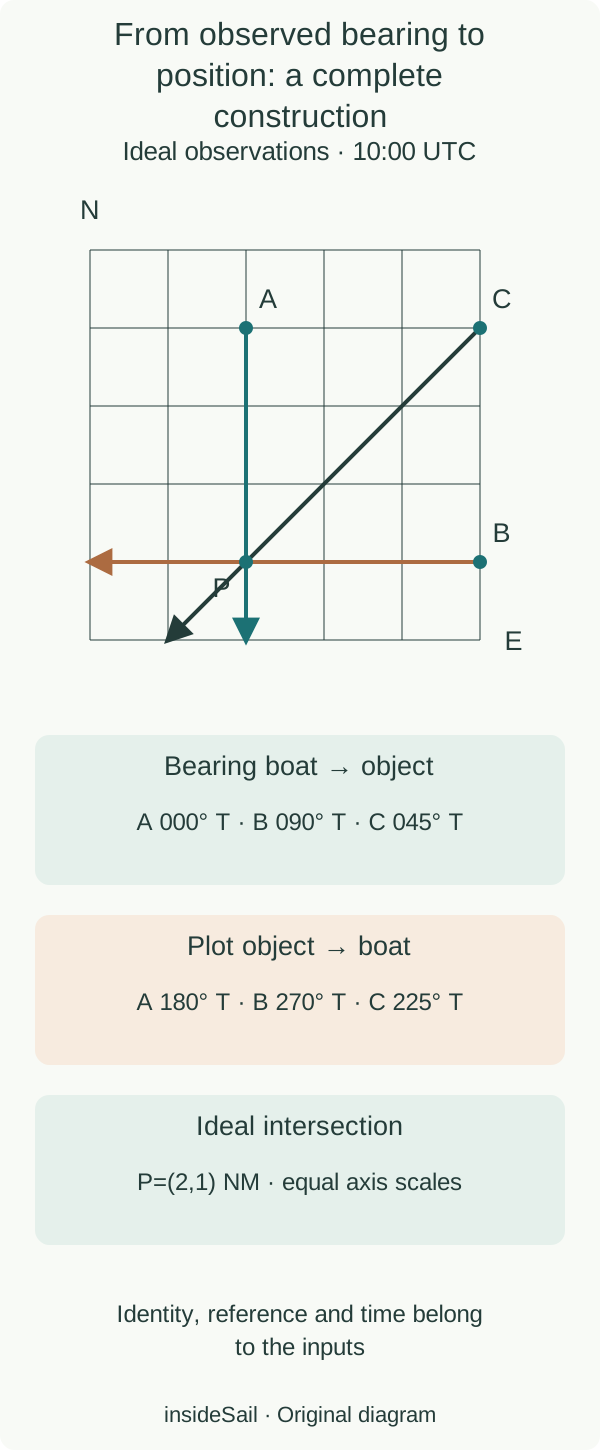
Original fictional constructions for learning. Navigation review pending.
insideSailOriginal insideSail artwork — all rights reservedEnlarge the diagram
1. Name the observation before drawing
| Fictional reference | Position (E,N) | Bearing from boat to object | Time |
|---|---|---|---|
| A | (2,4) | 000° T | 10:00 UTC |
| B | (5,1) | 090° T | 10:00 UTC |
| C | (5,4) | 045° T | 10:00 UTC |
Identity is part of the input: observing the wrong tower and plotting the right one produces a tidy line with the wrong origin. Here references are letters without real locations.
Bearings are already specified relative to true north. Magnetic, compass or relative readings require conversion using applicable information before plotting. “045°” without its reference does not fully identify an observation.
2. Plot from the object using the reciprocal direction
Bearing 000° T says A is north of the boat. Starting at A, possible observer locations therefore extend southwards on reciprocal 180° T.
Plot that line with ruler and protractor. For B, observation 090° T gives a west-going line from B, 270° T.
The two lines intersect at P=(2,1). The result belongs to the observation time rather than a future position or the vessel’s location when the chart was opened.
3. Introduce what the ideal construction omitted
In practice, small differences can form a cocked hat. There is no universal guarantee that true position lies inside it or at its centre.
A common reference error can displace every line, while wrong object identification may alter one. The third line adds information and an opportunity to detect inconsistency without automatically certifying accuracy.
The references themselves have chart-position quality too.
Successive observations can also originate at different positions. At a constant 5 knots, 70 seconds represents 5×70/3600≈0.0972 miles, about 180 m.
Plotting every line as simultaneous would erase that movement. Advancing lines to a common time requires a movement model and introduces further assumptions; simply changing caption times is insufficient.
The arithmetic shows the scale of the issue without prescribing an operating cadence.
A complete record retains object, bearing, reference, time and origin. The construction answers “where would a vessel compatible with these inputs be?”.
Applying it during an approach requires practical learning, current documents and assessment of uncertainty against available space. The grid teaches the method and its dependencies without inventing actual marks or a safe track.
- Observed direction is boat→object; plotting starts at the object.
- A fix belongs to its observation time.
- Three consistent lines can still share an error.
Sources and references
- Boat Crew Handbook — Navigation and Piloting, BCH16114.3 ↗
United States Coast Guard · Chapter 3 E.9, printed p.3-94; E.12.a–E.12.b, pp.3-101–3-102. Chapter 3 G.9–G.10, pp.3-138–3-140; F.11, pp.3-117–3-122.
Bearing-to-line relationship only. The suggestion that the true position is at the centre of a triangle is not adopted; all example geometry is original. DR/EP and distance–speed–time terminology only; current-circle construction is independently derived and numerically checked.
Checked on
Keep discovering
The next piece of the puzzle
Discuss this concept
Loading the conversation…