
Automated technical check · version 6 ·
Hull speed: a theoretical speed reference
It is neither an absolute maximum speed nor a cruising-speed promise.
In this guide
A reference, not a wall
Waterline length helps put a theoretical speed into context.
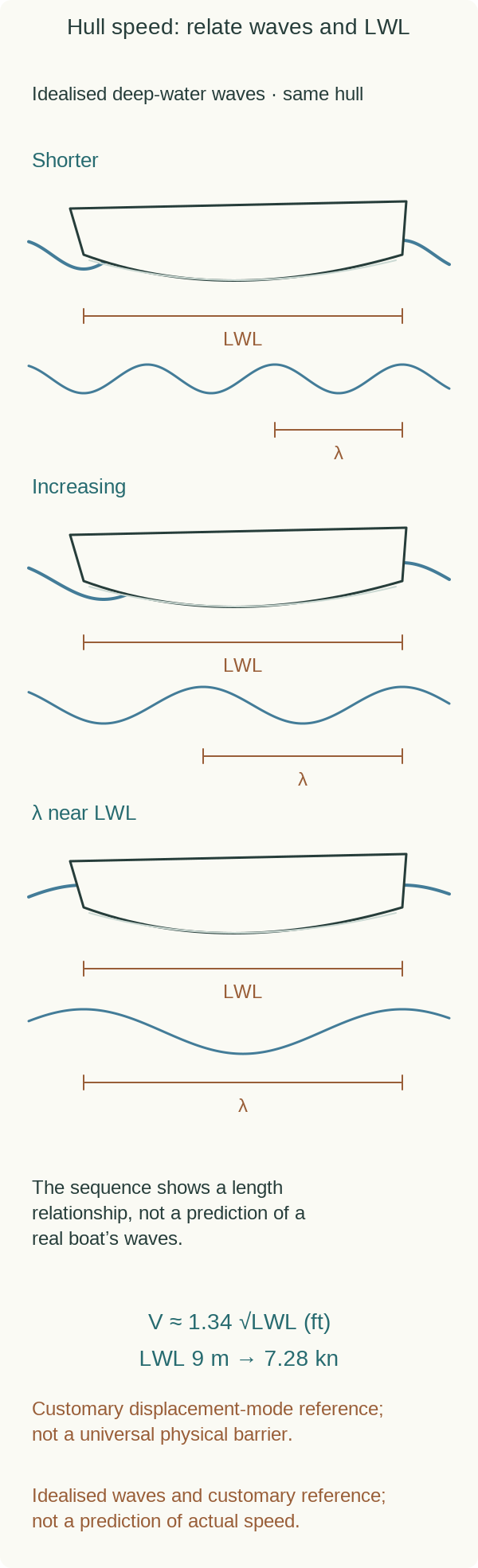
Idealised waves and customary reference; not a prediction of actual speed.
insideSailOriginal insideSail artwork — all rights reservedEnlarge the diagram
Length in the water
The rule relates speed to the square root of LWL.
What it offers: Uses an identifiable input and a reproducible formula.
What to consider: The coefficient must match the unit: metres or feet.
Waves and displacement
Puts wave generation in a conventional displacement monohull into context.
What it offers: Helps explain why length and speed expectations are related.
What to consider: The formula does not calculate the power needed to reach that reference.
The real boat
Hull form, loading, wind, surfing and planing can produce different behaviour.
What it offers: The reference is more useful alongside explanation and real data.
What to consider: It is not a passage, fuel-consumption or guaranteed-speed prediction.
Three things to remember
- The calculation starts with LWL, not LOA.
- It is a reference for displacement mode.
- It is neither a maximum speed nor a cruising-speed promise.
Learn by exploring
What if this number changes?
Move the controls and see the relationship. A hypothetical example, unrelated to an actual model.
This theoretical speed uses the conventional 1.34 × √LWL in feet. It is neither an absolute limit nor a cruising-speed prediction.
See the formula and units
Hull speed (kn) ≈ 1.34 × √LWL_ft ≈ 2.43 × √LWL_mThe conventional formula uses the units shown in the expression. The interactive example converts units when needed.
LWL: ft or m, with the corresponding coefficient. Output: kn.
In plain language
The conventional rule relates speed to the square root of LWL. With LWL in feet, 1.34 gives knots; with metres, the equivalent coefficient is approximately 2.43.
How to interpret it
It is a reference associated with wave generation in displacement mode, not a universal physical barrier.
Why it matters
It helps put speed expectations for a conventional monohull into context.
Limitations
Hull form, planing, surfing, wind, loading and power alter behaviour. It is not a passage prediction.
In practice
Hypothetical example: a 9 m LWL gives a reference of approximately 7.29 knots.
Further reading
NOAA Sea Grant — calculating hull speed ↗
Keep discovering
The next piece of the puzzle
The concept in a few words
Hull speed: a theoretical speed reference
It is neither an absolute maximum speed nor a cruising-speed promise.
Sources and references
- Western Region Sea State and Surf Forecaster’s Manual — WR-51 ↗
US Weather Bureau / NOAA archive · WBTM WR-51, July 1970; section IV, PDF p.16 / printed p.9, equations 1–5 for deep-water wave relationships. Original schematic wave profiles, not measured hull waves.
Reference for insideSail educational figure ir26-speed-hull-waves-lwl-sequence.
Checked on - NOAA Sea Grant — calculating hull speed ↗
NOAA · Reducing Fuel Costs: A Guide for Recreational Boating, Ryck Lydecker, 1986. Appendix 1: Calculating Hull Speed, PDF p.31 / printed p.25. Historical square-root LWL convention, not a universal maximum speed.
Checked on
Loading discussion…