By insideSail
Published without technical review · version 3 ·
Lateral marks and junctions: read the whole arrangement
Shape, colour, light and a modified band explain different identities.
In this guide
Lateral marks define the sides of a channel relative to conventional direction. At a junction, a modified lateral mark can also indicate the preferred channel.
Recognising it requires more than a familiar colour: combine region, shape or topmark, principal colour, band and light. The preferred channel is the one designated by the authority; it is not a rating of comfort, destination or priority between vessels.
Read the ordinary laterals first
Original schematic without spatial scale; not a chart, route or navigation instruction.
insideSailOriginal insideSail artwork — all rights reservedEnlarge the diagram
In Region A port is red and starboard green. The distinctive port shape is cylindrical; starboard is conical.
Pillar and spar presentations are also permitted. Where a distinctive body shape is not used for identification, the corresponding topmark should be carried where practicable.
If fitted, the light has that side’s colour in the region. Ordinary laterals can use different rhythms except the one reserved for modified marks: there is no universal period or group for all red or green marks.
A band adds information
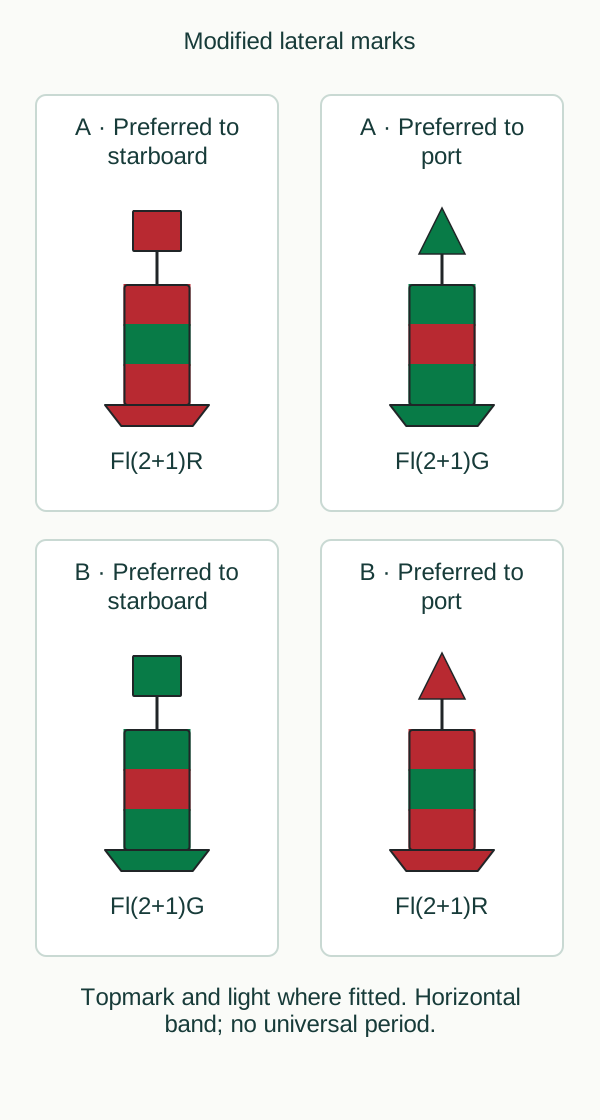
A modified lateral carries a broad horizontal band of the other lateral colour. Its body retains a principal colour and the topmark, if present, retains its lateral identity.
The light uses the principal colour and composite group flashing: two, then one, before repeating. International notation Fl(2+1) distinguishes that organisation from Fl(3), one uniform group of three.
The band is not decoration and does not turn the topmark into two cones.
| In A, preferred channel… | Body and topmark | Light when fitted | Lateral role for preferred channel |
|---|---|---|---|
| To starboard | Red with green band; red can | Red Fl(2+1) | Port |
| To port | Green with red band; upward green cone | Green Fl(2+1) | Starboard |
The preferred-channel name and lateral role can seem opposite, but describe different things. If the mark acts as the port-hand boundary of the preferred channel, that channel lies to its starboard when read in conventional direction.
If it acts as the starboard-hand boundary, the preferred channel lies to port. This is a defined spatial relationship, rather than an instruction to turn whenever the mark appears ahead.
What about Region B?
Roles and shapes remain, but colours swap. Preferred channel to starboard: principal green, red band, green can and green Fl(2+1).
Preferred channel to port: principal red, green band, upward red cone and red Fl(2+1). A description changing only the light while retaining the wrong body colour is inconsistent.
The table above represents A; it is not a universal colour table for both regions.
Confusions to avoid and key points
Compare it with an ordinary red lateral: in A both can have a red can, but only the modified one adds the green band and corresponding 2+1 grouping. Lettering identifies the particular mark; the band conveys its junction role.
These are separate information fields. Describing only “red buoy number four” can therefore identify an object without explaining what the modified mark means.
A complete educational record keeps particular identity and system meaning separate.
- Counting three flashes does not distinguish Fl(3) from Fl(2+1): observe the complete grouping.
- Reversing heading does not reverse conventional direction.
- Preferred channel grants neither encounter priority nor adequate depth for every draught.
- Mark characteristics and channel conditions are different information.
References: IALA R1001, edition 2.0, June 2023, 2.1.2–2.1.5; Portugal: RBMN, Articles 6 and 7, including Article 7 paragraphs 4 and 5.
Concepts in this lesson
Lateral mark
A channel-side mark relative to conventional direction, with Region A/B colour; can references port and upward cone starboard.
Educational recognition; provides no route or depth.
Preferred-channel mark
Modified lateral identifying preferred channel at a junction, with an opposite-colour horizontal band and Fl(2+1) if lit; it does not guarantee vessel suitability.
Educational recognition; provides no route or depth.
Sources and references
- IALA R1001 — Regions, conventional direction and lateral identification ↗
IALA · Sections 2.1.1–2.1.5; PDF p.9 onwards; edition 2.0 June 2023.
IALA recommendation, edition 2.0 June 2023, 2.1.1–2.1.5. Consulted edition does not establish individual national effective dates. Publication and jurisdiction require qualified review.
Checked on - IALA R1001 — Lateral marks and preferred channels, Regions A and B ↗
IALA · Sections 2.1.3–2.1.5; PDF p.10 onwards; edition 2.0 June 2023.
IALA recommendation, edition 2.0 June 2023, 2.1.3–2.1.5. Consulted edition does not establish individual national effective dates. Publication and jurisdiction require qualified review.
Checked on - RBMN — artigo 3: Método de caracterização das marcas ↗
Diário da República · RBMN annex Article 6; printed p.1979, PDF p.2. RBMN annex Article 7; printed p.1979, PDF p.2.
Annex RBMN Article 6, published text 24 June 2016. Commencement follows Portaria Article5; later national interpretation/updates and local directions require qualified checking. Not treated as automatic adoption of IALA2023. Annex RBMN Article 7, published text 24 June 2016. Commencement follows Portaria Article5; later national interpretation/updates and local directions require qualified checking. Not treated as automatic adoption of IALA2023.
Checked on
Regulatory references
- RBMN artigo 7 — Marcas laterais — região A ↗
Portaria 177/2016, original published annex · Defesa Nacional e Mar; technical direction Direção de Faróis / DGAM · Portugal
Verified on - Regions, conventional direction and lateral identification ↗
IALA R1001 edition 2.0 June 2023 · IALA · International recommendation; competent-authority implementation
Verified on - RBMN artigo 6 — Regras gerais das marcas laterais ↗
Portaria 177/2016, original published annex · Defesa Nacional e Mar; technical direction Direção de Faróis / DGAM · Portugal
Verified on - Lateral marks and preferred channels, Regions A and B ↗
IALA R1001 edition 2.0 June 2023 · IALA · International recommendation; competent-authority implementation
Verified on
Keep discovering
The next piece of the puzzle
Discuss this concept
Loading the conversation…