By insideSail
Published without technical review · version 3 ·
Regions A and B: state buoyage direction first
Lateral colours change by region; the reference is not the boat’s momentary bow.
In this guide
A lateral mark identifies a side of a channel. Understanding it needs two references: the IALA region and the conventional direction of buoyage.
That direction is established for the place; it does not follow each boat’s bow. This explains why the same mark can appear on our left on one journey and on our right on the return, without changing its identity.
Start with the arrow, then read the mark
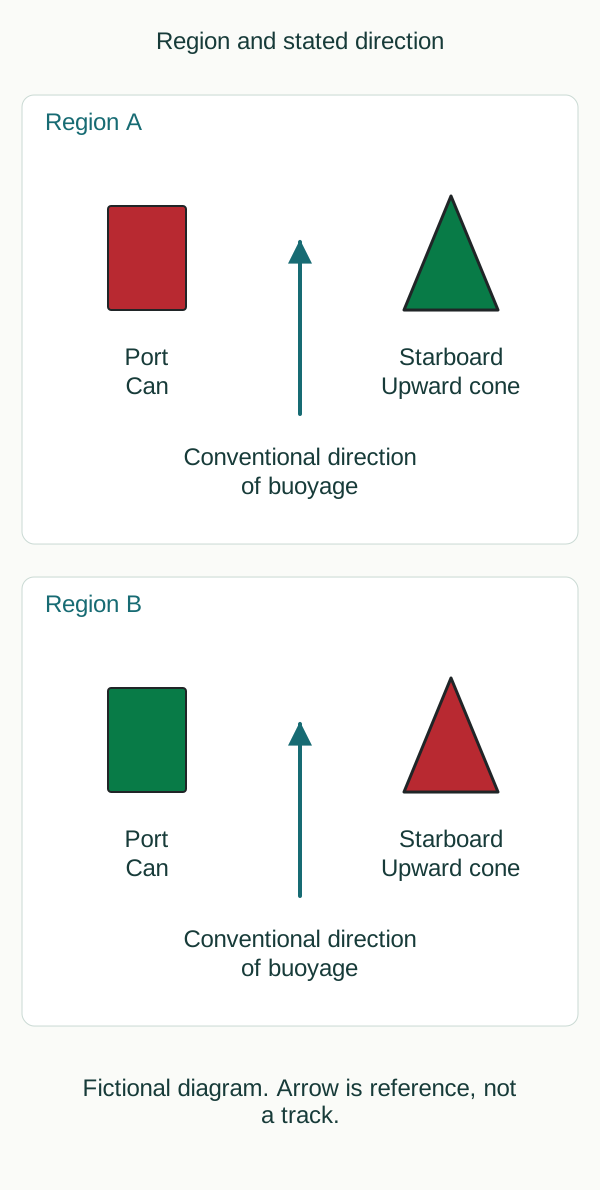
Original schematic without spatial scale; not a chart, route or navigation instruction.
insideSailOriginal insideSail artwork — all rights reservedEnlarge the diagram
The diagram’s arrow fixes the conventional direction. Imagine looking along it: port is to the left and starboard to the right.
Those sides classify the marks in that direction, rather than the viewpoint of someone ashore or taking a photograph from an opposite heading. Chart north is a different reference: a buoyage arrow can point north, south or in any other direction.
| Region | Port in the conventional direction | Starboard in the conventional direction |
|---|---|---|
| A | Red; can | Green; upward cone |
| B | Green; can | Red; upward cone |
What changes between A and B?
Lateral colours change, including the light when fitted. The sides associated with shapes remain: can for port, cone apex upwards for starboard.
A can has a flat top; a cone ends at an apex. Not all buoys have these distinctive bodies.
A pillar or spar can carry the corresponding topmark where practicable. This upper recognition feature helps identify the mark; it is not a radar reflector.
The regional change does not swap cardinal, isolated danger, safe water, special or emergency characteristics. A north cardinal remains black above yellow with two upward cones in both regions.
Europe uses Region A, including Portugal and the United Kingdom. Region B includes the Americas, Japan, the Republic of Korea and the Philippines, among other areas.
The reference for a particular area should be confirmed in the appropriate nautical documents.
How is the direction established?
R1001 provides for the general direction of approach from seaward to a harbour, river, estuary or other waterway. It also allows a direction determined by the competent authority, consulting neighbouring countries where appropriate; in principle it runs clockwise around landmasses.
“Entering, red to port” is a memory aid for A, but does not replace the definition. A through-channel may need a published reference that cannot be inferred simply from the word entering.
Portugal and common confusions
Portaria 177/2016 adopts Region A and assigns technical direction to Direção de Faróis within DGAM. It commenced on publication on 24 June 2016 and transposes IALA’s 2010 revision.
The international recommendation consulted here is June 2023. A newer recommendation does not automatically amend the national act.
R1001 and RBMN also relate numbering and lettering to conventional direction; even numbers on red and odd on green should not be extended to every aid type or used instead of local identification.
A boat’s port and starboard are fixed sides, defined when looking forward from stern to bow. They do not change when someone turns around.
Lateral marks apply those same names to a channel with its declared conventional reference. Keeping the two uses separate also avoids confusing a red buoy light with a vessel’s red navigation light, which belongs to COLREGs and serves a different purpose.
- Separate region, conventional direction and the boat’s heading.
- Colour and shape are complementary characteristics, rather than depths.
- A photograph without region and direction can leave identification incomplete.
References: IALA R1001, edition 2.0, June 2023, 2.1.1–2.1.4 and Annex A; Portugal: Portaria 177/2016, Articles 2, 3 and 5; RBMN annex, Articles 4–7.
Concepts in this lesson
Conventional direction of buoyage
Published reference for lateral-mark sides, defined by seaward approach or the authority; it does not rotate with the observer’s bow.
Educational recognition; provides no route or depth.
Topmark
Upper recognition element whose form and colour contribute to identity; distinct from body, lantern and radar reflector.
Educational recognition; provides no route or depth.
Sources and references
- Portaria 177/2016 — Regulamento de Balizagem Marítima Nacional ↗
Diário da República / Defesa Nacional e Mar · Portaria articles 1–5 and RBMN annex articles 1–22; printed pp.1978–1983, PDF pp.1–6.
Original official act and full annex directly consulted, not the neighbouring issue segment ending at p.1978. Portugal Region A, Direção de Faróis/DGAM. National implementation references the 2010 IALA revision; 2023 recommendations are not automatically substituted.
Checked on - IALA R1001 — Regions, conventional direction and lateral identification ↗
IALA · Sections 2.1.1–2.1.5; PDF p.9 onwards; edition 2.0 June 2023.
IALA recommendation, edition 2.0 June 2023, 2.1.1–2.1.5. Consulted edition does not establish individual national effective dates. Publication and jurisdiction require qualified review.
Checked on - IALA R1001 — Lateral marks and preferred channels, Regions A and B ↗
IALA · Sections 2.1.3–2.1.5; PDF p.10 onwards; edition 2.0 June 2023.
IALA recommendation, edition 2.0 June 2023, 2.1.3–2.1.5. Consulted edition does not establish individual national effective dates. Publication and jurisdiction require qualified review.
Checked on - RBMN — artigo 3: Método de caracterização das marcas ↗
Diário da República · RBMN annex Article 4; printed p.1979, PDF p.2. RBMN annex Article 5; printed p.1979, PDF p.2. RBMN annex Article 6; printed p.1979, PDF p.2. RBMN annex Article 7; printed p.1979, PDF p.2.
Annex RBMN Article 4, published text 24 June 2016. Commencement follows Portaria Article5; later national interpretation/updates and local directions require qualified checking. Not treated as automatic adoption of IALA2023. Annex RBMN Article 5, published text 24 June 2016. Commencement follows Portaria Article5; later national interpretation/updates and local directions require qualified checking. Not treated as automatic adoption of IALA2023. Annex RBMN Article 6, published text 24 June 2016. Commencement follows Portaria Article5; later national interpretation/updates and local directions require qualified checking. Not treated as automatic adoption of IALA2023. Annex RBMN Article 7, published text 24 June 2016. Commencement follows Portaria Article5; later national interpretation/updates and local directions require qualified checking. Not treated as automatic adoption of IALA2023.
Checked on
Regulatory references
- Lateral marks and preferred channels, Regions A and B ↗
IALA R1001 edition 2.0 June 2023 · IALA · International recommendation; competent-authority implementation
Verified on - Regions, conventional direction and lateral identification ↗
IALA R1001 edition 2.0 June 2023 · IALA · International recommendation; competent-authority implementation
Verified on - Portaria 177/2016 — RBMN adoption and technical direction ↗
Original published act 24 June 2016 · Defesa Nacional e Mar · Portugal
Verified on - RBMN artigo 5 — Regiões de balizagem ↗
Portaria 177/2016, original published annex · Defesa Nacional e Mar; technical direction Direção de Faróis / DGAM · Portugal
Verified on - RBMN artigo 4 — Sentido convencional de balizagem ↗
Portaria 177/2016, original published annex · Defesa Nacional e Mar; technical direction Direção de Faróis / DGAM · Portugal
Verified on - RBMN artigo 6 — Regras gerais das marcas laterais ↗
Portaria 177/2016, original published annex · Defesa Nacional e Mar; technical direction Direção de Faróis / DGAM · Portugal
Verified on - RBMN artigo 7 — Marcas laterais — região A ↗
Portaria 177/2016, original published annex · Defesa Nacional e Mar; technical direction Direção de Faróis / DGAM · Portugal
Verified on
Keep discovering
The next piece of the puzzle
Discuss this concept
Loading the conversation…