By insideSail
AI-assisted editorial review · version 3 ·
Narrow channel and traffic separation: space changes duties
Rules 9 and 10 have different scopes while preserving other obligations.
In this guide
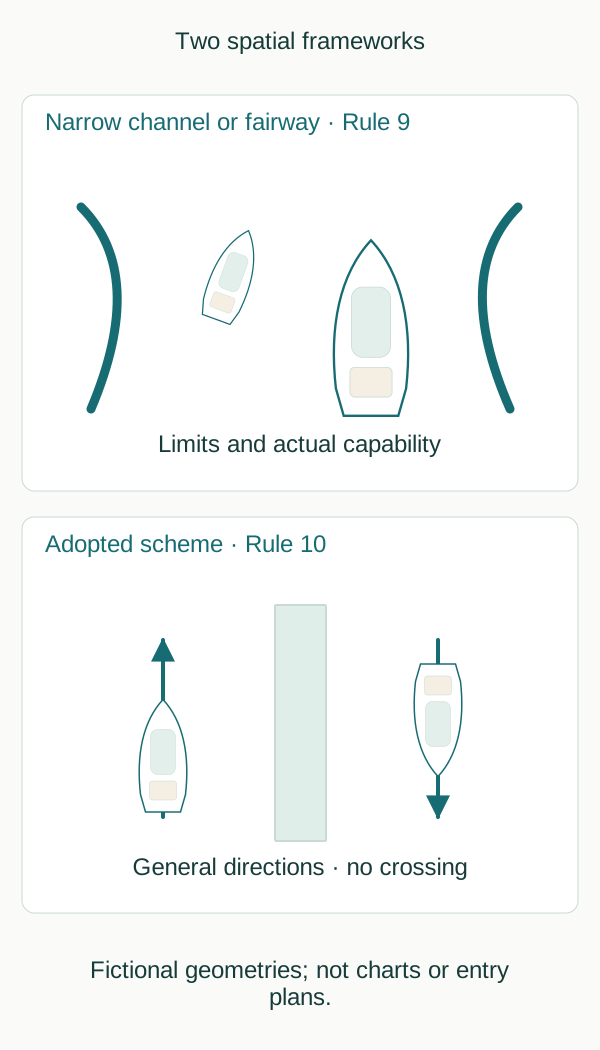
Original recognition schematic, not to scale; not navigation instruction.
insideSailOriginal insideSail artwork — all rights reservedEnlarge the diagram
A narrow channel and a traffic separation scheme are different things. One relates navigation to a narrow channel or fairway; the other organises traffic in a scheme adopted by the Organization.
Both can make a duty not to impede relevant, but with different subjects and conditions. The illustration separates fictional geometries without depths, positions or tracks.
Identifying space, scheme status and vessel capabilities comes before any conclusion about an encounter. A charted route does not automatically have the legal status of an IMO-adopted scheme.
Rule 9: within a narrow channel or fairway
Rule 9(a) requires keeping as near as safe and practicable to the outer limit lying on the vessel’s starboard side. Safe and practicable matter: the rule does not prescribe touching the edge or ignoring draught.
Under paragraph (b), a vessel under 20 metres or a sailing vessel must not impede one that can safely navigate only within the channel. This is not simply “larger beats smaller”; inability to navigate safely outside the channel is a specific condition.
Both vessel status and the actual navigable space belong in the analysis.
Fishing must not impede another vessel navigating within the channel, and a crossing must not impede one confined to it for safe navigation. Paragraph (e) addresses a special overtaking case requiring the overtaken vessel’s action to allow safe passage; signals and agreement do not remove the overtaker’s Rule 13 duty.
Paragraph (f) addresses bends or obstructions hiding vessels. Paragraph (g) requires avoiding anchoring in the channel when circumstances admit.
These provisions describe obligations rather than supplying a harbour-entry procedure or declaring every channel crossing acceptable.
Rule 10: a scheme adopted by the Organization
Rule 10(a) states its scope and preserves every other rule. For a vessel using the scheme, paragraph (b) addresses the appropriate lane, general traffic direction, separation and joining or leaving.
Where crossing is unavoidable, paragraph (c) refers to a heading as nearly as practicable at right angles to the general traffic direction, not necessarily the track over ground. Current can make those different.
That wording should not be converted into a charted route without conditions. A schematic traffic arrow illustrates the reference direction, rather than providing a passage plan.
The inshore traffic zone has its own conditions: Rule 10(d) includes permissions for vessels under 20 metres, sailing vessels and fishing vessels, together with local-destination and immediate-danger cases. Separation zones and lines, terminations, anchoring and vessels not using the scheme have further provisions in paragraphs (e)–(h).
Exceptions (k) and (l) concern specified navigation-safety maintenance or submarine-cable work only to the necessary extent. They do not arise because a boat has limited cockpit space, a small crew or a preference for a shorter passage.
Not impeding does not remove encounter rules
Rule 10(i) addresses fishing relative to any vessel following a lane; paragraph (j) requires vessels under 20 metres or sailing vessels not to impede safe passage of a power-driven vessel following a lane. Compare this with Rule 9(b), rather than merging their conditions.
Rule 8(f) explains that the early obligation persists when risk develops, and that the vessel whose passage must not be impeded remains subject to Part B. A scheme does not create immunity from collision-avoidance duties or make a vessel’s direction of travel the only relevant fact.
Sources and references
- RIEAM / COLREGs — Rule 9: Narrow channels ↗
Instituto Hidrográfico / International Maritime Organization · Rule 9, normative Portuguese printed p.11 (PDF p.17); International English cross-check in USCG handbook.
Rule 9; IH normative Portuguese printed p.11, PDF p.17; English International column cross-check. Individual provision commencement not established: valid_from remains null.
Checked on - RIEAM / COLREGs — Rule 13: Overtaking ↗
Instituto Hidrográfico / International Maritime Organization · Rule 13, normative Portuguese printed p.19 (PDF p.25); International English cross-check in USCG handbook.
Rule 13; IH normative Portuguese printed p.19, PDF p.25; English International column cross-check. Individual provision commencement not established: valid_from remains null.
Checked on - RIEAM / COLREGs — Rule 32: Definitions of sound signals ↗
Instituto Hidrográfico / International Maritime Organization · Rule 34, normative Portuguese printed p.53 (PDF p.59); International English cross-check in USCG handbook.
Rule 34; IH normative Portuguese printed p.53, PDF p.59; English International column cross-check. Individual provision commencement not established: valid_from remains null.
Checked on - RIEAM / COLREGs — Rule 10: Traffic separation schemes ↗
Instituto Hidrográfico / International Maritime Organization · Rule 10, normative Portuguese printed p.14 (PDF p.20); International English cross-check in USCG handbook.
Rule 10; IH normative Portuguese printed p.14, PDF p.20; English International column cross-check. Individual provision commencement not established: valid_from remains null.
Checked on - RIEAM / COLREGs — Rule 8: Action to avoid collision ↗
Instituto Hidrográfico / International Maritime Organization · Rule 8, normative Portuguese printed p.9 (PDF p.15); International English cross-check in USCG handbook.
Rule 8; IH normative Portuguese printed p.9, PDF p.15; English International column cross-check. Individual provision commencement not established: valid_from remains null.
Checked on
Regulatory references
- Regra 8 / Rule 8 — Manobras para evitar abalroamentos / Action to avoid collision ↗
COLREG 1972 as amended; IH 9th edition September 2025 / International cross-check August 2024 · International Maritime Organization · International convention; national/local implementation must be checked
Verified on - Regra 10 / Rule 10 — Dispositivos de separação de tráfego / Traffic separation schemes ↗
COLREG 1972 as amended; IH 9th edition September 2025 / International cross-check August 2024 · International Maritime Organization · International convention; national/local implementation must be checked
Verified on - Regra 13 / Rule 13 — Ultrapassagem / Overtaking ↗
COLREG 1972 as amended; IH 9th edition September 2025 / International cross-check August 2024 · International Maritime Organization · International convention; national/local implementation must be checked
Verified on - Regra 34 / Rule 34 — Sinais de manobra e de advertência / Manoeuvring and warning signals ↗
COLREG 1972 as amended; IH 9th edition September 2025 / International cross-check August 2024 · International Maritime Organization · International convention; national/local implementation must be checked
Verified on - Regra 9 / Rule 9 — Canais estreitos / Narrow channels ↗
COLREG 1972 as amended; IH 9th edition September 2025 / International cross-check August 2024 · International Maritime Organization · International convention; national/local implementation must be checked
Verified on
Keep discovering
The next piece of the puzzle
Discuss this concept
Loading the conversation…