By insideSail
Published without technical review · version 3 ·
Safe water: a navigational identity, not water quality
Vertical stripes and a red ball identify a mark that does not mark a danger.
In this guide
A safe water mark indicates navigable water around it and does not mark a danger. It can provide a landfall reference, an approach reference or a mid-channel mark.
The Portuguese name águas limpas is the nautical family name, rather than an environmental assessment: it says nothing about pollution, transparency or drinking water. The English term safe water mark describes the navigation function, with the same international characteristics.
One sphere and vertical stripes
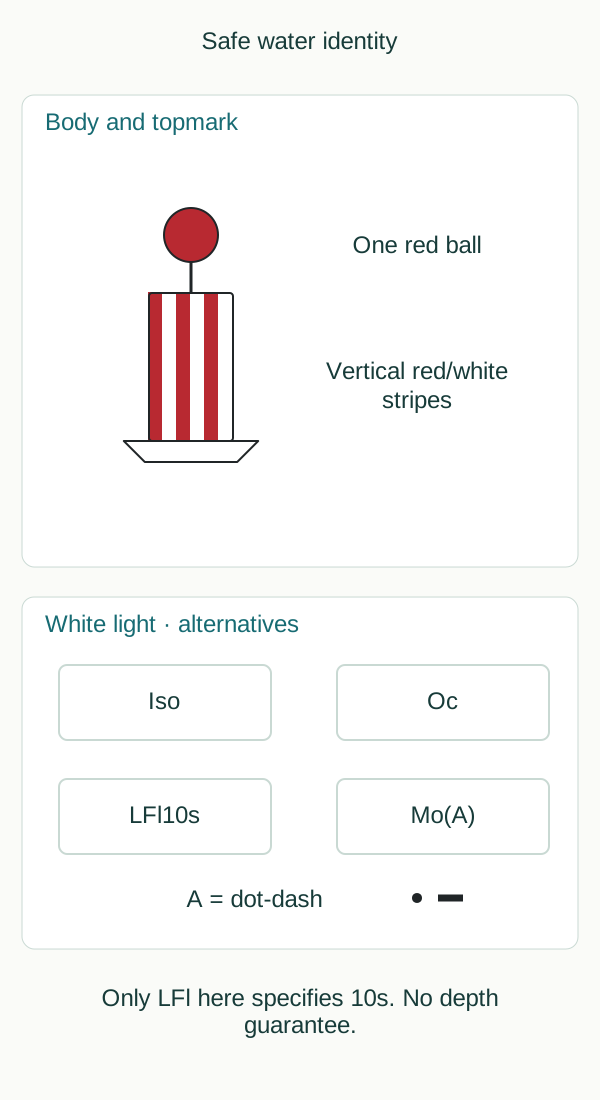
Original schematic without spatial scale; not a chart, route or navigation instruction.
insideSailOriginal insideSail artwork — all rights reservedEnlarge the diagram
| Element | Safe water identity |
|---|---|
| Body colour | Red and white vertical stripes |
| Shape | Spherical; or pillar/spar with spherical topmark |
| Topmark if any | One red sphere |
| Light when fitted | White: Iso, Oc, one LFl every 10s or Morse A |
Stripe orientation matters. Red and white vertical stripes differ from the horizontal bands of cardinals or isolated danger.
The upper sphere is single and red, whereas isolated danger uses two black spheres. A spherical buoy body and a narrow body carrying a spherical topmark are two presentations of the same family; the diagram separates body and topmark to make that relationship visible.
The four light alternatives
Iso means equal light and dark durations in the cycle. Oc means occulting, with total light duration longer than darkness.
LFl is a long flash lasting at least two seconds; in this family’s alternative it repeats every ten seconds. Mo(A) represents Morse A: dot followed by dash.
These are alternatives, not four signals every buoy emits in sequence. Neither Iso/Oc period nor all Morse phase timings can be inferred from the family name.
| Notation | What to compare | What not to infer |
|---|---|---|
| Iso | Equal light and dark durations | It is not a fixed light |
| Oc | More light than darkness | It is not Fl rhythm |
| LFl10s | Long flash within a ten-second cycle | The light does not last ten seconds |
| Mo(A) | Dot then dash | It is not a uniform group of two flashes |
A reference, rather than a depth measurement
R1001 includes uses such as landfall, port or estuary approach, channel entrance and mid-channel, including indication of the best passage under bridges. The particular function belongs to its published context: the same identity does not put every mark on a channel’s geometric centreline.
The family announces neither a depth in metres nor keel clearance for every boat. Navigable water is information related to the place, rather than an individual certificate for all draughts.
Compare two descriptions using the same white colour: Mo(A)W has one short and one long element, whereas Fl(2)W has a group of two flashes. The first is a safe-water alternative; the second belongs to isolated danger.
Counting light appearances is insufficient because duration and organisation also matter. The purpose is to relate notation to the described sequence, rather than memorise unexplained letters.
This comparison connects the family lesson with the more general lesson on rhythm and period.
- Safe water does not describe water quality.
- One red sphere differs from two black spheres.
- White identifies light colour; rhythm and the complete arrangement identify family.
- Use and depth belong to the published nautical context.
References: IALA R1001, edition 2.0, June 2023, 2.4.1–2.4.2; Portugal: RBMN, Article 12. Rhythms: IHO S-4, B-471.2.
The concept in a few words
Safe water mark
A mark indicating navigable water around without marking danger; vertical red/white stripes and red ball with defined white-light alternatives.
Educational recognition; provides no route or depth.
Sources and references
- IALA R1001 — Light rhythm identities and abbreviations ↗
IALA · Sections 2.2.2, 2.2.4, 2.4.2.2, 2.6.2.1, 4 (definitions) and 5 (abbreviations); PDF p.13 onwards and p.29; edition 2.0 June 2023.
IALA recommendation, edition 2.0 June 2023, 2.2.2, 2.2.4, 2.4.2.2, 2.6.2.1 and 4. Consulted edition does not establish individual national effective dates. Publication and jurisdiction require qualified review.
Checked on - Regulations for International (INT) Charts and Chart Specifications of the IHO — S-4 ↗
International Hydrographic Organization · B-460–B-466 buoy characteristics; B-471 light descriptions; B-475.1–B-475.6 sectors and leading lights; PDF pp.306–331 and 336–339.
Official 452-page PDF directly consulted; edition verified against current IHO catalogue. Original educational fragments rather than reproduced INT1 symbol plates. Paper chart conventions are not universal electronic display behaviour.
Checked on - IALA R1001 — Safe water identity, uses and light alternatives ↗
IALA · Sections 2.4.1–2.4.2; PDF p.17 onwards; edition 2.0 June 2023.
IALA recommendation, edition 2.0 June 2023, 2.4.1–2.4.2. Consulted edition does not establish individual national effective dates. Publication and jurisdiction require qualified review.
Checked on - RBMN — artigo 8: Quadrantes das marcas cardeais ↗
Diário da República · RBMN annex Article 12; printed p.1980, PDF p.3.
Annex RBMN Article 12, published text 24 June 2016. Commencement follows Portaria Article5; later national interpretation/updates and local directions require qualified checking. Not treated as automatic adoption of IALA2023.
Checked on
Regulatory references
- Safe water identity, uses and light alternatives ↗
IALA R1001 edition 2.0 June 2023 · IALA · International recommendation; competent-authority implementation
Verified on - Light rhythm identities and abbreviations ↗
IALA R1001 edition 2.0 June 2023 · IALA · International recommendation; competent-authority implementation
Verified on - RBMN artigo 12 — Marcas de águas limpas ↗
Portaria 177/2016, original published annex · Defesa Nacional e Mar; technical direction Direção de Faróis / DGAM · Portugal
Verified on - S-4 B-460–466 / B-470–475 — buoy and light charting specifications ↗
IHO S-4 edition 4.10.0 March 2026 · International Hydrographic Organization · International chart-production specification; not a local pilotage rule
Verified on
Keep discovering
The next piece of the puzzle
Discuss this concept
Loading the conversation…