By insideSail
Published without technical review · version 3 ·
Same channel, opposite headings: the reference does not rotate
The mark’s side and the boat’s side use different references when returning.
In this guide
A lateral mark is named relative to conventional buoyage direction. A boat has port and starboard relative to her bow.
These are two reference frames: when the boat changes orientation, the mark retains its identity but may appear on the opposite side aboard. Separating them makes an entrance, departure or differently oriented picture easier to interpret.
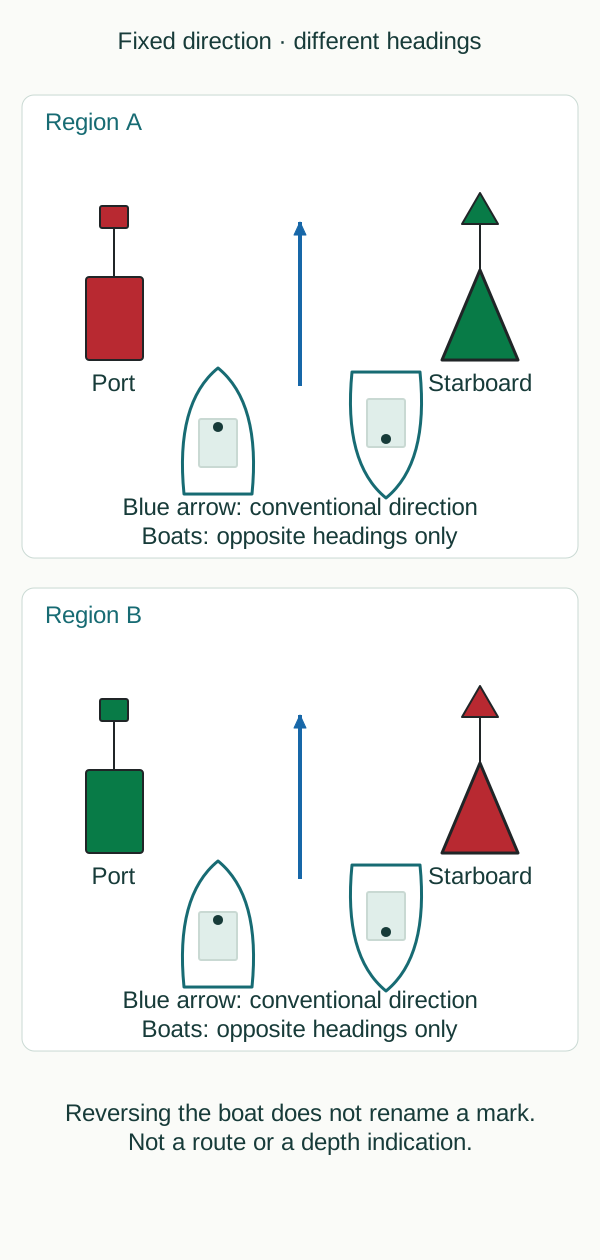
Original conceptual schematic, not to scale; fictional cases, not a manoeuvre procedure.
insideSailOriginal insideSail artwork — all rights reservedEnlarge the diagram
First establish the channel reference
Conventional direction normally follows the approach from seaward into a harbour, river or estuary; it can also be determined by the authority, in principle clockwise around landmasses. Charts and local documentation establish which applies.
The conventional-direction arrow declares that reference. It is neither a geographic-north arrow nor something that changes with each boat using the channel.
In Region A, lateral port is red and lateral starboard green. In Region B those colours reverse.
The shape relationship remains: can for port, conical for starboard, with corresponding topmarks where fitted. A buoy may use a pillar or spar body rather than a can or conical silhouette, so body shape and topmark need to be distinguished.
Worked case: two boats, the same mark
- Name marks using the arrow and region first: red port; green starboard.
- Locate boat 1’s port side: it is left in plan, on the red-mark side.
- Rotate only the boat silhouette to represent boat 2. Port is now right in plan.
- Describe the change: the red port lateral mark appears on boat 2’s starboard side. The mark’s identity has not changed.
| Region | Mark identity | Colour | Boat aligned with arrow | Boat facing opposite way |
|---|---|---|---|---|
| A | Port lateral | Red | On boat’s port side | On boat’s starboard side |
| A | Starboard lateral | Green | On boat’s starboard side | On boat’s port side |
| B | Port lateral | Green | On boat’s port side | On boat’s starboard side |
| B | Starboard lateral | Red | On boat’s starboard side | On boat’s port side |
A plausible sentence that leaves information out
“The red buoy is to port” describes a relationship with the observer. It may be true aboard one boat and false aboard the other.
“Region A port lateral mark” identifies a category relative to conventional direction. Combining them makes the record precise: “Region A port lateral mark, observed on the boat’s starboard side while facing opposite conventional direction”.
No repainting is required to explain the difference.
The same relationship can be read by rotating a sheet carrying the boat over one carrying marks and an arrow. Rotation changes which boat side faces each mark but preserves channel arrangement.
This makes the distinction between geometry and vocabulary visible. Rotating the whole sheet, including its arrow, changes its orientation on the table but preserves the internal relationship: page-up is not a universal reference either.
Limits of the rule and common mistakes
- Do not infer conventional direction solely from heading or “I am entering”.
- Do not swap port/starboard shapes when comparing A/B colours.
- Do not give a cardinal a lateral identity because it appears on one boat side.
- A mark with a contrasting band may be a modified junction lateral; it needs its own interpretation.
Lateral interpretation explains the reference of marked sides. Selecting a passage additionally requires current charts, draught, tide, restrictions and local circumstances.
Retain three ideas: region determines the colour combination; conventional direction determines lateral names; heading determines the boat’s sides. The junction lesson adds the preferred channel without changing those three reference frames.
Sources and references
- IALA R1001 — Regions, conventional direction and lateral identification ↗
IALA · Sections 2.1.1–2.1.5; PDF p.9 onwards; edition 2.0 June 2023.
IALA recommendation, edition 2.0 June 2023, 2.1.1–2.1.5. Consulted edition does not establish individual national effective dates. Publication and jurisdiction require qualified review.
Checked on - IALA R1001 — Lateral marks and preferred channels, Regions A and B ↗
IALA · Sections 2.1.3–2.1.5; PDF p.10 onwards; edition 2.0 June 2023.
IALA recommendation, edition 2.0 June 2023, 2.1.3–2.1.5. Consulted edition does not establish individual national effective dates. Publication and jurisdiction require qualified review.
Checked on - RBMN — artigo 3: Método de caracterização das marcas ↗
Diário da República · RBMN annex Article 4; printed p.1979, PDF p.2. RBMN annex Article 5; printed p.1979, PDF p.2. RBMN annex Article 6; printed p.1979, PDF p.2. RBMN annex Article 7; printed p.1979, PDF p.2.
Annex RBMN Article 4, published text 24 June 2016. Commencement follows Portaria Article5; later national interpretation/updates and local directions require qualified checking. Not treated as automatic adoption of IALA2023. Annex RBMN Article 5, published text 24 June 2016. Commencement follows Portaria Article5; later national interpretation/updates and local directions require qualified checking. Not treated as automatic adoption of IALA2023. Annex RBMN Article 6, published text 24 June 2016. Commencement follows Portaria Article5; later national interpretation/updates and local directions require qualified checking. Not treated as automatic adoption of IALA2023. Annex RBMN Article 7, published text 24 June 2016. Commencement follows Portaria Article5; later national interpretation/updates and local directions require qualified checking. Not treated as automatic adoption of IALA2023.
Checked on
Regulatory references
- Lateral marks and preferred channels, Regions A and B ↗
IALA R1001 edition 2.0 June 2023 · IALA · International recommendation; competent-authority implementation
Verified on - Regions, conventional direction and lateral identification ↗
IALA R1001 edition 2.0 June 2023 · IALA · International recommendation; competent-authority implementation
Verified on - RBMN artigo 5 — Regiões de balizagem ↗
Portaria 177/2016, original published annex · Defesa Nacional e Mar; technical direction Direção de Faróis / DGAM · Portugal
Verified on - RBMN artigo 7 — Marcas laterais — região A ↗
Portaria 177/2016, original published annex · Defesa Nacional e Mar; technical direction Direção de Faróis / DGAM · Portugal
Verified on - RBMN artigo 4 — Sentido convencional de balizagem ↗
Portaria 177/2016, original published annex · Defesa Nacional e Mar; technical direction Direção de Faróis / DGAM · Portugal
Verified on - RBMN artigo 6 — Regras gerais das marcas laterais ↗
Portaria 177/2016, original published annex · Defesa Nacional e Mar; technical direction Direção de Faróis / DGAM · Portugal
Verified on
Keep discovering
The next piece of the puzzle
Discuss this concept
Loading the conversation…