By insideSail
Published without technical review · version 3 ·
Sector lights: towards the source or away from it?
Two arrows on the same line can have opposite bearings; always state the reference.
In this guide
A sector light displays different colours or rhythms over defined arcs. The colour reaching an observer depends on position relative to the source.
The difficulty arises when drawing the numbers: a bearing from sea towards the light and an outgoing beam direction are opposite. Stating an arrow’s origin avoids drawing a sector on the wrong side even when its numbers were copied correctly.
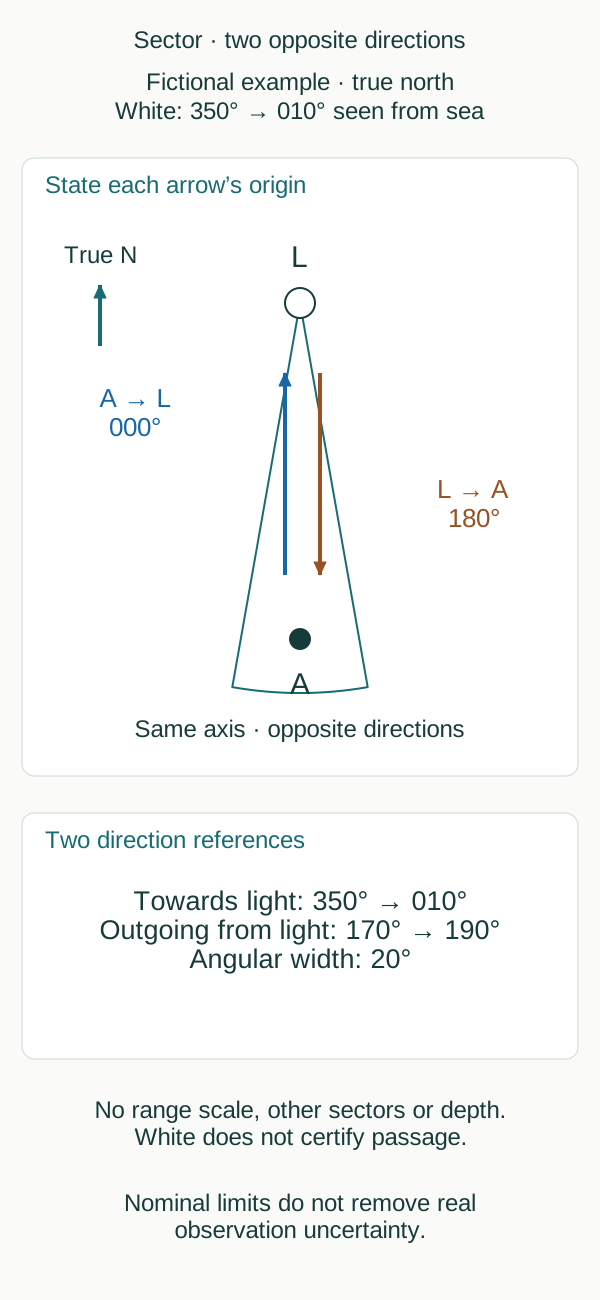
Original interpretation schematic with declared functions and references. No scale, approved installation or operational track.
insideSailOriginal insideSail artwork — all rights reservedEnlarge the diagram
Towards the light or away from it?
The consulted IHO conventions specify true bearings measured clockwise. Sector limits are given from seaward towards the light.
The consulted UKHO documentation also uses bearings from seaward. The number therefore belongs to the observer-to-source sight line.
Drawing a fan outwards from the source requires the reciprocal direction. Reading a publication begins with its convention rather than assuming where page-north lies.
In the figure, true north points up. A lies directly south of source L.
Bearing A→L is 000°; direction L→A is 180°. These are different directions along the same line.
Rotating the boat at A leaves this relationship unchanged because bearing depends on positions. It does not automatically turn 000° into the boat’s course or heading either.
Those fields answer different questions.
Worked case: a sector crossing 000°
- Find the width across north: 350° to 360° gives 10°; 000° to 010° adds 10°. Total: 20°.
- Convert the first limit to the outgoing direction: 350°+180°=530°; subtract one 360° turn to obtain 170°.
- Convert the second: 010°+180°=190°.
- Draw the outgoing fan between 170° and 190°, south of the source. An observer at outgoing 180° sees the source at 000°.
| Bearing towards L | Direction L→observer | Relationship in fictional case |
|---|---|---|
| 355° | 175° | Inside nominal white sector |
| 000° | 180° | On the illustrated angular centre |
| 005° | 185° | Inside nominal white sector |
| 015° | 195° | Outside; adjacent colour unspecified |
Nominal matters at the limits. A small zone of colour or intensity uncertainty can exist between sectors, and a drawing does not promise a perfectly sharp, instantaneous visual change.
Obstacles can also obscure sectors. IHO addresses boundaries, descriptive arcs and obscuration separately.
A coloured fan supplies neither luminous range, distance to the source nor visibility conditions by itself.
Colour meaning depends on published function
Sectors can identify channels, turning points, junctions, hazards or other references. White is not a universal declaration of safe water for every draught.
A sector light’s red and green are not a vessel’s sidelights either. When marking channel limits, region and conventional direction have their corresponding role.
Local documentation declares the actual meaning, while current charts add depths and restrictions.
Common confusions and key points
- 350°→010° crosses north; it is not a 340° sector.
- Towards and away from the source differ by 180° in this geometric model.
- True bearings are not interchangeable with magnetic or compass readings.
- Colour, characteristic, nominal limit, range and depth are distinct information.
Compare observers at sourceward bearings 005° and 015°: angular position changed and the latter left nominal white. Now compare two headings at the 005° position: position remained unchanged, so the received sector remains the same.
Sources and references
- RBMN — artigo 14: Boias de assinalamento de emergência ↗
Diário da República · RBMN annex Article 18; printed p.1981, PDF p.4.
Annex RBMN Article 18, published text 24 June 2016. Commencement follows Portaria Article5; later national interpretation/updates and local directions require qualified checking. Not treated as automatic adoption of IALA2023.
Checked on - Maritime NZ — Aids to navigation application help: sectored and obscured arcs ↗
Maritime New Zealand · Details of lights: Obscured Arcs and Sectored Arcs paragraphs; directions given by observer from seaward, bearings true and clockwise. Other form specifications excluded.
Official page directly consulted11October2026. Supports only explicit direction/reference explanation; local NZ equipment, legislation and rhythm summaries are not imported.
Checked on - Regulations for International (INT) Charts and Chart Specifications of the IHO — S-4 ↗
International Hydrographic Organization · B-460–B-466 buoy characteristics; B-471 light descriptions; B-475.1–B-475.6 sectors and leading lights; PDF pp.306–331 and 336–339. B-132/B-132.1–3, PDF59–60: true clockwise bearings, sector/leading bearings from seaward, reciprocals. B-433.1–3, PDF233–234: marks, legends and navigable versus remaining lead; B-475.6, PDF339 cross-reference.
Official 452-page PDF directly consulted; edition verified against current IHO catalogue. Original educational fragments rather than reproduced INT1 symbol plates. Paper chart conventions are not universal electronic display behaviour. Exact additional passages directly read from official freshly fetched March2026 edition; existing source/regulatory records unchanged. Original reference geometry is not a chart or engineering approval.
Checked on - UKHO and UKHMA Harbour Master’s Guide to Hydrographic and Maritime Information Exchange, July 2026 ↗
United Kingdom Hydrographic Office · Cover PDF1: July 2026; Aids to Navigation, printed p.19/PDF20: sector bearings from seaward, leading-light lead/distance.
The official file cover, directly read 12 October 2026, says July 2026; the URL path 2025-05 is not the edition. Canonical and historical query URLs return the same PDF SHA-256 6951106a59a8cd21766cb022102b23a9d614eaeed1e60635a994e4b7b55b58b4. The previous April 2025 bibliographic label is preserved in the original manuscript pack, not propagated to this new citation. Terminology and institutional reporting context only; not pilotage or a Europe-wide procedure.
Checked on - IALA R1001 — Lighthouses, leading lines, sector lights and other aids ↗
IALA · Sections 2.7.1–2.7.6; PDF p.21 onwards; edition 2.0 June 2023.
IALA recommendation, edition 2.0 June 2023, 2.7.1–2.7.6. Consulted edition does not establish individual national effective dates. Publication and jurisdiction require qualified review.
Checked on
Regulatory references
- S-4 B-460–466 / B-470–475 — buoy and light charting specifications ↗
IHO S-4 edition 4.10.0 March 2026 · International Hydrographic Organization · International chart-production specification; not a local pilotage rule
Verified on - RBMN artigo 18 — Farolim de sectores ↗
Portaria 177/2016, original published annex · Defesa Nacional e Mar; technical direction Direção de Faróis / DGAM · Portugal
Verified on - Lighthouses, leading lines, sector lights and other aids ↗
IALA R1001 edition 2.0 June 2023 · IALA · International recommendation; competent-authority implementation
Verified on
Keep discovering
The next piece of the puzzle
Discuss this concept
Loading the conversation…