By insideSail
Published without technical review · version 2 ·
Seven keel families: recognise shape, ballast and movement
An atlas explains what each label describes and which questions remain open.
In this guide
Keel can mean a structural part of a hull or an appendage beneath it. Here catalogue labels distinguish configurations.
Shape, ballast distribution and movement are separate axes. One appendage may have a fin and bulb, lift vertically and coexist with twin rudders.
Instead of seeking one perfect label, describe what photographs and documentation establish. The atlas isolates simplified characteristics; a shared label does not mean identical construction, performance or suitable operating conditions.
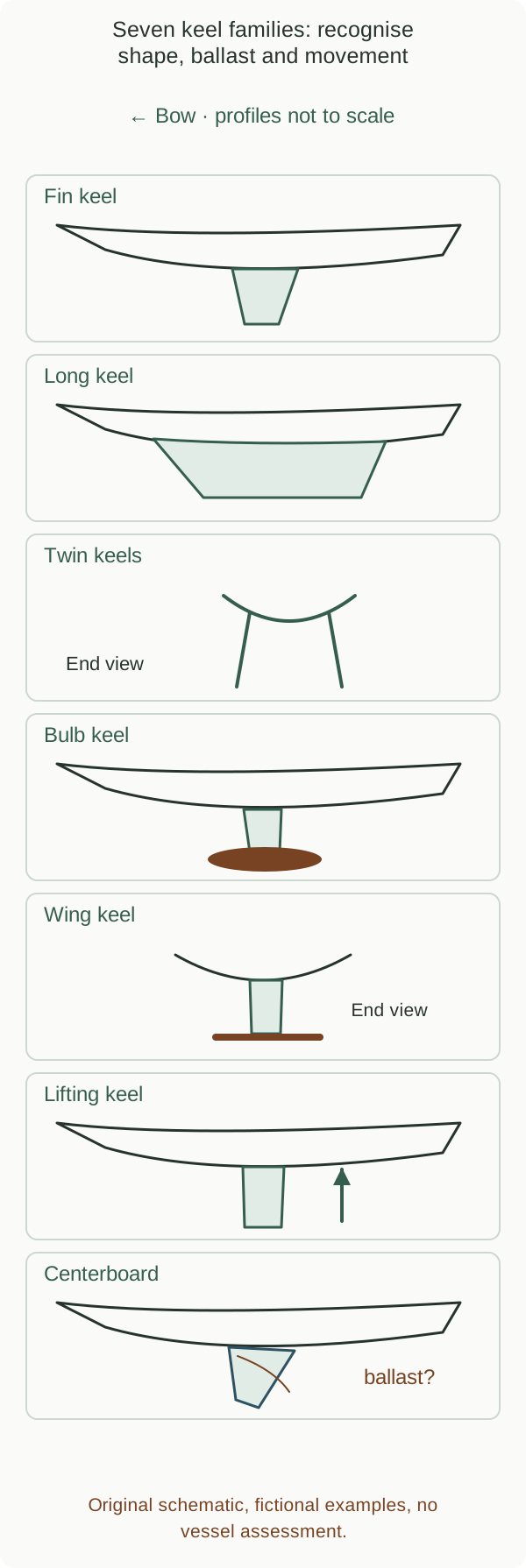
Original schematic, fictional examples, no vessel assessment.
insideSailOriginal insideSail artwork — all rights reservedEnlarge the diagram
Fixed configurations
| Family | What the label identifies |
|---|---|
| Fin keel | An appendage relatively concentrated fore and aft. |
| Long keel | A keel extending along more of the hull. |
| Bilge / twin keels | Two lateral appendages; inspect an underside or end view. |
| Bulb keel | Mass concentrated in a bulb associated with the keel. |
| Wing keel | Wings or lateral extensions; these are not two independent keels. |
Fin and long mainly describe relative fore-and-aft extent; there is no universal centimetre boundary. Intermediate and modified-long configurations exist.
Bulb and wing add information about the tip and volume distribution. A side photograph can hide wings or a second keel, so the atlas adds an end view where needed.
Ballast location still requires documentation: external shape does not reveal every part’s density. A large exterior volume need not contain the mass its appearance suggests.
Moving configurations
Lifting keel describes a keel changing position through a documented lifting or other mechanism. Centerboard describes a movable board providing lateral resistance; the name alone does not establish that it contains the principal ballast.
A boat may retain fixed hull ballast and lower a relatively light board, while another has a ballasted movable appendage. Establishing this distinction prevents the Finder equating two designs merely because both can reduce draught.
Raised and lowered dimensions should remain separate, with operating conditions visible.
Turn shape into useful questions
Lateral resistance, manoeuvrability, drag and stability depend on complete geometry and conditions, not family alone. A moving piece adds components whose condition matters: mechanism, case and access.
A fixed bolted keel and one incorporated into the hull call for different evidence. These differences create no automatic safety or quality ranking.
Ask what is verified, what use the builder allows and what condition the individual boat is in. A model-family drawing cannot answer a survey question about attachments or damage.
Documented examples include twin-keel options in the RM range, moving keels at Southerly, and centerboards and lifting keels at Alubat. They establish that configurations exist without transferring a brand’s marketing assurances to the whole family.
Follow the version with a recorded appendage when opening real-model examples. An inconclusive photograph warrants an unverified classification.
The atlas teaches recognition; a model specification retains evidence. Do not infer that every boat in a range shares the advertised option.
Sources and references
- All about keels, part one — Robert H. Perry ↗
Robert H. Perry / Good Old Boat · Original Issue 71, March/April 2010; fin, long keel and centreboard descriptions.
Primary designer account read. Limited taxonomy summary only, no copied boat examples, drawing, performance ranking or grounding assurance.
Checked on - RM Yachts — keel configurations ↗
RM Yachts · Range opening; RM890+ versions; RM980 twin rudders.
Manufacturer directly consulted for documented configuration examples only. Marketing assurances are not adopted.
Checked on - The Alubat DNA ↗
Alubat · Centreboard and lifting-keel paragraphs; distinction between OVNI and CIGALE configurations.
Official page directly read. Family labels are not a stability assessment or operating instruction.
Checked on - Lifting Keel ↗
Southerly Yachts · Description of variable draught and raised/lowered configuration.
Official product page directly read. No advertised pointing angle, drying-out permission or safe depth is transferred.
Checked on
Keep discovering
The next piece of the puzzle
Discuss this concept
Loading the conversation…