By insideSail
Published without technical review · version 2 ·
Severe bleeding and heat loss: help in parallel
A bounded limb-wound example connects direct pressure, emergency help and protection.
In this guide
This lesson follows an adult with severe external limb bleeding and no embedded object. It is not an algorithm for every injury.
Movement, access and delay to medical care afloat make early emergency contact important while another person assists. The sequence uses published ERC 2025 guidance within this bounded scope.
It does not practise on an actual wound or use a healthy volunteer to test treatment.
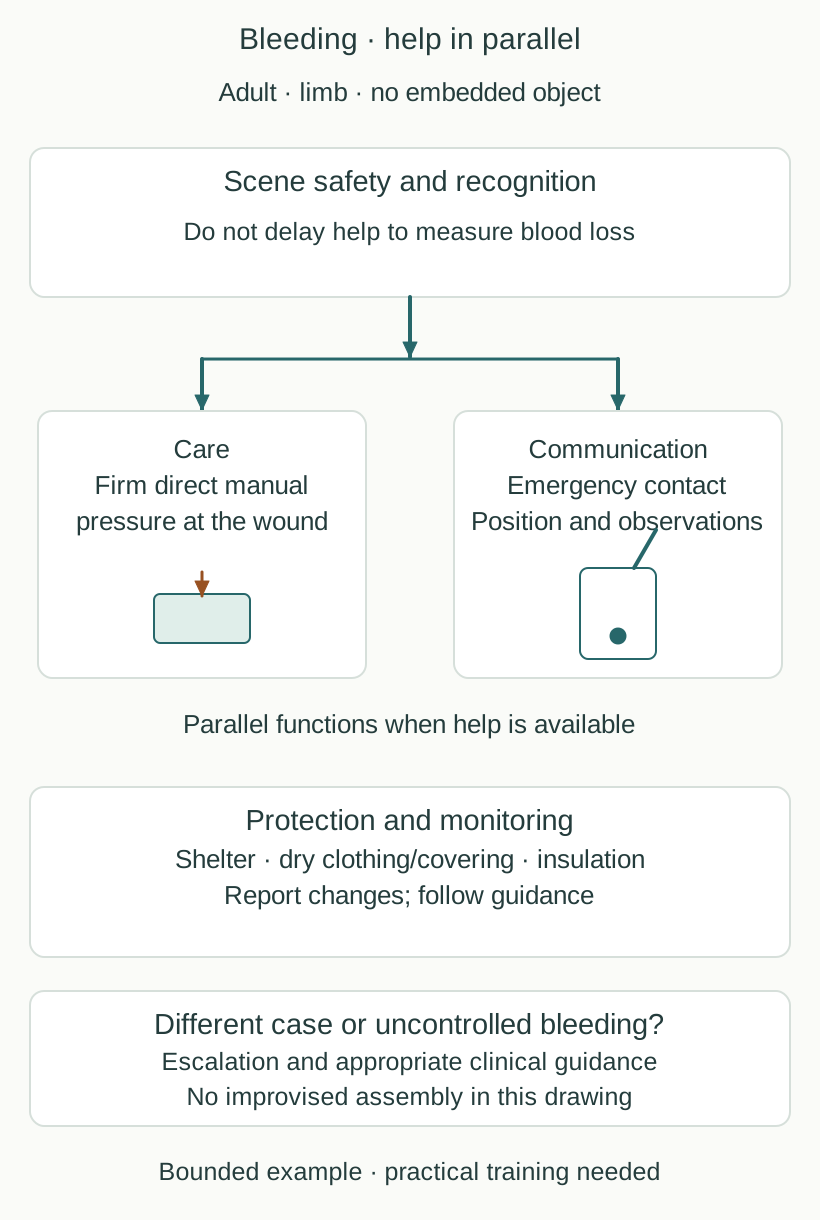
Original teaching illustration; bounded case, not to scale. See the lesson’s assumptions and limits.
insideSailOriginal insideSail artwork — all rights reservedEnlarge the diagram
Recognise and protect
Substantial or continuing blood loss needs urgent assistance without waiting to measure a volume. Check scene safety, use protection from blood contact where possible and call for emergency help.
With another person available, communication and care can proceed together. Report position and observations rather than an invented diagnosis.
Responsiveness and breathing remain important; a visible wound does not remove the need to recognise other immediate threats.
Pressure at the bleeding source
For the declared case ERC recommends firm direct manual pressure at the wound; a suitable dressing can be applied with firm pressure over it. Aim to control bleeding while monitoring the person and following received guidance.
Do not repeatedly release pressure merely to check whether bleeding continues. An embedded object must not be removed or pressed on; that is another configuration needing specific advice.
An open chest wound does not automatically receive this limb-wound treatment.
For life-threatening limb bleeding not controlled by direct pressure, ERC recommends a tourniquet. That does not mean improvising one with onboard rope.
Selection and use need suitable training, equipment and guidance; a layperson must not loosen an applied tourniquet to “restore circulation”. This lesson identifies escalation and training needs without drawing a generic assembly, tightening values or an incomplete application recipe.
Limit heat loss while help arrives
Cold can worsen an injured person’s situation without immersion. Prevention includes dry clothing or blankets, wind protection and insulation from cold surfaces.
Remove wet clothing gently and replace it with dry items where possible, avoiding unnecessary exposure. Shelter and coverings are not complete hypothermia treatment.
Do not postpone pressure or emergency contact to find a blanket or force drinks on someone unable to swallow safely.
Information for continued care
Retain time, observed mechanism, changes and actions without guessing lost volume. When a professional or emergency service directs an intervention, confirm understanding and record it.
Medical information remains private. After training, review supplies, access and capability; finding a kit does not demonstrate management of every injury.
Clinical training adds supervised execution, case adaptation and practical assessment of quality to this educational explanation.
Sources and references
- European Resuscitation Council Guidelines 2025 — First Aid ↗
European Resuscitation Council · Resuscitation 215 (2025) 110752: printed pp.8 and 20–21 bleeding; p.9 and p.22 prevention of hypothermia; initial assessment pp.4–5.
Published official guideline directly read, not consultation draft. Bounded adult limb-wound and heat-loss scenarios; no medication, paediatric extrapolation or improvised tourniquet instruction.
Checked on - Severe bleeding ↗
St John Ambulance · Source clinically reviewed 28 April 2025; What to do: protection, direct pressure, embedded objects, assistance and responsiveness.
Current primary page directly read after the NHS first-aid entry redirected to St John Ambulance. Source clinical review does not validate this InsideSail manuscript. UK telephone examples and additional bandaging/leg-elevation instructions are not imported.
Checked on
Keep discovering
The next piece of the puzzle
Discuss this concept
Loading the conversation…