By insideSail
Published without technical review · version 2 ·
Skipper: responsibility, jurisdiction and evidence
Flag, location, use and passage affect applicable requirements.
In this guide
The skipper organises a voyage and makes decisions affecting people, vessel and others. Responsibility is more than holding a qualification or signing a list.
Qualification, operational rules and preparation are related but distinct questions. Applicability can depend on flag, waters, private or commercial use and vessel characteristics.
Editorial records must retain those conditions instead of deriving “required in Europe” from one British or Portuguese example.
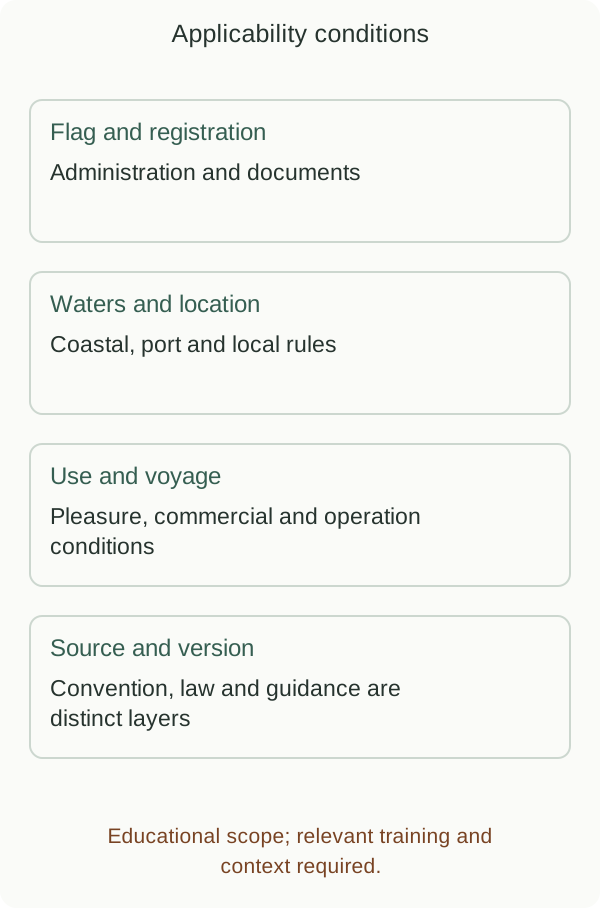
Educational scope; relevant training and context required.
insideSailOriginal insideSail artwork — all rights reservedEnlarge the diagram
A legal question begins with its conditions
| Input | Why it matters |
|---|---|
| Flag and registration | Identify an administrative and documentation layer. |
| Location and operation area | May introduce coastal, port and local restrictions. |
| Use and people | Private pleasure and commercial activity can have different regimes. |
| Vessel and voyage | Dimensions, characteristics and voyage category affect requirements. |
Distinguish international convention, national legislation, authority guidance and good-practice recommendation. A UK Marine Guidance Note explains application; it is neither the convention itself nor Portuguese law.
The consulted MGN 610 explains SOLAS V and UK implementation including 2025 changes. It should become neither “SOLAS only concerns large ships” nor “every provision applies identically to every yacht”.
Applicability requires examination of the particular obligation.
Decree-Law 93/2018 is a reference for Portugal’s recreational-craft framework. Its original PDF identifies the enactment but independently establishes neither current consolidated wording nor every equipment rule.
Consultation date differs from entry into force. Show both only when known and retain amendments awaiting checking.
This chapter establishes no foreign-qualification equivalence, authorised area or mandatory equipment inventory for every voyage.
Responsibility cannot be assigned to a screen
Forecast, passage, fuel, equipment, people’s fitness and contingencies belong to preparation alongside applicable requirements. Software can organise information without automatically knowing vessel condition, competence, local restrictions or changes.
Design certification proves no current maintenance; marina reviews are not pilotage information; another user’s track validates no passage. Skippers need to understand source limits and use appropriate information rather than merely accumulate documents.
When asking an authority, supply only necessary details and identify the obligation needing clarification. “May I sail?”
is less precise than a qualification question with specified use, flag and area. Do not habitually disclose personal data in public questions.
Record reply and scope without converting it into permission for another vessel or use. An in-force instrument may not apply to the case; another may explain history rather than current requirements.
Legal review must check both currency and applicability while retaining guidance, obligation and editorial recommendation as distinct layers. An answer’s consultation date supports traceability, not a promise that subsequent law or the reader’s circumstances will remain unchanged.
Useful records retain document, version, jurisdiction, authority, consultation date and the question answered. Guidance can change while the boat remains identical.
Commercial arrangements cannot alter the description of an obligation.
Sources and references
- MGN 610(M+F) Amendment 1 — SOLAS Chapter V ↗
Maritime and Coastguard Agency · §1.1 implementation in UK law; voyage planning and vessel/crew/passage context.
Guidance directly consulted. International convention and UK implementation are separate legal layers.
Checked on - MGN 599 (M) Amendment 1 — pleasure vessels guidance ↗
UK Maritime and Coastguard Agency · Pleasure-vessel scope; equipment/legal distinctions; §7.4 voyage planning.
UK guidance, not European law. Statutory applicability must be checked against the actual flag, use and vessel; no Class XII checklist transferred to a 10 m yacht.
Checked on - Decreto-Lei 93/2018 — Regime jurídico da náutica de recreio ↗
Diário da República / DGRM · 13 November 2018 official publication; recreational-craft and skipper legal framework.
Historical enactment PDF directly consulted; this is not an assertion that all provisions remain unamended. Consolidation and current implementing equipment rules require Portuguese legal review.
Checked on
Regulatory references
- MGN 610(M+F) Amendment 1 ↗
Amendment 1, live official guidance · MCA · United Kingdom implementation of SOLAS V
Verified on - Regime jurídico da náutica de recreio ↗
DL 93/2018 original publication, not consolidated · República Portuguesa / DGRM · Portugal
Verified on
Keep discovering
The next piece of the puzzle
Discuss this concept
Loading the conversation…