By insideSail
AI-assisted editorial review · version 3 ·
Stand-on: may, shall and continuing responsibility
Rule 17 distinguishes an initial situation, a conditional permission and a later obligation.
In this guide
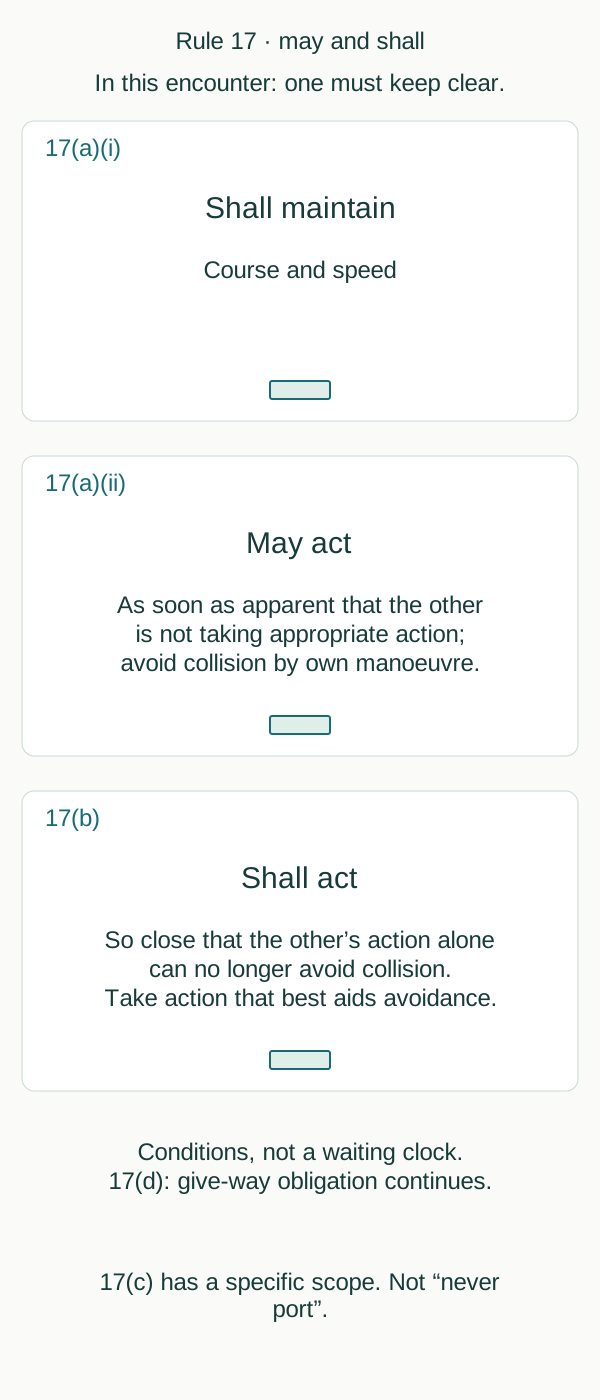
Original conceptual schematic, not to scale; fictional cases, not a manoeuvre procedure.
insideSailOriginal insideSail artwork — all rights reservedEnlarge the diagram
An encounter role, not a permanent status
Stand-on identifies the vessel that initially has to maintain course and speed in an encounter where one of the two must keep out of the way. This wording grants neither ownership of an area of water nor immunity from the encounter’s consequences.
The word priority, used in some translations, can suggest an absolute entitlement to a beginner. Following the conditions that change the obligation is more useful for understanding Rule 17.
The provision establishing that relationship must first be determined. It might be two sailing vessels under Rule 12 or another allocation within the in-sight section.
A position on a screen does not by itself create a stand-on vessel. Nor should these paired roles be imposed on Rule 19 as though its conditions were those of a visual encounter in open water.
The initial situation and the permission
Rule 17(a)(i) establishes maintaining course and speed. The following subparagraph permits action to avoid collision by the vessel’s own manoeuvre as soon as it becomes apparent that the give-way vessel is not taking appropriate action.
The distinction between shall and may is not an editorial detail. The second condition requires appraisal of the other vessel’s behaviour, not a predetermined fixed waiting time.
The drawing uses conditional panels rather than a time scale. Closing speed, manoeuvring ability, available space and bearing trend are unknown.
A minute cannot therefore be inserted between the panels, nor a distance circle around the vessel. Such quantities would add a rule that the text does not provide and conceal factors essential to the actual appraisal.
When action becomes mandatory
Rule 17(b) describes a different condition: from any cause, the vessel required to maintain course and speed finds herself so close that collision cannot be avoided by the give-way vessel’s action alone. She must then take the action that best aids avoidance.
This does not permit deliberately waiting for that stage. Nor does it remove the earlier permission or the general duties of look-out and prevention.
The qualification in Rule 17(c) has a narrow scope: a power-driven vessel in a crossing situation, taking action under 17(a)(ii) with another power-driven vessel on her port side. In those conditions, if circumstances admit, she must not alter course to port.
Summarising it as never turn to port would erase the written scope, condition and qualification. It supplies no universal yacht manoeuvre here.
Rule 18 is not an unqualified hierarchy
Rule 18 opens with an exception where Rules 9, 10 and 13 otherwise require. An overtaking sailing vessel gains no exemption because the other vessel is power-driven.
A sailing vessel in a channel may have a defined obligation not to impede passage. Vessel categories, including fishing or restricted manoeuvrability, also require the definitions in Rule 3 rather than an impression about size or occupation.
A further exercise retains the same vessel while changing only the stated condition: appropriate action by the other present, appropriate action absent, or the other’s action alone no longer sufficient. Vessel identity is unchanged, but the state-related obligation may change.
An answer should cite the full condition, including what is known about the other vessel, without inventing a transition instant.
Finally, 17(d) preserves the give-way vessel’s obligation. Intervention by the other vessel does not automatically transfer that obligation.
Reading these rules should explain the initial role, the observed condition modifying it and the relevant qualifications. The educational aim is to understand conditional responsibility, not select an actual track, determine fault in an incident or reduce collision prevention to a list of winners.
Sources and references
- RIEAM / COLREGs — Rule 9: Narrow channels ↗
Instituto Hidrográfico / International Maritime Organization · Rule 9, normative Portuguese printed p.11 (PDF p.17); International English cross-check in USCG handbook.
Rule 9; IH normative Portuguese printed p.11, PDF p.17; English International column cross-check. Individual provision commencement not established: valid_from remains null.
Checked on - RIEAM / COLREGs — Rule 11: Application of Section II ↗
Instituto Hidrográfico / International Maritime Organization · Rule 11, normative Portuguese printed p.17 (PDF p.23); International English cross-check in USCG handbook. Rule 12, normative Portuguese printed p.17 (PDF p.23); International English cross-check in USCG handbook.
Rule 11; IH normative Portuguese printed p.17, PDF p.23; English International column cross-check. Individual provision commencement not established: valid_from remains null. Rule 12; IH normative Portuguese printed p.17, PDF p.23; English International column cross-check. Individual provision commencement not established: valid_from remains null.
Checked on - RIEAM / COLREGs — Rule 19: Conduct of vessels in restricted visibility ↗
Instituto Hidrográfico / International Maritime Organization · Rule 19, normative Portuguese printed p.26 (PDF p.32); International English cross-check in USCG handbook.
Rule 19; IH normative Portuguese printed p.26, PDF p.32; English International column cross-check. Individual provision commencement not established: valid_from remains null.
Checked on - RIEAM / COLREGs — Rule 16: Action by give-way vessel ↗
Instituto Hidrográfico / International Maritime Organization · Rule 16, normative Portuguese printed p.22 (PDF p.28); International English cross-check in USCG handbook. Rule 17, normative Portuguese printed p.22 (PDF p.28); International English cross-check in USCG handbook.
Rule 16; IH normative Portuguese printed p.22, PDF p.28; English International column cross-check. Individual provision commencement not established: valid_from remains null. Rule 17; IH normative Portuguese printed p.22, PDF p.28; English International column cross-check. Individual provision commencement not established: valid_from remains null.
Checked on - RIEAM / COLREGs — Rule 13: Overtaking ↗
Instituto Hidrográfico / International Maritime Organization · Rule 13, normative Portuguese printed p.19 (PDF p.25); International English cross-check in USCG handbook.
Rule 13; IH normative Portuguese printed p.19, PDF p.25; English International column cross-check. Individual provision commencement not established: valid_from remains null.
Checked on - Navigation Rules and Regulations Handbook — corrected August 2024 ↗
United States Coast Guard Navigation Center · International column only, Rules 1–38 and Annexes I–IV. The adjacent U.S. Inland column is excluded.
Official PDF directly consulted. International/Inland differences are not European rules. Filename says 08-12-2024; landing page says corrected 8 August 2024: no unsupported exact correction day inferred.
Checked on - RIEAM / COLREGs — Rule 4: Application of Section I ↗
Instituto Hidrográfico / International Maritime Organization · Rule 5, normative Portuguese printed p.7 (PDF p.13); International English cross-check in USCG handbook.
Rule 5; IH normative Portuguese printed p.7, PDF p.13; English International column cross-check. Individual provision commencement not established: valid_from remains null.
Checked on - RIEAM / COLREGs — Rule 18: Responsibilities between vessels ↗
Instituto Hidrográfico / International Maritime Organization · Rule 18, normative Portuguese printed p.23 (PDF p.29); International English cross-check in USCG handbook.
Rule 18; IH normative Portuguese printed p.23, PDF p.29; English International column cross-check. Individual provision commencement not established: valid_from remains null.
Checked on - RIEAM / COLREGs — Rule 2: Responsibility ↗
Instituto Hidrográfico / International Maritime Organization · Rule 2, normative Portuguese printed p.3 (PDF p.9); International English cross-check in USCG handbook. Rule 3, normative Portuguese printed p.3 (PDF p.9); International English cross-check in USCG handbook.
Rule 2; IH normative Portuguese printed p.3, PDF p.9; English International column cross-check. Individual provision commencement not established: valid_from remains null. Rule 3; IH normative Portuguese printed p.3, PDF p.9; English International column cross-check. Individual provision commencement not established: valid_from remains null.
Checked on - RIEAM / COLREGs — Rule 6: Safe speed ↗
Instituto Hidrográfico / International Maritime Organization · Rule 7, normative Portuguese printed p.8 (PDF p.14); International English cross-check in USCG handbook.
Rule 7; IH normative Portuguese printed p.8, PDF p.14; English International column cross-check. Individual provision commencement not established: valid_from remains null.
Checked on - RIEAM / COLREGs — Rule 10: Traffic separation schemes ↗
Instituto Hidrográfico / International Maritime Organization · Rule 10, normative Portuguese printed p.14 (PDF p.20); International English cross-check in USCG handbook.
Rule 10; IH normative Portuguese printed p.14, PDF p.20; English International column cross-check. Individual provision commencement not established: valid_from remains null.
Checked on - RIEAM / COLREGs — Rule 8: Action to avoid collision ↗
Instituto Hidrográfico / International Maritime Organization · Rule 8, normative Portuguese printed p.9 (PDF p.15); International English cross-check in USCG handbook.
Rule 8; IH normative Portuguese printed p.9, PDF p.15; English International column cross-check. Individual provision commencement not established: valid_from remains null.
Checked on
Regulatory references
- Regra 5 / Rule 5 — Vigilância / Look-out ↗
COLREG 1972 as amended; IH 9th edition September 2025 / International cross-check August 2024 · International Maritime Organization · International convention; national/local implementation must be checked
Verified on - Regra 18 / Rule 18 — Responsabilidades recíprocas dos navios / Responsibilities between vessels ↗
COLREG 1972 as amended; IH 9th edition September 2025 / International cross-check August 2024 · International Maritime Organization · International convention; national/local implementation must be checked
Verified on - Regra 19 / Rule 19 — Condução dos navios em condições de visibilidade reduzida / Conduct of vessels in restricted visibility ↗
COLREG 1972 as amended; IH 9th edition September 2025 / International cross-check August 2024 · International Maritime Organization · International convention; national/local implementation must be checked
Verified on - Regra 8 / Rule 8 — Manobras para evitar abalroamentos / Action to avoid collision ↗
COLREG 1972 as amended; IH 9th edition September 2025 / International cross-check August 2024 · International Maritime Organization · International convention; national/local implementation must be checked
Verified on - Regra 10 / Rule 10 — Dispositivos de separação de tráfego / Traffic separation schemes ↗
COLREG 1972 as amended; IH 9th edition September 2025 / International cross-check August 2024 · International Maritime Organization · International convention; national/local implementation must be checked
Verified on - Regra 3 / Rule 3 — Definições gerais / General definitions ↗
COLREG 1972 as amended; IH 9th edition September 2025 / International cross-check August 2024 · International Maritime Organization · International convention; national/local implementation must be checked
Verified on - Regra 12 / Rule 12 — Navios à vela / Sailing vessels ↗
COLREG 1972 as amended; IH 9th edition September 2025 / International cross-check August 2024 · International Maritime Organization · International convention; national/local implementation must be checked
Verified on - Regra 7 / Rule 7 — Risco de abalroamento / Risk of collision ↗
COLREG 1972 as amended; IH 9th edition September 2025 / International cross-check August 2024 · International Maritime Organization · International convention; national/local implementation must be checked
Verified on - Regra 11 / Rule 11 — Aplicação da Secção II / Application of Section II ↗
COLREG 1972 as amended; IH 9th edition September 2025 / International cross-check August 2024 · International Maritime Organization · International convention; national/local implementation must be checked
Verified on - Regra 2 / Rule 2 — Responsabilidade / Responsibility ↗
COLREG 1972 as amended; IH 9th edition September 2025 / International cross-check August 2024 · International Maritime Organization · International convention; national/local implementation must be checked
Verified on - Regra 9 / Rule 9 — Canais estreitos / Narrow channels ↗
COLREG 1972 as amended; IH 9th edition September 2025 / International cross-check August 2024 · International Maritime Organization · International convention; national/local implementation must be checked
Verified on - Regra 16 / Rule 16 — Manobra do navio que deve afastar-se / Action by give-way vessel ↗
COLREG 1972 as amended; IH 9th edition September 2025 / International cross-check August 2024 · International Maritime Organization · International convention; national/local implementation must be checked
Verified on - Regra 13 / Rule 13 — Ultrapassagem / Overtaking ↗
COLREG 1972 as amended; IH 9th edition September 2025 / International cross-check August 2024 · International Maritime Organization · International convention; national/local implementation must be checked
Verified on - Regra 17 / Rule 17 — Manobra do navio que tem prioridade / Action by stand-on vessel ↗
COLREG 1972 as amended; IH 9th edition September 2025 / International cross-check August 2024 · International Maritime Organization · International convention; national/local implementation must be checked
Verified on
Keep discovering
The next piece of the puzzle
Discuss this concept
Loading the conversation…