By insideSail
Published without technical review · version 2 ·
Water ingress: recognise change and call for help
Location, trend, pumps and source control are different questions.
In this guide
Bilge water can have different origins, and an unexpected change needs attention. Finding water does not immediately establish its source or severity.
A running pump does not establish control either. Response connects people, observation, pumping and safe reduction of ingress where possible.
This lesson covers preparation and priorities rather than underwater repair, entry into hazardous spaces or a universal valve sequence.
Educational scope; relevant training and context required.
insideSailOriginal insideSail artwork — all rights reservedEnlarge the diagram
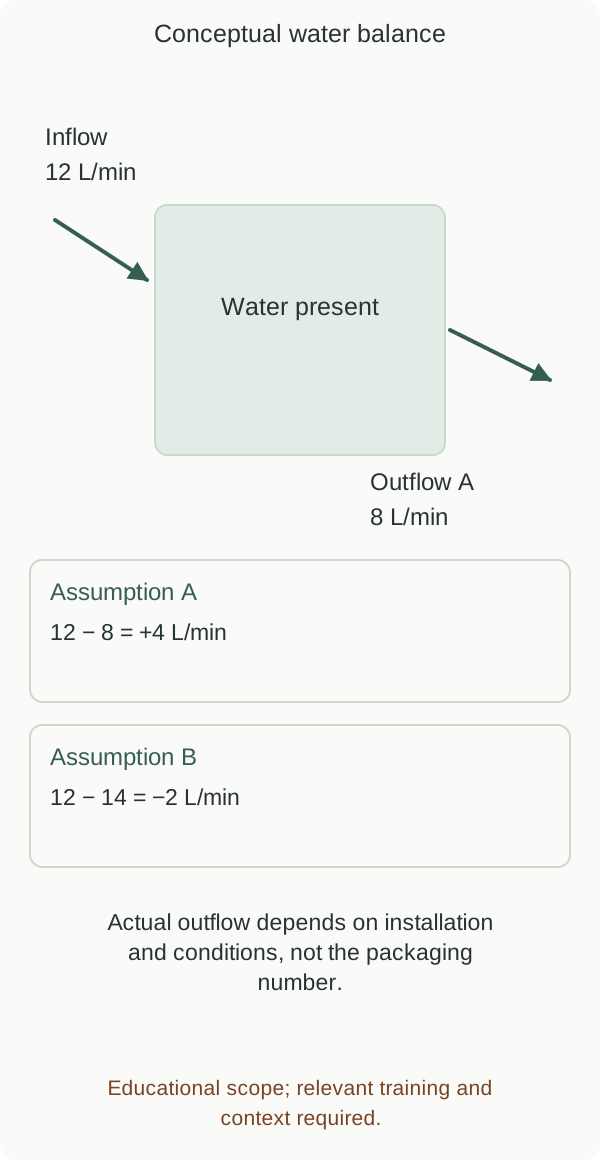
Inflow and outflow explain a trend
The relationship in numbers
Volume change = inflow − outflow
Ideal interval-volume model; not a real flooding forecast.
Know the system before trouble
Locate alarms, controls, pumps and discharge paths through guidance and documentation. Distinguish automatic from manual activation and identify shared power dependencies.
The consulted Whale manual warns that normal-bilge-water pumps may not cope with rapid ingress and that capacity depends on installation. One product’s limits are not transferred to another.
Individual assessment needs to identify the actual system and its assessed application.
People and communication in parallel
Task allocation prevents everyone investigating one point while nobody communicates during a flooding risk. Someone coordinates and retains position information; another can observe changes within safe limits and their competence.
Seeking early assistance does not require proving an exact cause. Report observations, trend and available capacity clearly, updating rescuers.
Preparation for possible transfer can coexist with safe control efforts without delaying an alert.
Investigation should not create another exposure. Electrical equipment, fuels and limited access can add risks.
An identified accessible component may have a manufacturer-defined control, but this does not authorise shutting every control experimentally or dismantling loaded or pressurised components. Without safety or competence to intervene, proportionate action protects people and coordinates assistance while preserving useful observations.
Records and accompanied practice
In an exercise without actual flooding, confirm that crew identify the alarm and understand communication and boat-control roles. Operation demonstrations follow the system and instructions; water is not deliberately introduced without an appropriate test plan.
Record and resolve location, interpretation or communication failures before departure. Missing alarms or unconfirmed capacity are preparation issues rather than gaps to fill editorially with optimistic estimates.
An exercise table can record observed level at two times and the state of each known resource. Lack of exact measurement does not mean lack of danger: visible progression and capability loss can justify prompt communication and assessment.
Inflow-minus-outflow arithmetic only organises volume assumptions. Compartments, heel and water paths complicate level-to-volume relationships beyond a rectangular tank.
A running pump does not prove a falling level, and an isolated reading establishes no trend. The diagram should help formulate these questions without calculating time to sinking or requiring entry into an unknown compartment to confirm the cause.
Distinguish missing evidence from a reassuring observation instead of filling a gap with a convenient number.
Work documented on one boat does not establish the condition of every boat of that model. After an incident, chronology and appropriate assessment remain necessary; no water being visible at one instant is not acceptance of a repair.
Sources and references
- Yacht sailing and motorboating ↗
RNLI · Safety checklist: briefing, training, weather, shore contact and means of help.
Preparedness guidance only. No statistics or comparative risk scores imported.
Checked on - Supersub/Supersub Smart installation guidelines ↗
Whale / Munster Simms Engineering · Official manufacturer-linked PDF, v 13/0618 filename; English printed p.2 application/warnings: capacity depends on installation, not sufficient for all flooding.
Selected application/warning text consulted; rechecked in the official Whale indexed PDF at whale.navico.com/globalassets/whale/marine/bilge/bilge-resources/supersub_installation_guide.pdf. Direct original and mirror fetches were unavailable during the final cross-check; no local PDF retained. Only the stated normal-bilge scope, capacity dependence and rapid-flooding limit are used. No wiring, installation, replacement interval or capacity transferred to another model.
Checked on
Keep discovering
The next piece of the puzzle
Discuss this concept
Loading the conversation…