By insideSail
Published without technical review · version 2 ·
Waves and current: direction and form
The same generation can encounter a differently moving medium.
In this guide
A wave propagates in a medium that may itself move. Current changes the relationship between propagation relative to water and relative to the ground.
Waves encountering opposing current can change length, height and steepness. Transformation depends on current structure, depth and wave components.
It is not a rule for adding wind and current as velocities of one object.
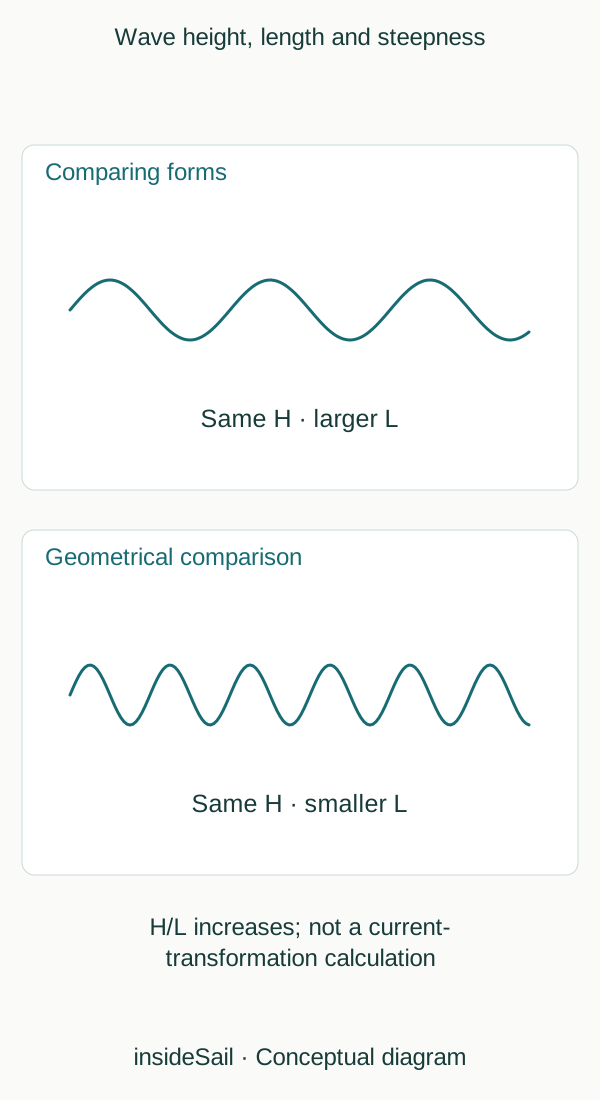
Geometrical H/L comparison, not to scale. It represents neither wind or current directions nor a wave forecast.
insideSailOriginal insideSail artwork — all rights reservedEnlarge the diagram
Name directions before comparing
Wind “from north” means air coming from north and moving south. A current “to north” describes opposite movement.
Waves can have their own direction inherited from earlier generation. Wind against current and waves against current may coincide, but are not synonyms.
Swell may arrive from another direction even in weak local wind.
Wave steepness relates height to wavelength. The same height distributed over a shorter wavelength increases H/L.
Adverse current can contribute to shorter, steeper waves; varying current can also change direction and concentrate energy. This physical statement does not assert that every adverse current immediately causes breaking or that following current makes a passage safe.
Bathymetry, refraction, current variation and crossing components make actual conditions more complex than two sine curves. The figure compares H/L geometry only; wind, current and propagation directions are explained in the text, without vectors in the drawing.
It contains no chart, time window or passage choice. Interpreting these relationships particularly matters at entrances and current areas.
Old forecasting formulas and safe-passage claims in the historical reference are not adopted.
A simple kinematic comparison separates frames: if an ideal pattern travels at 8 m/s relative to water and water moves 1 m/s in the same ground direction, ground phase speed is 9 m/s in that model; with opposing motion, 7 m/s. The calculation retains the assumed pattern rather than calculating height and wavelength transformation through varying current.
That second problem involves wave dynamics, not merely addition.
Angular relationships can vary too. A wave crossing a current boundary can change direction, while different components respond differently.
One side view does not show that two-dimensional distribution. The figure retains two cases with declared propagation and current labels rather than representing every possible effect.
This prevents deriving entrance conditions from a general word such as “ebb” without directions and local information.
- State wind FROM, current TO and wave propagation.
- Height and steepness are not equivalent.
- A physical tendency does not approve a passage.
Sources and references
- Rip Current Science ↗
NOAA National Weather Service · Surface-signature section: shoreward waves can steepen in opposing offshore flow.
Selected physical relationship only; no swimming response or detection-based safety advice.
Checked on - Wind Against Current — product description ↗
NOAA Ocean Prediction Center · Science/context paragraphs on opposing wind/current and wave development; original product text dated 23 April 2015.
Historical product is not recommended as a current European forecast; no thresholds, resolution or product algorithm imported.
Checked on - Western Region Sea State and Surf Forecaster’s Manual — WR-51 ↗
US Weather Bureau / NOAA archive · July 1970; “The Bar Problem”, printed pp.18–19, qualitative wave/current relationship only.
Historical physics companion; old prediction recipes, breaking limits, bar-crossing safety claims and original artwork expressly excluded.
Checked on
Keep discovering
The next piece of the puzzle
Discuss this concept
Loading the conversation…