By insideSail
Published without technical review · version 2 ·
Weather planning and changing assumptions
Relate forecasts to place, time and passage context.
In this guide
A forecast becomes part of a plan when related to the boat’s expected location and time. The same route at another time or speed can encounter different conditions.
Weather planning also includes uncertainty, alternatives and development. This lesson organises relationships without creating an automatic voyage-approval method.
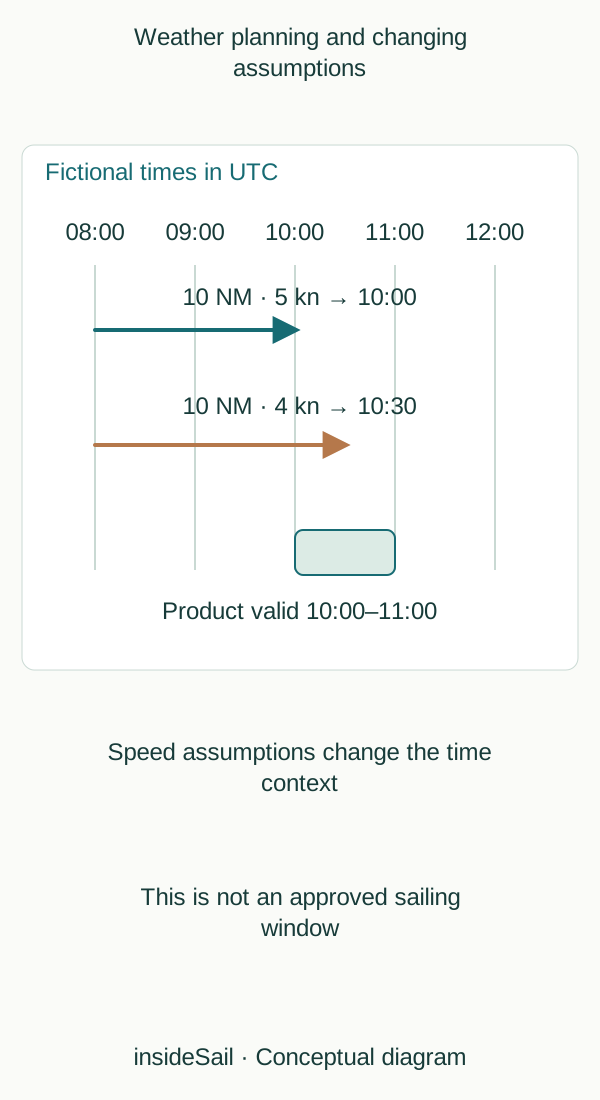
Conceptual schematic not to scale; no local forecast or operational decision.
insideSailOriginal insideSail artwork — all rights reservedEnlarge the diagram
Place and time work together
A forecast area can include exposed and sheltered coast or conditions developing during its validity interval. A grid point does not contain the full detail of an entrance.
Wind, wave, visibility and warning products describe different dimensions; comparing several wind numbers does not replace the others. Individual-vessel and crew context does not automatically appear in a weather product.
A new issue is more than the same file with another date. It can incorporate new observations and change the scenario.
Comparisons should retain run, validity, variable, area and units. A change can reveal predicted development or methodological differences.
Useful trends cannot be obtained by treating products with different validity times as alternatives for the same instant.
Alternatives need their own weather and nautical context. A nearby destination can have different exposure, while delay alters access timing.
Underway observations relate assumptions to events, but this lesson prescribes neither monitoring intervals, departure decisions nor deterioration responses. The MCA reference frames planning in the UK rather than providing one rule for all Europe.
Consider two invented products for one time: A gives area mean wind, while B gives a point gust. Their numerical difference does not automatically identify the “more conservative” product because quantities differ.
Compare the questions first. Compatible products may then show different scenarios, which should remain visible rather than being hidden in an automatic average of applications.
Uncertainty has time consequences. A half-hour arrival change and half-hour forecast-development change do not automatically cancel; they can bring events together or apart depending on direction.
Time bands make the relationship visible without choosing an operational limit. The example assigns no band probabilities; it identifies vessel timing and phenomenon timing as two changing assumptions.
- Associate forecast with expected location and time.
- Products and alternatives need their own context.
- Updated information can change the plan’s basis.
Sources and references
- MGN 599 (M) Amendment 1 — pleasure vessels guidance ↗
UK Maritime and Coastguard Agency · §7.4 weather, tide, vessel, crew and contingencies; updated 10 December 2024.
UK context, not a European legal summary or voyage approval.
Checked on - Estado do mar nas praias ↗
IPMA · Wave parameters and model-grid point explanation.
No current numerical forecast or model-resolution recommendation imported.
Checked on - Forecast User Guide — Section 5, Ensemble rationale and construction ↗
ECMWF · Initial-analysis error, model deficiencies and ensemble rationale.
Enduring uncertainty concepts only; no member count, resolution, current product configuration or operational guarantee.
Checked on
Keep discovering
The next piece of the puzzle
Discuss this concept
Loading the conversation…