By insideSail
Published without technical review · version 2 ·
A coastal scenario: connecting the components
A worked reasoning example without a real route or pilotage instructions.
In this guide
Coastal navigation combines geographical, temporal and observed information. This lesson follows an entirely fictional scenario to make those relationships visible.
The coast is abstract, points have no real coordinates and values are assumptions. The result is not an approved voyage.
The aim is to connect the components without choosing a navigational decision.
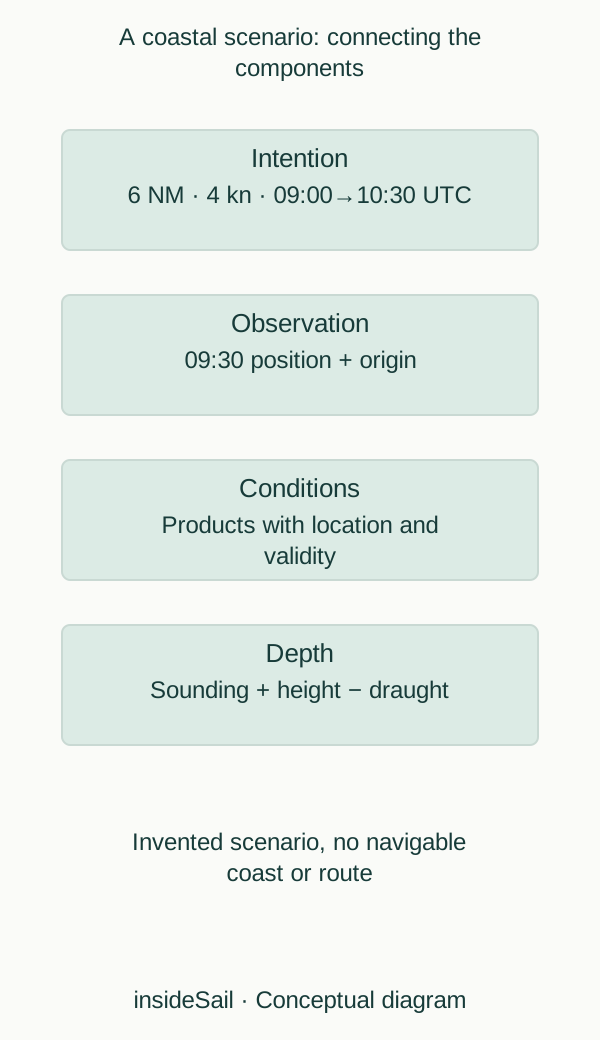
Teaching schematic not to scale; without local data or operational approval.
insideSailOriginal insideSail artwork — all rights reservedEnlarge the diagram
What each information adds
The plan represents a leg between A and B. An observed position places the boat at an instant.
An observed line of position relates it to features without supplying every coordinate by itself. A movement estimate places a future point subject to assumptions.
These pieces do not compete to produce one winning number: they answer different questions that need connecting.
Add an observation at 09:30. The boat can be displaced from the planned line even if its heading appears aligned with the leg.
Heading describes orientation; COG describes movement. If position and offset are calculated from the same receiver, their agreement does not constitute two independent confirmations.
The scenario makes these dependencies visible without choosing a steering correction.
The fictional destination has a depth question. Sounding and tidal height need the same zero; draught belongs to the individual vessel.
Even positive static clearance leaves data quality and dynamic effects unassessed. An alternative changes route, time and arrival conditions and therefore needs its own context.
The figure places these relationships together rather than drawing an automatically safe path.
This brings preceding lessons together: compatible references, explicit times, observation versus estimate, and understanding errors. Local data and operational instructions are deliberately absent.
Practical learning must address identification, observations, communication and decisions using actual documents and appropriate supervision. A worked example prepares understanding without claiming equivalence to experience at sea.
The scenario separates planned line from uncertainty region. A 09:30 observation supplies an estimated point with its own origin, while a conceptual band indicates non-infinite precision.
Relationship to the coast depends on boat position and charted-feature positions alike. Shrinking the screen icon does not shrink those errors.
The diagram combines geometry and systems lessons without making shading an approved margin.
Finally, the example record keeps three conceptual columns: intention, observation and assumption. “Arrival 10:30” is calculated intention; “09:30 position” is observation; “constant 4 knots” is assumption.
A differing observation may mean the assumption no longer represents movement. We do not jump directly to an action: first identify the changed relationship.
This language prepares practical learning where causes, conditions and responses need their own appraisal.
- Connect components without erasing their origins.
- Time, geometry and access are distinct questions.
- The scenario teaches reasoning rather than supplying a passage.
Sources and references
- Zero Hidrográfico (ZH) ↗
Instituto Hidrográfico · ZH definition; depths positive below ZH; relationship to local mean sea level.
Portuguese ZH is described as below the lowest astronomical tide; it is not silently equated with every national chart datum.
Checked on - MGN 599 (M) Amendment 1 — pleasure vessels guidance ↗
UK Maritime and Coastguard Agency · Updated 10 December 2024; §7.4 voyage-planning context.
UK jurisdiction stated; not a pan-European legal summary. Publication of applied lessons still requires qualified review.
Checked on - Boat Crew Handbook — Navigation and Piloting, BCH16114.3 ↗
United States Coast Guard · Chapter 2 A.29 p.2-16; Chapter 3 E.1 pp.3-78–3-80; E.9 p.3-94; G.9–G.10 pp.3-138–3-140.
Selected line-of-position, range/transit and DR/EP concepts. No US fix frequency, plotting recipe or course instruction adopted.
Checked on
Keep discovering
The next piece of the puzzle
Discuss this concept
Loading the conversation…