By insideSail
AI-assisted editorial review · version 3 ·
A yacht overtaking: when the obligation starts and ends
The initial relationship does not automatically become a crossing when the bearing changes.
In this guide
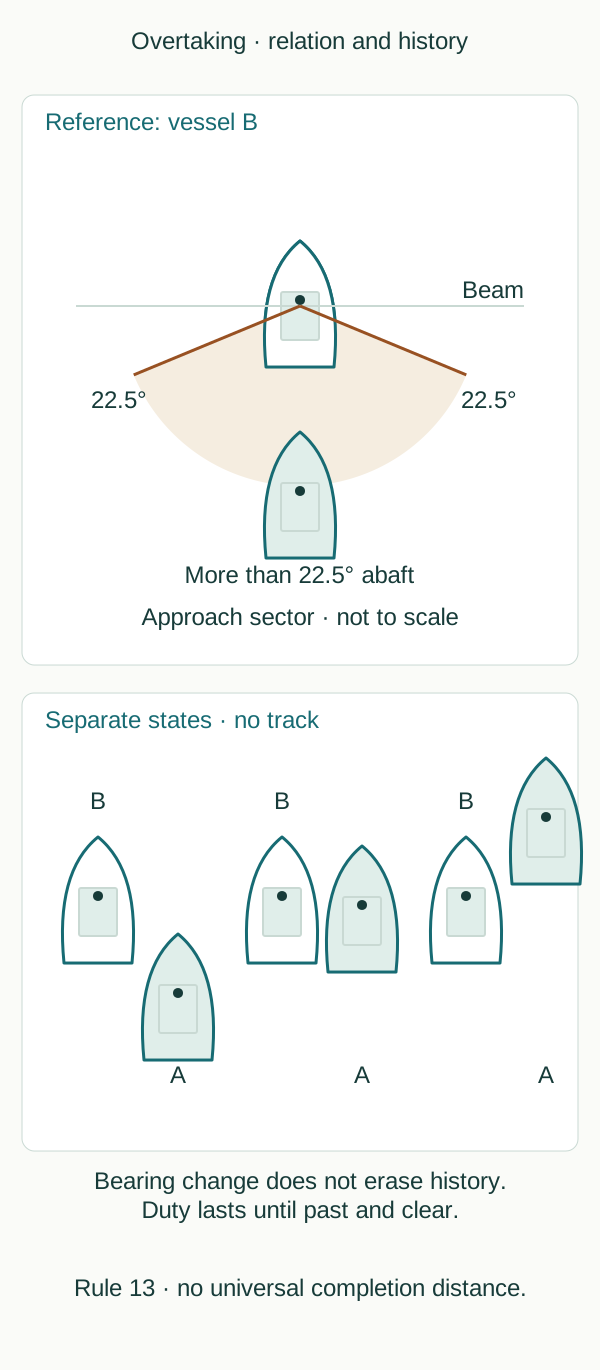
Original conceptual schematic, not to scale; fictional cases, not a manoeuvre procedure.
insideSailOriginal insideSail artwork — all rights reservedEnlarge the diagram
A rule crossing vessel categories
Rule 13 requires any vessel overtaking another to keep out of the overtaken vessel’s way, notwithstanding Rules 4 to 18. The word any matters to a sailor: sailing without engine propulsion does not remove that obligation when overtaking a power-driven vessel.
Nor does it give a fast yacht preference over a slower sailing vessel. Vessel category still matters, but does not replace the overtaking relationship.
This rule must be read alongside the scope of the conduct rules and the general obligations. The illustrated overtaking case here concerns vessels in sight of one another.
A radar echo in restricted visibility must not automatically be fitted into this picture as though it supplied visual contact. Rule 19 has its own conditions, although it also refers to a vessel being overtaken within one of its qualifications.
The sector belongs to the overtaken vessel
The definition uses an approach from a direction more than 22.5 degrees abaft the other vessel’s beam. That reference is measured on the vessel being overtaken.
It is not an angle from north, the wind or the observer’s own bow. The rule describes the equivalent night aspect as one in which only that vessel’s sternlight, and neither of her sidelights, would be visible.
The figure marks a geometric relationship, not a tool for visually measuring an exact boundary. Seeing one white light alone does not prove that it is a sternlight: other lights, obscuration or incomplete information may be involved.
The definition describes the aspect corresponding to the position; actual identification requires observations to be combined. The regulatory boundary must not be confused with a safety margin selected by the drawing.
Uncertainty and persistence of the obligation
Rule 13(c) requires a vessel in doubt about whether she is overtaking another to assume that she is and act accordingly. This is an express provision about that classification.
It does not give every uncertain contact a universal solution or remove the need to assess risk. It matters particularly when the position is near the boundary between an initially crossing relationship and an overtaking relationship.
Once overtaking is established, a subsequent alteration of bearing between the vessels does not turn the overtaking vessel into a crossing vessel. The obligation continues until finally past and clear.
Having the bow slightly ahead is therefore not the same as having completed the encounter. The text supplies no fixed distance in metres or boat lengths at which that conclusion can automatically be declared.
Identification is not a manoeuvre design
In a narrow channel, Rule 9 may require a specific process where overtaking is possible only if the overtaken vessel acts to permit safe passing. Rule 9(e)(ii) itself preserves the Rule 13 obligation.
Agreement about passing does not transfer responsibility to the vessel ahead. This lesson does not depict sound signals, lateral distances or an execution sequence; those elements depend on the applicable scope.
When reading a case, retain three distinct facts: where the approach began, how the relationship changed and whether the vessel became genuinely past and clear. The current snapshot does not replace the history.
The figure is an exercise in interpreting provisions through static states, not permission to pass. Look-out, risk and quality of action remain subject to the other provisions even where overtaking classification seems clear.
Sources and references
- RIEAM / COLREGs — Rule 9: Narrow channels ↗
Instituto Hidrográfico / International Maritime Organization · Rule 9, normative Portuguese printed p.11 (PDF p.17); International English cross-check in USCG handbook.
Rule 9; IH normative Portuguese printed p.11, PDF p.17; English International column cross-check. Individual provision commencement not established: valid_from remains null.
Checked on - RIEAM / COLREGs — Rule 11: Application of Section II ↗
Instituto Hidrográfico / International Maritime Organization · Rule 11, normative Portuguese printed p.17 (PDF p.23); International English cross-check in USCG handbook. Rule 12, normative Portuguese printed p.17 (PDF p.23); International English cross-check in USCG handbook.
Rule 11; IH normative Portuguese printed p.17, PDF p.23; English International column cross-check. Individual provision commencement not established: valid_from remains null. Rule 12; IH normative Portuguese printed p.17, PDF p.23; English International column cross-check. Individual provision commencement not established: valid_from remains null.
Checked on - RIEAM / COLREGs — Rule 19: Conduct of vessels in restricted visibility ↗
Instituto Hidrográfico / International Maritime Organization · Rule 19, normative Portuguese printed p.26 (PDF p.32); International English cross-check in USCG handbook.
Rule 19; IH normative Portuguese printed p.26, PDF p.32; English International column cross-check. Individual provision commencement not established: valid_from remains null.
Checked on - RIEAM / COLREGs — Rule 13: Overtaking ↗
Instituto Hidrográfico / International Maritime Organization · Rule 13, normative Portuguese printed p.19 (PDF p.25); International English cross-check in USCG handbook.
Rule 13; IH normative Portuguese printed p.19, PDF p.25; English International column cross-check. Individual provision commencement not established: valid_from remains null.
Checked on - Navigation Rules and Regulations Handbook — corrected August 2024 ↗
United States Coast Guard Navigation Center · International column only, Rules 1–38 and Annexes I–IV. The adjacent U.S. Inland column is excluded.
Official PDF directly consulted. International/Inland differences are not European rules. Filename says 08-12-2024; landing page says corrected 8 August 2024: no unsupported exact correction day inferred.
Checked on - RIEAM / COLREGs — Rule 4: Application of Section I ↗
Instituto Hidrográfico / International Maritime Organization · Rule 5, normative Portuguese printed p.7 (PDF p.13); International English cross-check in USCG handbook.
Rule 5; IH normative Portuguese printed p.7, PDF p.13; English International column cross-check. Individual provision commencement not established: valid_from remains null.
Checked on - RIEAM / COLREGs — Rule 18: Responsibilities between vessels ↗
Instituto Hidrográfico / International Maritime Organization · Rule 18, normative Portuguese printed p.23 (PDF p.29); International English cross-check in USCG handbook.
Rule 18; IH normative Portuguese printed p.23, PDF p.29; English International column cross-check. Individual provision commencement not established: valid_from remains null.
Checked on - RIEAM / COLREGs — Rule 6: Safe speed ↗
Instituto Hidrográfico / International Maritime Organization · Rule 7, normative Portuguese printed p.8 (PDF p.14); International English cross-check in USCG handbook.
Rule 7; IH normative Portuguese printed p.8, PDF p.14; English International column cross-check. Individual provision commencement not established: valid_from remains null.
Checked on - RIEAM / COLREGs — Rule 8: Action to avoid collision ↗
Instituto Hidrográfico / International Maritime Organization · Rule 8, normative Portuguese printed p.9 (PDF p.15); International English cross-check in USCG handbook.
Rule 8; IH normative Portuguese printed p.9, PDF p.15; English International column cross-check. Individual provision commencement not established: valid_from remains null.
Checked on
Regulatory references
- Regra 9 / Rule 9 — Canais estreitos / Narrow channels ↗
COLREG 1972 as amended; IH 9th edition September 2025 / International cross-check August 2024 · International Maritime Organization · International convention; national/local implementation must be checked
Verified on - Regra 8 / Rule 8 — Manobras para evitar abalroamentos / Action to avoid collision ↗
COLREG 1972 as amended; IH 9th edition September 2025 / International cross-check August 2024 · International Maritime Organization · International convention; national/local implementation must be checked
Verified on - Regra 19 / Rule 19 — Condução dos navios em condições de visibilidade reduzida / Conduct of vessels in restricted visibility ↗
COLREG 1972 as amended; IH 9th edition September 2025 / International cross-check August 2024 · International Maritime Organization · International convention; national/local implementation must be checked
Verified on - Regra 5 / Rule 5 — Vigilância / Look-out ↗
COLREG 1972 as amended; IH 9th edition September 2025 / International cross-check August 2024 · International Maritime Organization · International convention; national/local implementation must be checked
Verified on - Regra 11 / Rule 11 — Aplicação da Secção II / Application of Section II ↗
COLREG 1972 as amended; IH 9th edition September 2025 / International cross-check August 2024 · International Maritime Organization · International convention; national/local implementation must be checked
Verified on - Regra 12 / Rule 12 — Navios à vela / Sailing vessels ↗
COLREG 1972 as amended; IH 9th edition September 2025 / International cross-check August 2024 · International Maritime Organization · International convention; national/local implementation must be checked
Verified on - Regra 13 / Rule 13 — Ultrapassagem / Overtaking ↗
COLREG 1972 as amended; IH 9th edition September 2025 / International cross-check August 2024 · International Maritime Organization · International convention; national/local implementation must be checked
Verified on - Regra 7 / Rule 7 — Risco de abalroamento / Risk of collision ↗
COLREG 1972 as amended; IH 9th edition September 2025 / International cross-check August 2024 · International Maritime Organization · International convention; national/local implementation must be checked
Verified on - Regra 18 / Rule 18 — Responsabilidades recíprocas dos navios / Responsibilities between vessels ↗
COLREG 1972 as amended; IH 9th edition September 2025 / International cross-check August 2024 · International Maritime Organization · International convention; national/local implementation must be checked
Verified on
Keep discovering
The next piece of the puzzle
Discuss this concept
Loading the conversation…