By insideSail
Published without technical review · version 2 ·
Construct a course allowing for current
Solve the inverse problem: desired ground track is known, through-water direction is not.
In this guide
Adding two known vectors answers “where are we moving?”. Following an intended direction asks a different question: what through-water movement is required?
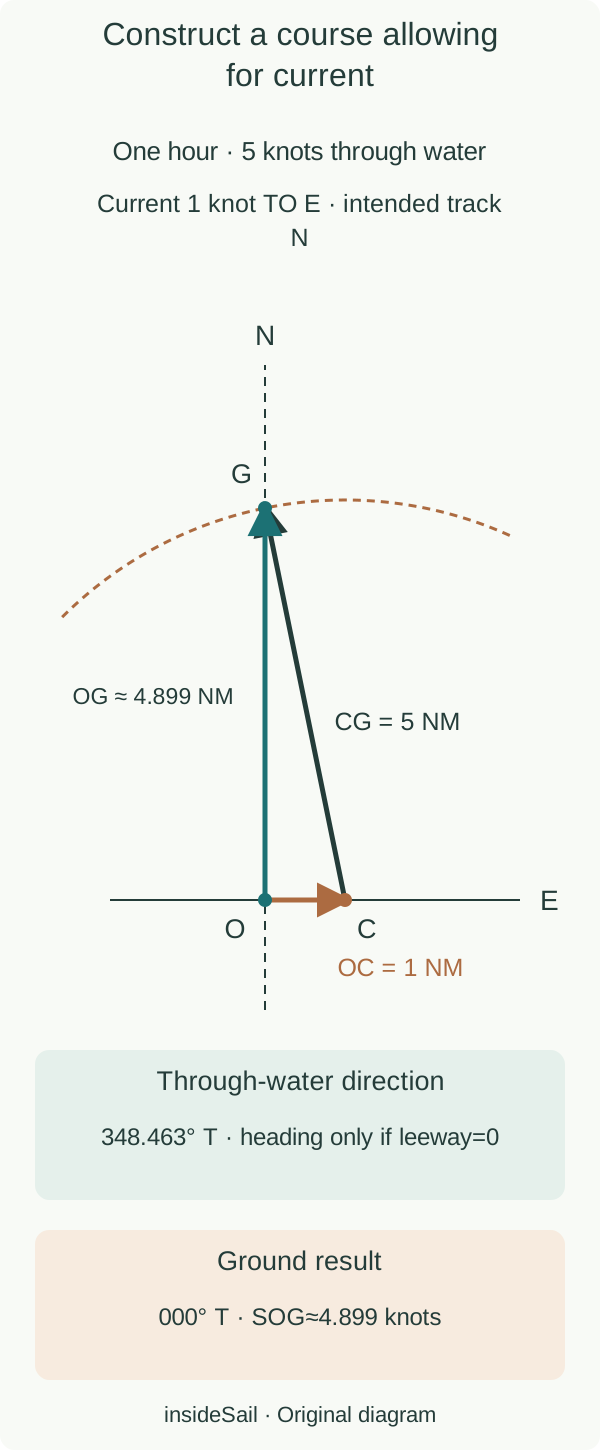
We construct that solution on an abstract plane, using through-water speed of 5 knots, a constant 1-knot east-going current and an intended true-north ground track. The inputs are invented rather than a forecast, boat performance claim or harbour approach.
Original fictional constructions for learning. Navigation review pending.
insideSailOriginal insideSail artwork — all rights reservedEnlarge the diagram
1. Fix frame, time and scale
All angles are true; arrows point TO motion. We assume no leeway, so through-water direction equals heading in this model.
Choose one hour as the construction interval: 5 knots represents 5 miles of displacement and 1 knot represents 1 mile. A single scale, such as 40 mm per mile, applies to every line.
A half-hour current displacement must not be mixed with a one-hour vessel displacement.
2. Find the triangle without assuming ground speed
From O, draw the intended north-going track line. Draw O→C eastwards, one mile long, for the current.
Centre an arc on C with a radius of five miles: this radius represents the vessel’s through-water displacement. Its intersection G with the northern part of the intended line closes the triangle.
C→G supplies through-water direction and length; O→G supplies ground movement. The graphical check is O→C + C→G = O→G.
The relationship in numbers
v water/ground + v boat/water = v boat/ground
Vectors in knots; a one-hour construction gives the same numerical lengths in miles.
The angle points slightly west, opposing the sideways current component. We compensate a lateral component rather than subtracting “one knot” from a direction.
SOG was not fixed at 5: it emerged from the construction. First drawing a five-unit ground vector and subtracting current would solve another problem that also prescribed ground speed.
It would require √26≈5.099 knots through water, contradicting our initial input.
3. Interpret the solution and assumptions
For an abstract six-mile north-going segment, ideal duration is 6/4.899≈1.225 hours, about 73.5 minutes. The arc also crosses the line to the south; reject that intersection because intended motion is northwards.
If sideways current exceeded the available 5 knots, this model would have no intersection. An algebraic solution and a direction actually attainable under sail are different questions: point of sail, available speed and leeway need further context.
Actual current can change over a leg and assumed speed may not persist. The 348.5° result cannot be transferred to a voyage.
The construction teaches the distinction between direct and inverse problems while exposing inputs requiring validation. Subsequent conversion to magnetic or compass reference changes angular origin but cannot repair an inappropriate current assumption.
- The radius represents through-water speed, not SOG.
- Use one interval and one scale.
- Check the sum and choose the intersection in the intended direction.
Sources and references
- Boat Crew Handbook — Navigation and Piloting, BCH16114.3 ↗
United States Coast Guard · Chapter 3 G.9–G.10, pp.3-138–3-140; F.11, pp.3-117–3-122.
DR/EP and distance–speed–time terminology only; current-circle construction is independently derived and numerically checked.
Checked on
Keep discovering
The next piece of the puzzle
Discuss this concept
Loading the conversation…