By insideSail
Published without technical review · version 2 ·
Humidity, dew point and atmospheric stability
Separate cooling, condensation and the tendency to continue rising.
In this guide
Why can one cloud layer remain low and extensive while another grows like a tower? Humidity and vertical movement are parts of the answer rather than interchangeable concepts.
We begin with dew point, then compare a parcel with its surroundings. Calculations and profiles are teaching examples without a location or forecast.
They explain mechanisms mentioned in lessons on fronts, clouds and breezes instead of merely memorising that “warm air rises”.
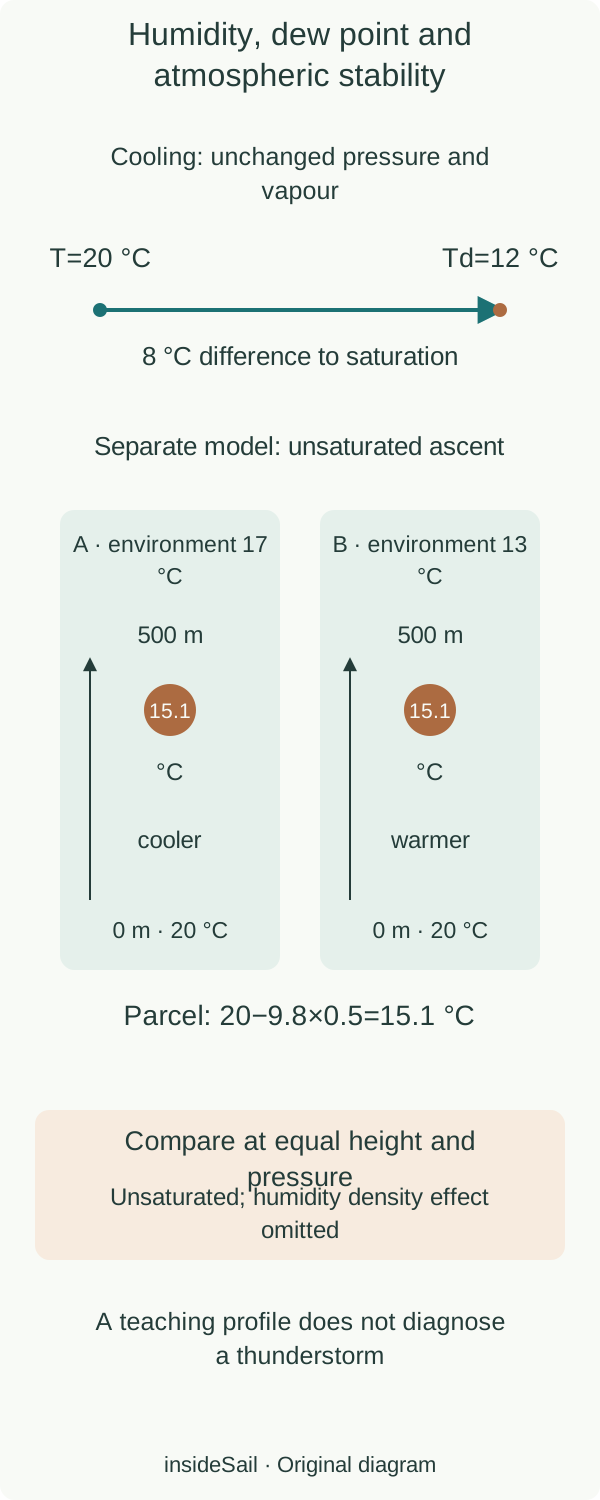
Original schematic. Fictional examples; symbolic visual identification without an operating forecast.
insideSailOriginal insideSail artwork — all rights reservedEnlarge the diagram
Dew point is not current temperature
Dew point is the temperature to which air would need to cool at unchanged pressure and water-vapour content to reach saturation with respect to water. Air at 20 °C with a dew point of 12 °C does not contain water in half its volume.
Their 8 °C difference describes cooling to saturation under the stated conditions. Mixing, evaporation or pressure change can alter dew point itself.
Relative humidity compares water-vapour partial pressure with saturation pressure at the temperature considered. It is neither a mass of water per cubic metre nor a rain forecast.
Cooling reduces the saturation reference, so relative humidity can increase without adding vapour. Condensation makes tiny droplets visible while vapour remains invisible.
Nuclei and growth processes also participate in cloud formation.
A lifted parcel cools through expansion
In an adiabatic approximation the parcel exchanges no heat with its surroundings. Rising into lower pressure makes it expand and cool.
An unsaturated parcel’s dry adiabatic lapse rate is approximately 9.8 °C per kilometre. That is not the obligatory temperature profile of the observed atmosphere.
Once condensation occurs, released latent heat modifies cooling; the saturated rate depends on conditions rather than a universally fixed replacement number.
The relationship in numbers
Tparcel = T0 − 9.8 × Δz
T in °C; Δz in km; unsaturated approximation without mixing or heat exchange.
Stability compares temperatures at the same height
Assume two fictional atmospheres at 20 °C near the surface and parcels remaining unsaturated to 500 m. Calculated parcel temperature there is 20−9.8×0.5=15.1 °C.
Environment A is 17 °C at 500 m, making the parcel cooler. Environment B is 13 °C, making it warmer.
Comparing at equal pressure and neglecting humidity differences, the first tends to be denser than its surroundings and the second less dense.
In A, buoyancy tends to oppose continued ascent; in B it favours ascent within this layer. External forcing can still lift air through a stable layer.
The comparison is specific to the profile and assumptions rather than a complete thunderstorm diagnosis. Moisture, mixing, condensation, other levels and lifting alter the actual situation.
An inversion, where environmental temperature increases with height, is another structure that can inhibit vertical movement.
Dew point, relative humidity and stability answer three questions: proximity to saturation, relation to a thermal reference and response to vertical displacement. None alone guarantees fog, rain or clear skies.
Distinguishing them explains why a cloud requires processes, while a voyage decision requires additional products and context.
- Relative humidity can change without added vapour.
- Parcel lapse rate and environmental profile differ.
- Compare parcel and surroundings at equal height before discussing stability.
Sources and references
- Basic Weather Education — Dewpoint Temperature ↗
NOAA National Weather Service · Basic Properties, Dewpoint Temperature; temperature and vertical profile paragraphs.
Fixed-pressure, unchanged-water-vapour definition only; no source numerical conversions adopted.
Checked on - Clouds — National Meteorological Library factsheet 1 ↗
Met Office · 2023 file; PDF pp.4–7: condensation, ascent, nuclei and lifting mechanisms.
Physical explanation only; no photographs, protected drawings or simplified fixed moist lapse rate adopted.
Checked on - JetStream — Parcel Theory ↗
NOAA · Parcel assumptions; unsaturated lapse rate; latent heat; buoyancy comparison.
Physical model read; no source figures, forecasting indices or storm thresholds reproduced.
Checked on - National Weather Service glossary — adiabatic ↗
NOAA National Weather Service · Adiabatic Process; Adiabatic Lapse Rate; Moist Adiabatic Lapse Rate.
Unsaturated approximation 9.8 °C/km; moist rate expressly not constant.
Checked on
Keep discovering
The next piece of the puzzle
Discuss this concept
Loading the conversation…