By insideSail
Published without technical review · version 3 ·
Incomplete recognition: what an observation has not resolved
One colour, silhouette or white light can leave several hypotheses open.
In this guide
Seeing part of a mark is not the same as identifying it. A white light can belong to several categories; a silhouette can hide colour; a topmark may be unresolved.
The useful approach is to organise observations by attribute: what is known, what is missing and which information would distinguish hypotheses. An incomplete description then remains useful instead of becoming an invented certainty.
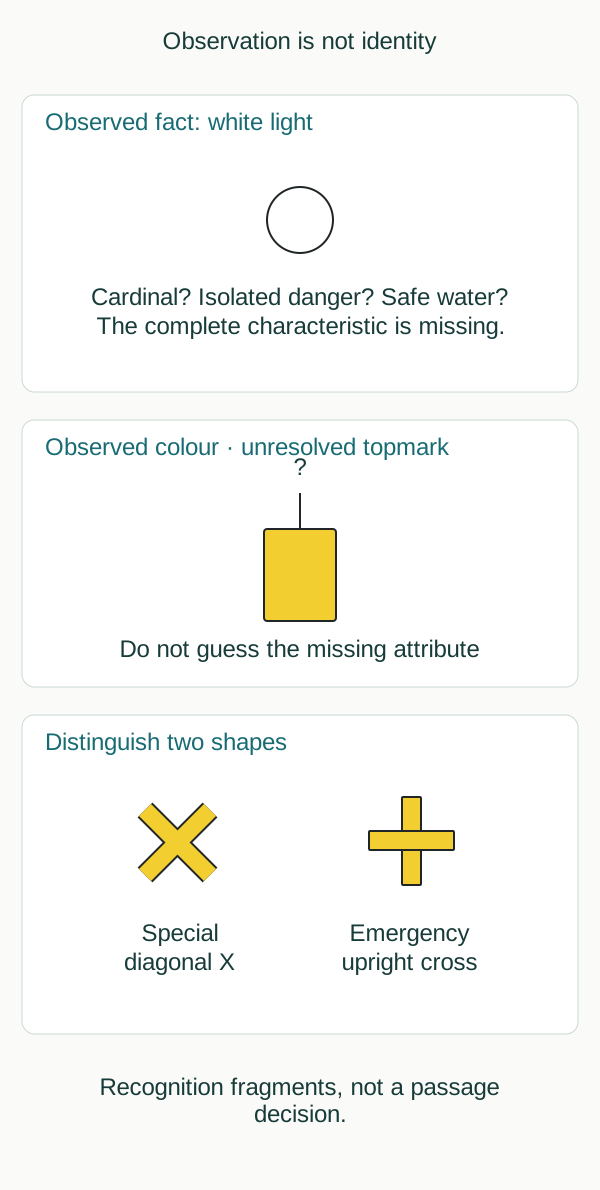
Original conceptual schematic, not to scale; fictional cases, not a manoeuvre procedure.
insideSailOriginal insideSail artwork — all rights reservedEnlarge the diagram
An identity combines several pieces
Daytime appearance combines colour, shape and topmark. At night, light colour and characteristic become particularly important.
Identification, published position and authority description help connect those pieces with a particular aid. Not every attribute will be available in every observation: a topmark may be obscured or beyond visual resolution, and some provisions allow it to be absent.
Writing “unresolved” differs from writing “does not exist”.
Worked case: two white flashes
| Information | Supported conclusion | Still unresolved |
|---|---|---|
| White light | Observed colour | Mark category |
| Two illuminated moments | Count within the window | Complete group or fragment |
| No recorded repetition | Period unknown | Interval to the next cycle |
| Topmark unresolved | Observation limitation | Topmark present, absent or obscured |
An isolated-danger mark uses a white two-flash group where fitted, but two observed flashes do not establish that characteristic by themselves. They may be part of a longer sequence.
A cardinal also uses white, organised as Q or VQ; a safe-water mark uses other white characteristics. The useful question is “did we observe a complete cycle from one identified source?”
before choosing a category name.
- Transcribe the observation without adding missing attributes.
- List hypotheses compatible with the fragment without inventing probabilities.
- Identify distinguishing information: a complete cycle, topmark, body bands and documentary correspondence.
- When new evidence becomes available, add its origin and date. Retain the initial observation as partial.
Worked case: yellow alone is insufficient
Another fictional note reads “yellow body; topmark unresolved”. A special mark is a hypothesis, but its local purpose remains unknown.
Later adding a yellow X and a documented characteristic gives the identification more support. Its function may concern a recreational area, an installation or another published use; colour does not select between those purposes.
Understanding the purpose requires linking the mark with local information.
A special mark’s yellow X differs from the upright yellow cross of an emergency wreck-marking buoy. The latter adds vertical blue/yellow stripes and alternating blue/yellow light.
Calling both simply a “cross” loses the distinguishing orientation. Describe what the image shows: X, upright cross or orientation unresolved.
A mirrored or heavily stylised drawing can make silhouette-only identification insufficient.
Common confusions and key points
- Confidence can differ by attribute: clear colour, unknown period.
- Conical shape alone establishes neither region nor conventional direction.
- A short illuminated interval does not prove a fixed light; a short dark interval does not prove failure.
- Mark identity, local purpose and suitability of a passage are different questions.
The outcome is a better description rather than a more confident guess. Record resolved attributes and gaps separately.
The light-cycle lesson explains repetition; the position-and-fault lesson connects observations with official records and displays. In real use, current charts and the competent authority provide the context absent from these fragments.
Later information may confirm colour while correcting the proposed name. Separate fields allow that correction without erasing a valid observation.
This is how a record improves over time.
Sources and references
- RBMN — artigo 14: Boias de assinalamento de emergência ↗
Diário da República · RBMN annex Article 14; printed p.1981, PDF p.4.
Annex RBMN Article 14, published text 24 June 2016. Commencement follows Portaria Article5; later national interpretation/updates and local directions require qualified checking. Not treated as automatic adoption of IALA2023.
Checked on - IALA R1001 — Special marks and Mobile AtoN, exact edition context ↗
IALA · Sections 2.5.1–2.5.2.6; PDF p.18 onwards; edition 2.0 June 2023.
IALA recommendation, edition 2.0 June 2023, 2.5.1–2.5.2.6. Consulted edition does not establish individual national effective dates. Publication and jurisdiction require qualified review.
Checked on - IALA R1001 — Light rhythm identities and abbreviations ↗
IALA · Sections 2.2.2, 2.2.4, 2.4.2.2, 2.6.2.1, 4 (definitions) and 5 (abbreviations); PDF p.13 onwards and p.29; edition 2.0 June 2023.
IALA recommendation, edition 2.0 June 2023, 2.2.2, 2.2.4, 2.4.2.2, 2.6.2.1 and 4. Consulted edition does not establish individual national effective dates. Publication and jurisdiction require qualified review.
Checked on - IALA R1001 — Cardinal quadrants, topmarks, colours and light rhythms ↗
IALA · Sections 2.2.1–2.2.4; PDF p.12 onwards; edition 2.0 June 2023.
IALA recommendation, edition 2.0 June 2023, 2.2.1–2.2.4. Consulted edition does not establish individual national effective dates. Publication and jurisdiction require qualified review.
Checked on - RBMN — artigo 3: Método de caracterização das marcas ↗
Diário da República · RBMN annex Article 3; printed p.1979, PDF p.2.
Annex RBMN Article 3, published text 24 June 2016. Commencement follows Portaria Article5; later national interpretation/updates and local directions require qualified checking. Not treated as automatic adoption of IALA2023.
Checked on - IALA R1001 — Emergency wreck identity and other new-danger marking ↗
IALA · Sections 2.6.1–2.6.2 and 3.2.2; PDF p.20 onwards; edition 2.0 June 2023.
IALA recommendation, edition 2.0 June 2023, 2.6.1–2.6.2 and 3.2.2. Consulted edition does not establish individual national effective dates. Publication and jurisdiction require qualified review.
Checked on - IALA R1001 — Isolated danger and limits of inference about passing distance ↗
IALA · Sections 2.3.1–2.3.2; PDF p.15 onwards; edition 2.0 June 2023.
IALA recommendation, edition 2.0 June 2023, 2.3.1–2.3.2. Consulted edition does not establish individual national effective dates. Publication and jurisdiction require qualified review.
Checked on - IALA R1001 — Safe water identity, uses and light alternatives ↗
IALA · Sections 2.4.1–2.4.2; PDF p.17 onwards; edition 2.0 June 2023.
IALA recommendation, edition 2.0 June 2023, 2.4.1–2.4.2. Consulted edition does not establish individual national effective dates. Publication and jurisdiction require qualified review.
Checked on - RBMN — artigo 8: Quadrantes das marcas cardeais ↗
Diário da República · RBMN annex Article 10; printed p.1980, PDF p.3. RBMN annex Article 11; printed p.1980, PDF p.3. RBMN annex Article 12; printed p.1980, PDF p.3. RBMN annex Article 13; printed pp.1980–1981, PDF pp.3–4.
Annex RBMN Article 10, published text 24 June 2016. Commencement follows Portaria Article5; later national interpretation/updates and local directions require qualified checking. Not treated as automatic adoption of IALA2023. Annex RBMN Article 11, published text 24 June 2016. Commencement follows Portaria Article5; later national interpretation/updates and local directions require qualified checking. Not treated as automatic adoption of IALA2023. Annex RBMN Article 12, published text 24 June 2016. Commencement follows Portaria Article5; later national interpretation/updates and local directions require qualified checking. Not treated as automatic adoption of IALA2023. Annex RBMN Article 13, published text 24 June 2016. Commencement follows Portaria Article5; later national interpretation/updates and local directions require qualified checking. Not treated as automatic adoption of IALA2023.
Checked on
Regulatory references
- RBMN artigo 10 — Descrição das marcas cardeais ↗
Portaria 177/2016, original published annex · Defesa Nacional e Mar; technical direction Direção de Faróis / DGAM · Portugal
Verified on - RBMN artigo 3 — Método de caracterização das marcas ↗
Portaria 177/2016, original published annex · Defesa Nacional e Mar; technical direction Direção de Faróis / DGAM · Portugal
Verified on - RBMN artigo 13 — Marcas especiais ↗
Portaria 177/2016, original published annex · Defesa Nacional e Mar; technical direction Direção de Faróis / DGAM · Portugal
Verified on - Emergency wreck identity and other new-danger marking ↗
IALA R1001 edition 2.0 June 2023 · IALA · International recommendation; competent-authority implementation
Verified on - Safe water identity, uses and light alternatives ↗
IALA R1001 edition 2.0 June 2023 · IALA · International recommendation; competent-authority implementation
Verified on - Cardinal quadrants, topmarks, colours and light rhythms ↗
IALA R1001 edition 2.0 June 2023 · IALA · International recommendation; competent-authority implementation
Verified on - RBMN artigo 11 — Marcas de perigo isolado ↗
Portaria 177/2016, original published annex · Defesa Nacional e Mar; technical direction Direção de Faróis / DGAM · Portugal
Verified on - Isolated danger and limits of inference about passing distance ↗
IALA R1001 edition 2.0 June 2023 · IALA · International recommendation; competent-authority implementation
Verified on - RBMN artigo 14 — Boias de assinalamento de emergência ↗
Portaria 177/2016, original published annex · Defesa Nacional e Mar; technical direction Direção de Faróis / DGAM · Portugal
Verified on - RBMN artigo 12 — Marcas de águas limpas ↗
Portaria 177/2016, original published annex · Defesa Nacional e Mar; technical direction Direção de Faróis / DGAM · Portugal
Verified on - Special marks and Mobile AtoN, exact edition context ↗
IALA R1001 edition 2.0 June 2023 · IALA · International recommendation; competent-authority implementation
Verified on - Light rhythm identities and abbreviations ↗
IALA R1001 edition 2.0 June 2023 · IALA · International recommendation; competent-authority implementation
Verified on
Keep discovering
The next piece of the puzzle
Discuss this concept
Loading the conversation…