By insideSail
Published without technical review · version 3 ·
Junctions: which side is the preferred channel on?
The branch name and the mark’s lateral role do not name the same side.
In this guide
At a junction, a modified lateral mark can indicate the preferred channel. “Preferred to starboard” names the branch on that side relative to conventional direction; the mark then occupies the port side of that channel.
The apparent contradiction disappears when the junction is drawn and the branch name is separated from the mark’s lateral role.
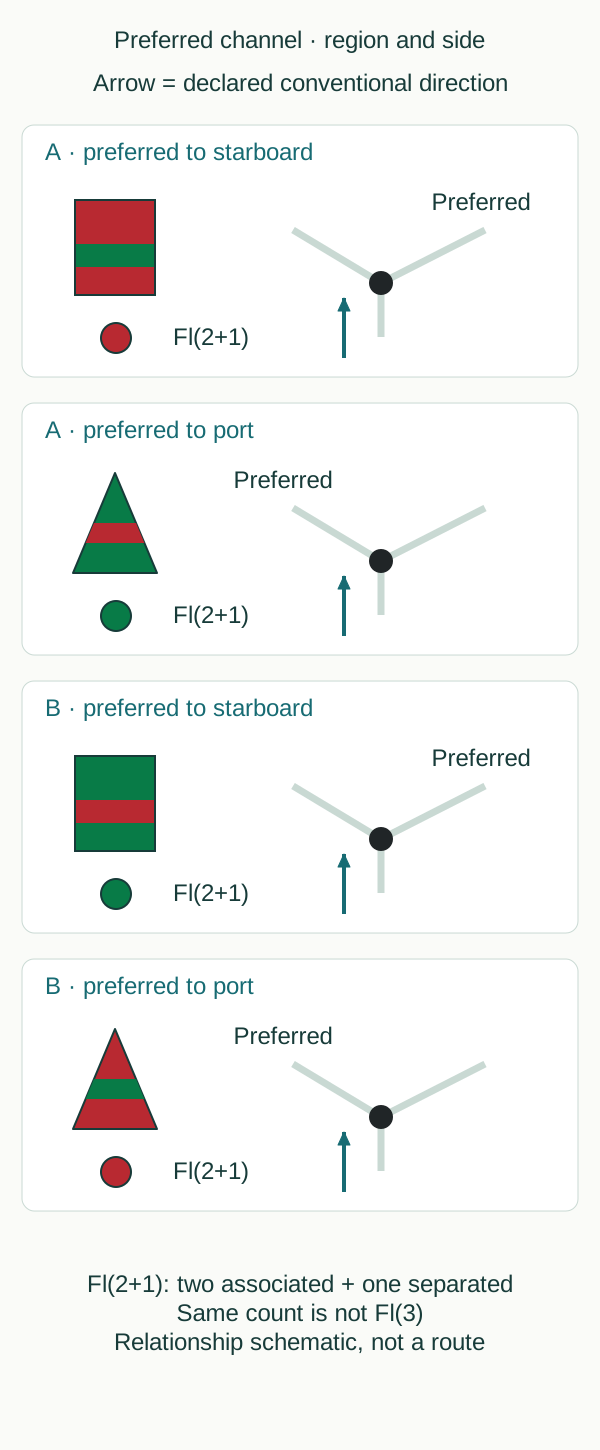
Original interpretation schematic with declared functions and references. No scale, approved installation or operational track.
insideSailOriginal insideSail artwork — all rights reservedEnlarge the diagram
The channel has a side; the mark has a role
Imagine conventional direction pointing up with a junction ahead. The preferred channel branches right of the mark.
Relative to the reference, right is starboard; for the preferred channel the mark lies on its port side. If the preferred branch goes left, the mark has the starboard-side role.
Classification remains tied to the conventional arrow even if a boat faces down in the figure.
The modified mark retains its predominant lateral identity and adds a broad horizontal band of the other colour. Where fitted, its light follows the predominant colour and shows Fl(2+1).
Region, preferred branch, predominant colour, band, shape or topmark and light therefore need to be read together. The band neither changes light colour nor turns a port mark into a starboard mark.
| Region | Preferred channel | Lateral role | Predominant / band colour | Shape or topmark / light |
|---|---|---|---|---|
| A | To starboard | Port | Red / green | Can / red Fl(2+1) |
| A | To port | Starboard | Green / red | Upward cone / green Fl(2+1) |
| B | To starboard | Port | Green / red | Can / green Fl(2+1) |
| B | To port | Starboard | Red / green | Upward cone / red Fl(2+1) |
Worked case: red with a green band
- Predominant red in A identifies the port-side role.
- The green band and composite light group identify a modified lateral rather than a simple lateral.
- The mark has the preferred channel’s port role; therefore the preferred branch is to starboard of the mark relative to the reference.
- An oppositely oriented boat may see the mark on the other side aboard; this renames neither preferred channel nor mark.
Why Fl(2+1) is more than Fl(3)
Both notations can involve three flashes in total but organise them differently. Fl(2+1) combines an associated pair with a separated single within the cycle; Fl(3) is a three-flash group.
The figure’s strip shows component separation without fixing seconds between flashes. This category assigns no single period to every junction: consult the actual published characteristic.
Counting events and understanding grouping are different tasks.
Common confusions
- Preferred to starboard names the branch; the mark has that branch’s port role.
- Band colour does not determine light colour.
- A/B colours change; can/conical roles remain.
- Preferred does not grant priority between vessels or guarantee suitability for draught.
The system’s preference does not select your destination: the secondary branch may be the intended one, while the preferred channel may have important limits for the individual boat. Current charts, conditions and local restrictions complete that decision.
To recall identity, draw the branch first, determine which side the mark occupies, then apply the regional combination of colour, band, shape and light. Opposite headings helps keep the reference stable.
In the equivalent B example, red and green change, including the light. Preferred to starboard and the can’s port role remain: region changes the visual combination rather than branch geometry.
Sources and references
- IALA R1001 — Regions, conventional direction and lateral identification ↗
IALA · Sections 2.1.1–2.1.5; PDF p.9 onwards; edition 2.0 June 2023.
IALA recommendation, edition 2.0 June 2023, 2.1.1–2.1.5. Consulted edition does not establish individual national effective dates. Publication and jurisdiction require qualified review.
Checked on - IALA R1001 — Lateral marks and preferred channels, Regions A and B ↗
IALA · Sections 2.1.3–2.1.5; PDF p.10 onwards; edition 2.0 June 2023.
IALA recommendation, edition 2.0 June 2023, 2.1.3–2.1.5. Consulted edition does not establish individual national effective dates. Publication and jurisdiction require qualified review.
Checked on - RBMN — artigo 3: Método de caracterização das marcas ↗
Diário da República · RBMN annex Article 4; printed p.1979, PDF p.2. RBMN annex Article 5; printed p.1979, PDF p.2. RBMN annex Article 6; printed p.1979, PDF p.2. RBMN annex Article 7; printed p.1979, PDF p.2.
Annex RBMN Article 4, published text 24 June 2016. Commencement follows Portaria Article5; later national interpretation/updates and local directions require qualified checking. Not treated as automatic adoption of IALA2023. Annex RBMN Article 5, published text 24 June 2016. Commencement follows Portaria Article5; later national interpretation/updates and local directions require qualified checking. Not treated as automatic adoption of IALA2023. Annex RBMN Article 6, published text 24 June 2016. Commencement follows Portaria Article5; later national interpretation/updates and local directions require qualified checking. Not treated as automatic adoption of IALA2023. Annex RBMN Article 7, published text 24 June 2016. Commencement follows Portaria Article5; later national interpretation/updates and local directions require qualified checking. Not treated as automatic adoption of IALA2023.
Checked on - Regulations for International (INT) Charts and Chart Specifications of the IHO — S-4 ↗
International Hydrographic Organization · B-460–B-466 buoy characteristics; B-471 light descriptions; B-475.1–B-475.6 sectors and leading lights; PDF pp.306–331 and 336–339.
Official 452-page PDF directly consulted; edition verified against current IHO catalogue. Original educational fragments rather than reproduced INT1 symbol plates. Paper chart conventions are not universal electronic display behaviour.
Checked on
Regulatory references
- Regions, conventional direction and lateral identification ↗
IALA R1001 edition 2.0 June 2023 · IALA · International recommendation; competent-authority implementation
Verified on - S-4 B-460–466 / B-470–475 — buoy and light charting specifications ↗
IHO S-4 edition 4.10.0 March 2026 · International Hydrographic Organization · International chart-production specification; not a local pilotage rule
Verified on - RBMN artigo 4 — Sentido convencional de balizagem ↗
Portaria 177/2016, original published annex · Defesa Nacional e Mar; technical direction Direção de Faróis / DGAM · Portugal
Verified on - Lateral marks and preferred channels, Regions A and B ↗
IALA R1001 edition 2.0 June 2023 · IALA · International recommendation; competent-authority implementation
Verified on - RBMN artigo 6 — Regras gerais das marcas laterais ↗
Portaria 177/2016, original published annex · Defesa Nacional e Mar; technical direction Direção de Faróis / DGAM · Portugal
Verified on - RBMN artigo 7 — Marcas laterais — região A ↗
Portaria 177/2016, original published annex · Defesa Nacional e Mar; technical direction Direção de Faróis / DGAM · Portugal
Verified on - RBMN artigo 5 — Regiões de balizagem ↗
Portaria 177/2016, original published annex · Defesa Nacional e Mar; technical direction Direção de Faróis / DGAM · Portugal
Verified on
Keep discovering
The next piece of the puzzle
Discuss this concept
Loading the conversation…