By insideSail
Published without technical review · version 2 ·
Monohull, catamaran and trimaran: count hulls and read the whole boat
A plan separates hull bodies from connections, appendages and living spaces.
In this guide
A sailboat need not have only one hull. Monohull, catamaran and trimaran describe different physical arrangements: one main body, two hulls, or a central hull accompanied by two side hulls.
Multihull is the broader family including the latter two arrangements. Our fictional top views point their bows upwards.
They are neither dimensioned plans nor commercial models or speed comparisons. Begin by identifying what is counted, then turn the arrangement into concrete questions about using the boat.
Hull count is useful vocabulary rather than a verdict on the design.
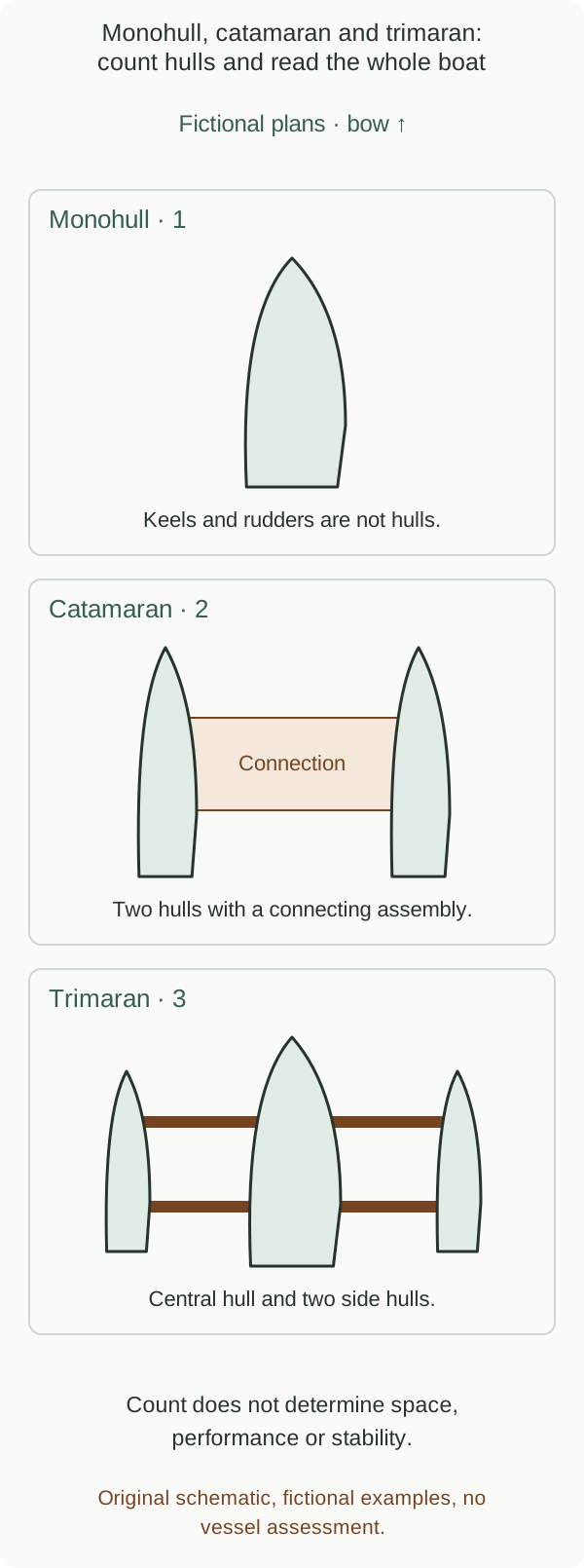
Original schematic, fictional examples, no vessel assessment.
insideSailOriginal insideSail artwork — all rights reservedEnlarge the diagram
Count hulls rather than keels or berths
In the first panel we follow one longitudinal hull outline. Two keels or two rudders beneath it do not turn that monohull into a catamaran.
The second has two hull outlines, joined by the assembly connecting both sides. Wärtsilä’s introductory definition identifies two hulls with a deck structure between them.
The third separates a central hull from two side hulls, often called floats or outriggers in this context. Drawn connections reveal their relationship without specifying structural dimensions.
The distinction concerns hull bodies, independently of how many people can sleep aboard.
A platform is not another hull
The area between hulls may include deck, nets or enclosed spaces according to the design. Do not count an upper covering as another hull or assume that every area in the plan is usable interior floor.
Height, access and what lies beneath that surface require other views. As an attributed example, NEEL describes a living platform relating the side hulls and cockpit, with systems in the central hull.
That arrangement does not define every trimaran. It demonstrates why counting hulls does not independently provide an accommodation plan or identify every space through which a person can move.
Overall beam and one hull’s width are different dimensions
Beam can also depend on configuration. Dragonfly documents a system allowing the floats of particular trimarans to fold in.
Open and folded beam are therefore distinct fields associated with an identified version and state. We supply neither operating instructions nor an assumption that every multihull has that capability.
When researching a berth, ask which actual dimensions are accepted and which configuration is documented. This lesson determines no clearance, price or operating permission.
A changing dimension remains part of the physical specification, rather than a reason to select the smallest available number without its conditions.
Compare trade-offs by asking the same question
For a family, a plan may reveal separate spaces and social areas, together with routes between them. Locate sleeping areas, level changes, storage and system access.
A broad exterior area may matter to one routine while another person values a shorter internal route. Compare those documented attributes instead of declaring that two hulls are always more habitable.
Connections in our drawing establish relationships between bodies without measuring access, comfort or maintenance complexity. A useful comparison retains the same question across all three families so that a different arrangement receives a fair reading.
Underwater shape, displacement, sail area and mass distribution add information absent from hull count. ORC distinguishes these elements in its measurement explanation.
We do not automatically apply empirical indices presented for comparable monohulls to a multihull, or turn a single hull into a guarantee of recovery. Stability and behaviour require documentation and analysis appropriate to the design and condition.
Moving from the atlas to a real model, retain hull family, dimensions, configuration and source as separate fields. Ask what the documented assembly offers your intended use, with uncertainty visible where the evidence ends.
Sources and references
- Innovation — trimaran accommodation arrangement ↗
NEEL Trimarans · A new aesthetic in naval architecture: connecting two side hulls with a living platform; separate central-hull systems description.
Official text directly read. This is an attributed arrangement example, not a statement that all trimarans have this interior or the advertised comfort/safety. No photograph, floorplan or protected wording reused.
Checked on - Dragonfly Swing Wing System — configuration-dependent beam ↗
Quorning Boats / Dragonfly · Opening system description and following paragraph on folded marina configuration.
Official text directly read. Used only to document that some trimarans have a system changing their beam. No folding procedure, percentages, times, stability promise, berthing clearance or product recommendation imported.
Checked on - Catamaran — hull and connecting deck identity ↗
Wärtsilä · Encyclopedia of Marine and Energy Technology; first sentence of the Catamaran entry, directly read 11 October 2026.
Only the two-hull/connecting-deck identity is used. Subsequent resistance/performance claims, merchant-vessel implications and artwork are not adopted.
Checked on - Measurements — complete geometry and separate hull families ↗
Offshore Racing Congress · Introductory paragraphs: hull shape, appendages, propeller, stability, rig and sails as distinct measured information; monohull/multihull applicability.
Official explanatory text directly read. Supports retaining geometry and configuration rather than replacing them with hull count. No rating procedure, eligibility or certification is supplied.
Checked on
Keep discovering
The next piece of the puzzle
This lesson in other manuals
Discuss this concept
Loading the conversation…