By insideSail
Automated technical check · version 2 ·
Motion over intervals: average direction is not distance travelled
Add displacements before averaging; retain duration and reference frame.
In this guide
Two speed values can be correct while appearing contradictory: one describes an instant, the other summarises an interval. A boat may turn, accelerate or return to its starting point during that interval.
Understanding a motion summary requires knowing what was added and what was divided by time. This lesson explores that distinction on fictional grids after separating heading, course over ground and speed over ground.
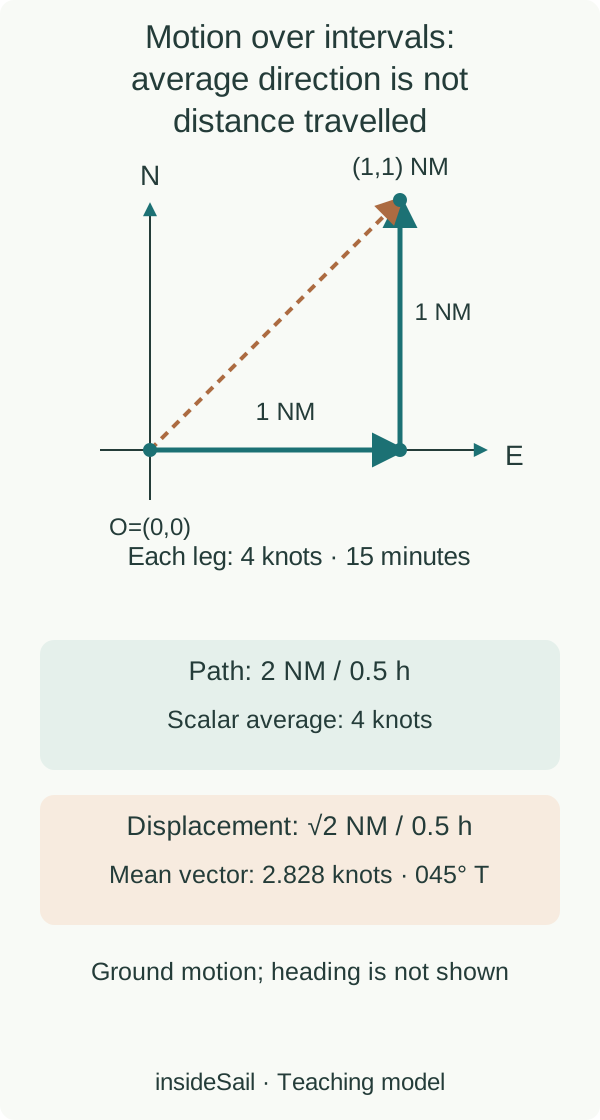
Original schematic; fictional examples and explicit assumptions. Does not represent actual navigation.
insideSailOriginal insideSail artwork — all rights reservedEnlarge the diagram
Displacement versus path length
Displacement is the vector from start to finish. Path length adds distances along the segments actually described by the model.
Average vector velocity divides total displacement by duration; average scalar speed divides path length by the same duration. If direction changes, the magnitude of the former may be smaller than the latter.
That follows from geometry rather than a mysterious loss of distance.
The relationship in numbers
v̄ = (Σ displacements) / total duration
Displacements in NM; duration in h; mean vector in knots.
The 045° direction summarises the connection between endpoints. It does not say the heading was 045° or that the boat travelled diagonally.
The example declares motion relative to the ground, so no current is added afterwards. Through-water values would describe another problem with another frame.
Heading and leeway are separate quantities rather than automatic deductions from two positions.
Time weighting
A simple average of segment speeds is unsuitable when durations differ. In another model, 6 knots east for 10 minutes produces 1 NM; 3 knots north for 20 minutes also produces 1 NM.
The half-hour vector average is again (2,2) knots and scalar average speed remains 4 knots. Simply averaging the two magnitudes gives 4.5 knots, which does not describe this interval because it gives equal weight to unequal durations.
Angles also cross a circular boundary. Directions 359° and 001° are close to north, despite their arithmetic number average being 180°.
For vectors of equal magnitude and equal duration, east components cancel while north components add; the resultant points towards 000°. Different weights or magnitudes can change that direction.
Adding components avoids treating a circle as a ruler of isolated numbers.
Spaced position samples do not show every curve between them. Dividing straight endpoint distance by time gives the magnitude of that interval’s average vector velocity, not its full observed path.
An instrument indication may use filtering and a different time window. These examples explain motion statistics without choosing an observation interval or a steering technique at sea.
- State interval and frame.
- Vector average uses displacement; scalar average uses path length.
- A zero resultant has no defined course.
Sources and references
- Scalars and Vectors ↗
NASA Glenn Research Center · Vector magnitude/direction, component operations and speed as scalar magnitude. Page states last updated 7 May 2021.
Directly consulted. No aircraft forces or protected diagrams transferred; original examples use a local plane.
Checked on - Displacement, Velocity, Acceleration ↗
NASA Glenn Research Center · Average velocity = displacement / time; average versus instantaneous velocity. Page states last updated 13 May 2021.
Directly consulted for enduring kinematics; original nautical examples. Update date is not entered as a publication date.
Checked on
Keep discovering
The next piece of the puzzle
Discuss this concept
Loading the conversation…