By insideSail
AI-assisted editorial review · version 3 ·
Sail against sail: three conditions in Rule 12
Wind side, relative position and an expressly defined uncertainty have different roles.
In this guide
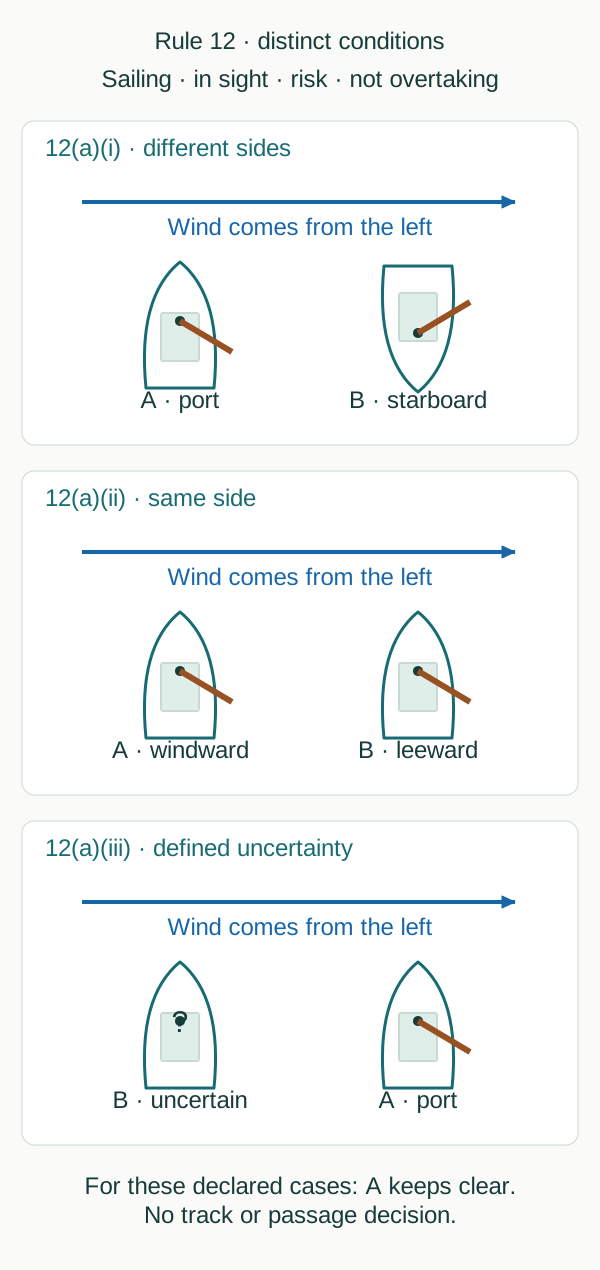
Original conceptual schematic, not to scale; fictional cases, not a manoeuvre procedure.
insideSailOriginal insideSail artwork — all rights reservedEnlarge the diagram
First establish the encounter
Rule 12 concerns two sailing vessels approaching with risk of collision. That is more specific than saying that two boats have sails set.
The definition in Rule 3 requires any fitted propelling machinery not to be used. A yacht being propelled by its engine does not enter this encounter as a sailing vessel merely because its sails remain raised.
Appearance alone may not disclose that operating status.
These provisions sit within the section for vessels in sight of one another. Before choosing between the three cases, an overtaking encounter must also be recognised: Rule 13 overrides the allocation in Rule 12.
A narrow-channel encounter may involve obligations that do not disappear when a vessel is sailing. Correct reading starts with scope rather than memorising a preference between two pictures.
Wind on different sides
In the first case the vessels have the wind on different sides. The vessel with wind on her port side must keep out of the other’s way.
Port and starboard belong to the boat, not the observer: a mirrored photograph or a view from ahead can mislead. For this rule, paragraph 12(b) determines the windward side as opposite the side carrying the mainsail, with a specific provision for square-rigged vessels.
Wind on the same side
When both have wind on the same side, the windward vessel must keep out of the leeward vessel’s way. Windward identifies the side from which the wind comes; leeward identifies the side towards which it travels.
Identifying each boom is no longer sufficient: both positions must be related to wind direction. Being nearer the shore, farther right on a screen or slightly ahead does not define the windward vessel.
Consider two identical boat drawings with their mainsails on the same side. Exchanging A and B along the wind direction changes which vessel is windward.
It does not change the side on which either boat has the wind. This exercise separates observations that beginners often merge: wind side on each vessel and the position of one vessel relative to the other.
The defined uncertainty has its own conditions
Rule 12(a)(iii) is not a vague clause resolving every uncertainty. It describes a vessel with wind on her port side seeing another to windward and being unable to determine with certainty which side that other vessel has the wind on.
In that combination the first vessel must keep out of the way. Removing either the port-side condition or the windward position changes the written provision.
Knowing the applicable case identifies an obligation but does not select a safe track. Continuing appraisal of risk, look-out and the quality of action remain covered by Rules 5, 7, 8 and 16.
The vessel maintaining course and speed also has the conditional duties in Rule 17. None of the three panels authorises continuing without observing how the encounter develops.
The figure shows declared static conditions, without distances, speeds or manoeuvres. These cases should be checked against the international normative text and the Portuguese RIEAM; explanatory notes in an edition do not add exceptions to the rule.
Useful reading can state which condition was established, what information remains missing and which rule supports the conclusion, rather than assigning a permanent priority to one boat.
Sources and references
- RIEAM / COLREGs — Rule 9: Narrow channels ↗
Instituto Hidrográfico / International Maritime Organization · Rule 9, normative Portuguese printed p.11 (PDF p.17); International English cross-check in USCG handbook.
Rule 9; IH normative Portuguese printed p.11, PDF p.17; English International column cross-check. Individual provision commencement not established: valid_from remains null.
Checked on - RIEAM / COLREGs — Rule 11: Application of Section II ↗
Instituto Hidrográfico / International Maritime Organization · Rule 11, normative Portuguese printed p.17 (PDF p.23); International English cross-check in USCG handbook. Rule 12, normative Portuguese printed p.17 (PDF p.23); International English cross-check in USCG handbook.
Rule 11; IH normative Portuguese printed p.17, PDF p.23; English International column cross-check. Individual provision commencement not established: valid_from remains null. Rule 12; IH normative Portuguese printed p.17, PDF p.23; English International column cross-check. Individual provision commencement not established: valid_from remains null.
Checked on - RIEAM / COLREGs — Rule 16: Action by give-way vessel ↗
Instituto Hidrográfico / International Maritime Organization · Rule 16, normative Portuguese printed p.22 (PDF p.28); International English cross-check in USCG handbook. Rule 17, normative Portuguese printed p.22 (PDF p.28); International English cross-check in USCG handbook.
Rule 16; IH normative Portuguese printed p.22, PDF p.28; English International column cross-check. Individual provision commencement not established: valid_from remains null. Rule 17; IH normative Portuguese printed p.22, PDF p.28; English International column cross-check. Individual provision commencement not established: valid_from remains null.
Checked on - RIEAM / COLREGs — Rule 13: Overtaking ↗
Instituto Hidrográfico / International Maritime Organization · Rule 13, normative Portuguese printed p.19 (PDF p.25); International English cross-check in USCG handbook.
Rule 13; IH normative Portuguese printed p.19, PDF p.25; English International column cross-check. Individual provision commencement not established: valid_from remains null.
Checked on - Navigation Rules and Regulations Handbook — corrected August 2024 ↗
United States Coast Guard Navigation Center · International column only, Rules 1–38 and Annexes I–IV. The adjacent U.S. Inland column is excluded.
Official PDF directly consulted. International/Inland differences are not European rules. Filename says 08-12-2024; landing page says corrected 8 August 2024: no unsupported exact correction day inferred.
Checked on - RIEAM / COLREGs — Rule 4: Application of Section I ↗
Instituto Hidrográfico / International Maritime Organization · Rule 5, normative Portuguese printed p.7 (PDF p.13); International English cross-check in USCG handbook.
Rule 5; IH normative Portuguese printed p.7, PDF p.13; English International column cross-check. Individual provision commencement not established: valid_from remains null.
Checked on - RIEAM / COLREGs — Rule 2: Responsibility ↗
Instituto Hidrográfico / International Maritime Organization · Rule 3, normative Portuguese printed p.3 (PDF p.9); International English cross-check in USCG handbook.
Rule 3; IH normative Portuguese printed p.3, PDF p.9; English International column cross-check. Individual provision commencement not established: valid_from remains null.
Checked on - RIEAM / COLREGs — Rule 6: Safe speed ↗
Instituto Hidrográfico / International Maritime Organization · Rule 7, normative Portuguese printed p.8 (PDF p.14); International English cross-check in USCG handbook.
Rule 7; IH normative Portuguese printed p.8, PDF p.14; English International column cross-check. Individual provision commencement not established: valid_from remains null.
Checked on - RIEAM / COLREGs — Rule 8: Action to avoid collision ↗
Instituto Hidrográfico / International Maritime Organization · Rule 8, normative Portuguese printed p.9 (PDF p.15); International English cross-check in USCG handbook.
Rule 8; IH normative Portuguese printed p.9, PDF p.15; English International column cross-check. Individual provision commencement not established: valid_from remains null.
Checked on
Regulatory references
- Regra 8 / Rule 8 — Manobras para evitar abalroamentos / Action to avoid collision ↗
COLREG 1972 as amended; IH 9th edition September 2025 / International cross-check August 2024 · International Maritime Organization · International convention; national/local implementation must be checked
Verified on - Regra 9 / Rule 9 — Canais estreitos / Narrow channels ↗
COLREG 1972 as amended; IH 9th edition September 2025 / International cross-check August 2024 · International Maritime Organization · International convention; national/local implementation must be checked
Verified on - Regra 12 / Rule 12 — Navios à vela / Sailing vessels ↗
COLREG 1972 as amended; IH 9th edition September 2025 / International cross-check August 2024 · International Maritime Organization · International convention; national/local implementation must be checked
Verified on - Regra 3 / Rule 3 — Definições gerais / General definitions ↗
COLREG 1972 as amended; IH 9th edition September 2025 / International cross-check August 2024 · International Maritime Organization · International convention; national/local implementation must be checked
Verified on - Regra 16 / Rule 16 — Manobra do navio que deve afastar-se / Action by give-way vessel ↗
COLREG 1972 as amended; IH 9th edition September 2025 / International cross-check August 2024 · International Maritime Organization · International convention; national/local implementation must be checked
Verified on - Regra 5 / Rule 5 — Vigilância / Look-out ↗
COLREG 1972 as amended; IH 9th edition September 2025 / International cross-check August 2024 · International Maritime Organization · International convention; national/local implementation must be checked
Verified on - Regra 17 / Rule 17 — Manobra do navio que tem prioridade / Action by stand-on vessel ↗
COLREG 1972 as amended; IH 9th edition September 2025 / International cross-check August 2024 · International Maritime Organization · International convention; national/local implementation must be checked
Verified on - Regra 11 / Rule 11 — Aplicação da Secção II / Application of Section II ↗
COLREG 1972 as amended; IH 9th edition September 2025 / International cross-check August 2024 · International Maritime Organization · International convention; national/local implementation must be checked
Verified on - Regra 7 / Rule 7 — Risco de abalroamento / Risk of collision ↗
COLREG 1972 as amended; IH 9th edition September 2025 / International cross-check August 2024 · International Maritime Organization · International convention; national/local implementation must be checked
Verified on - Regra 13 / Rule 13 — Ultrapassagem / Overtaking ↗
COLREG 1972 as amended; IH 9th edition September 2025 / International cross-check August 2024 · International Maritime Organization · International convention; national/local implementation must be checked
Verified on
Keep discovering
The next piece of the puzzle
Discuss this concept
Loading the conversation…