By insideSail
Automated technical check · version 2 ·
Sail area: compare the same quantity
Reference triangles, actual sails and configurations explain legitimate differences.
In this guide
Two specifications can report different sail areas without either necessarily being wrong. Before comparing the values, ask what was added together: a geometric approximation, the area of particular sails or a commercial configuration.
Square metres give a clear unit but do not supply a definition. This lesson does not recalculate SA/D.
It examines the input behind that ratio and explains why changing its basis changes the interpretation. A precise total is still an incomplete comparison when the two records describe different quantities.
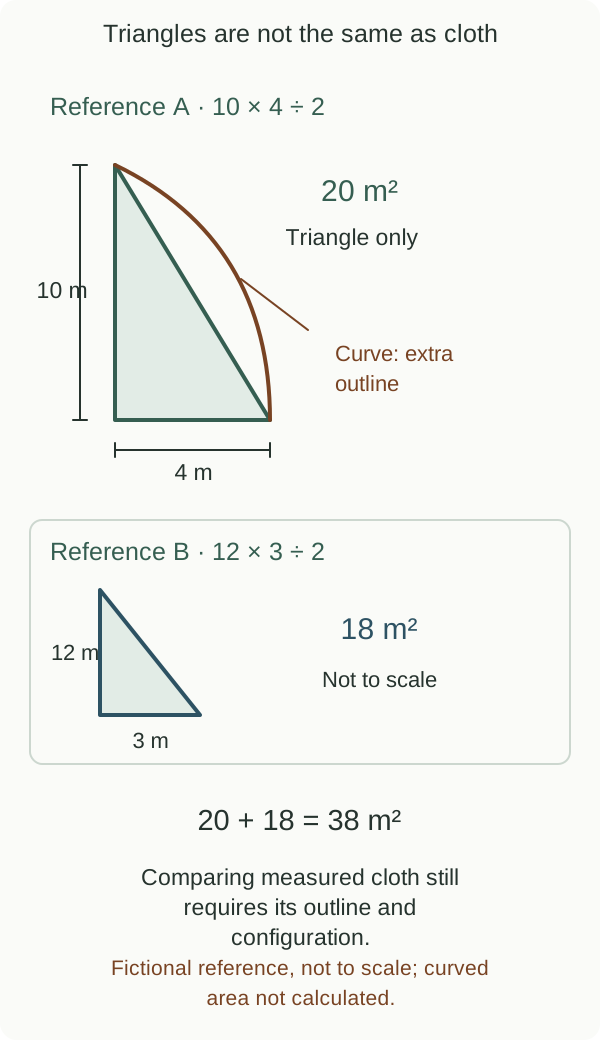
Fictional reference, not to scale; curved area not calculated.
insideSailOriginal insideSail artwork — all rights reservedEnlarge the diagram
A reference triangle is a stated approximation
Imagine an ideal triangle 10 m high and 4 m across its base. Its area is 20 m², half the product.
Add a second triangle 12 m by 3 m and the ideal sum is 38 m². These invented numbers describe no sailboat.
Their purpose is to expose the basis: we added two right triangles rather than measuring cloth with curved edges, top width or cut-outs. That total can be compared directly only with another obtained by the same method.
Keeping the sketch beside the calculation makes the assumption easier to remember.
The relationship in numbers
Ideal triangle area = base × height ÷ 2
m × m = m²; not a complete sail-measurement formula.
Letters need their measurement convention
P and E appear in many specifications associated with mainsail geometry; I and J commonly describe the forward geometry. Do not assume every source uses identical endpoints.
The ORC rig page declares a mast datum and uses IG for foretriangle height, while explaining its P, E and J references. A dimension from that datum is not automatically a height above the water.
Retain the source legend rather than substituting letters by appearance. If a historical drawing lacks its legend, that is missing information, not permission to choose the most convenient interpretation.
Actual cloth is more than the drawn triangle
A leech can extend beyond a simple triangle, and a square-top mainsail does not end at an ideal point. The public ORC explanation includes widths at several heights and top width in measurement; measured and rated area also have distinct definitions.
The useful idea is that two outlines sharing height and base can enclose different areas. The drawing separates the reference triangle from the additional outline.
A genoa adds another common confusion. An overlap percentage generally relates a dimension perpendicular to the luff to J under the relevant convention.
It does not mean the whole sail has that percentage of the area of all sails. Nor does an eased sheet leave exactly half an effective area.
Geometry, measurement and aerodynamic effect are different subjects. For catalogue comparison, identify which headsail is included and how its value is defined.
An inventory total including a downwind sail should not be placed beside an upwind reference total as though they were equivalent.
A useful record preserves value, unit, version, sail combination and method. An undocumented area can remain an unverified declaration without entering a calculation presented as confirmed.
Carry those conditions into SA/D. A mathematically correct ratio can still mislead when its inputs have different bases.
You do not need to master a rating rule to recognise the problem: ask which shapes and sails the number represents before interpreting an advantage. Keeping an unknown field open is often more informative than producing a tidy value by mixing unrelated dimensions.
- The unit does not replace the area definition.
- Approximation, measurement and rating use different bases.
- A sail or option change belongs to its documented configuration.
Sources and references
- Sails — measurement and rated area ↗
Offshore Racing Congress · Mainsail and Mizzen; Headsails: widths, roach, measured versus rated area, HLU/HLP.
Selected sections read in full. No rating-rule sail inventory, protected figure, certificate or numerical area of an actual boat copied.
Checked on - Rig — measurement references ↗
Offshore Racing Congress · Mast datum point and Foretriangle base; Boom: P, E, IG and J references.
Public sections read. ORC IG uses a stated mast datum and is not silently equated with every catalogue I or waterline-to-masthead height.
Checked on - Oceanis 37.1 — variants, layouts and specifications ↗
BENETEAU · Available in 2 versions; Specifications disclaimer; Layout plans, 2 cabins/1 shower room and 3 cabins/2 shower rooms; Water Capacity/Fuel Capacity.
Official live sections read. Only existence of different documented layouts/configurations supports examples; US prices, marketing adjectives and inferred actual usable volume excluded.
Checked on
Keep discovering
The next piece of the puzzle
Discuss this concept
Loading the conversation…