
By insideSail
Automated technical check · version 3 ·
Mast, boom and lines with different jobs
A first map of the rig: what supports it and what lets sails be controlled.
In this guide
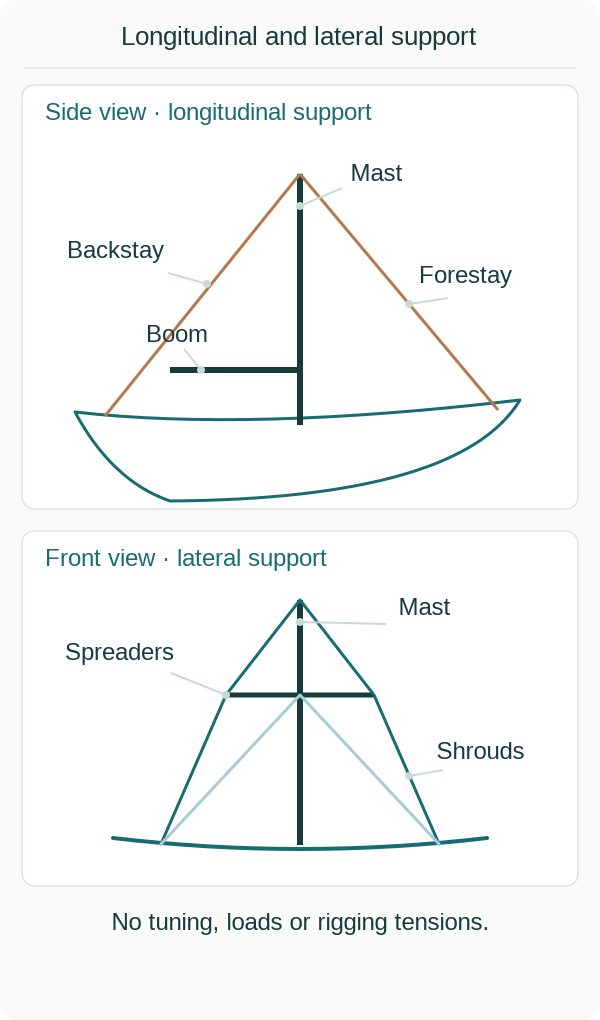
Side and front views of generic rig support. No tuning, allowable forces or maintenance instructions.
insideSailOriginal insideSail artwork — all rights reservedEnlarge the diagram
A rig looks like a web when every element is viewed alike. Separate three groups: rigid spars, supports and control lines.
Mast and boom belong to the first; stays and shrouds contribute support; halyards and sheets perform control jobs. The figure shows a simple architecture and omits details.
The actual arrangement depends on rig type and the system documented for the boat.
Stays, shrouds and spreaders in the figure
In the illustrated simple rig, the forestay follows the direction between mast and the boat’s forward area; the backstay relates mast to the after area. They belong to longitudinal support.
Shrouds relate the mast to the sides and contribute lateral support. Spreaders project sideways from the mast and hold the shrouds’ path away from it, forming part of the lateral-support geometry.
A profile makes the forward–aft relationship clearer, while a front view separates the sides. Stays and shrouds belong to standing rigging even where a system permits adjustment.
A halyard, meanwhile, has the hoisting job and a sheet the sail-control job. Depending on the system, a halyard may run within or beside the mast without becoming lateral support.
These relationships explain why two lines drawn close together can perform different jobs. They are positions and roles in a schematic family rather than installation dimensions or tuning tensions.
Other rig families arrange supports differently, so the names describe their jobs before any particular layout is investigated.
Spars and support
The mast is the vertical spar represented; the boom follows the lower region of the mainsail in many rigs. Longitudinal supports relate to forward and aft directions, while lateral supports relate mast and sides.
Spreaders are rigid elements associated with lateral-support arrangements. Recognising their jobs makes an inventory clearer without revealing tensions, dimensions or whether an alteration is appropriate.
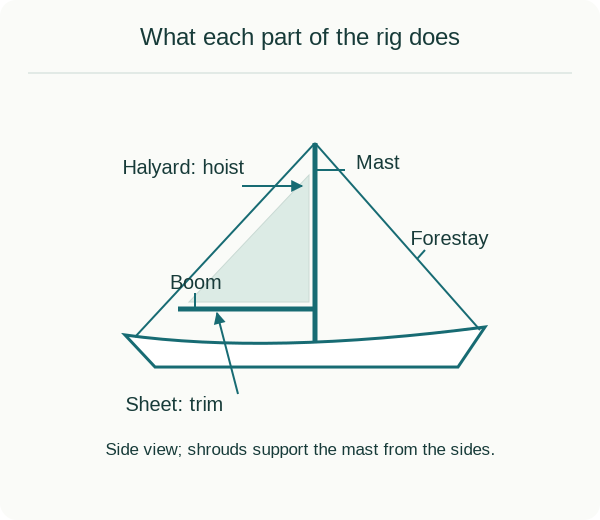
Original schematic illustration. Read the explanation and limitations in the lesson.
insideSailOriginal insideSail artwork — all rights reservedEnlarge the diagram
| Element | General job | Reading group |
|---|---|---|
| Mast / boom | Rigid elements of the rig. | Spars. |
| Stays / shrouds | Support for the spars. | Standing rigging. |
| Halyard | Line associated with hoisting a sail. | Running rigging. |
| Sheet | Line associated with controlling a sail. | Running rigging. |
Standing and running identify functions
Standing rigging does not mean that nothing can be adjusted; it identifies the support family. Running rigging groups controls used for rig functions.
The distinction does not depend only on a photograph of material. A support and a control line may have different constructions without changing their jobs.
Record functional name, component and product reference separately.
Worked example: two views of one mast
Next consider the boom and its connection to the mast. A view can show the general relationship without revealing the exact fitting or every control.
Keep that detail level in the description: “boom connected to mast” differs from identifying a specific part. The figure locates words from a document; product documentation explains the assembly.
Research progresses by relating views, names and references rather than inferring a complete system from a line.
Halyard and sheet: the name follows the job
A halyard can change direction around components without becoming a sheet. A sheet has another job even if both lines share a colour.
In a fictional inventory, “new rope” is unspecific; “halyard for an identified sail, with product reference” links role and material. Core-and-cover construction belongs to its own rope lesson.
It need not be redefined to recognise use.
Rig types such as sloop, cutter, ketch and yawl organise arrangements rather than merely count lines in a photograph. The canonical rig lesson develops these families; the sail lesson distinguishes elements used with them.
Here you gain a map for understanding names. Tuning, replacement and operation under load need their own documentation and review.
These drawings do not show how to install a system or distribute forces on an actual boat.
Three things to remember
- Separate rigid spars, supports and controls.
- Side and front views reveal different information.
- Halyard and sheet name jobs rather than colours or materials.
Concepts in this lesson
Boom
A rigid spar related to a sail’s lower area, such as the mainsail in the illustrated rig. It is not a control line.
Halyard
A line associated with hoisting a sail.
Mast
A raised rigid spar organising relationships with sails and supports. Position and arrangement depend on the rig.
Running rigging
Rig control lines, including halyards and sheets.
Sheet
A line associated with controlling a sail.
Shroud
Lateral support relating spars to the boat’s sides. It is distinct from a longitudinal stay and from control lines.
Spreader
A rigid element projecting sideways from the mast and holding the shrouds’ path away from it, contributing to lateral-support geometry.
Standing rigging
Elements supporting the mast, such as shrouds and stays.
Stay
Longitudinal rig support in the illustrated context: forestay relates mast to the forward area and backstay to the after area.
Sources and references
- Seldén product index — rig and deck components ↗
Seldén Mast · Mast sections, spreaders, stays and line management
Version: Institutional page. Jurisdiction: International.
Checked on - Hints and Advice on Rigging and Tuning ↗
Seldén Mast · Printed pp.6–7 Rig types; pp.8–9 Longitudinal rigging; pp.10–11 Lateral rigging; pp.12–14 Running rigging; p.56 Booms.
Official 92-page PDF retrieved and the stated sections consulted. Edition year not inferred. No tuning procedures or protected figures reproduced.
Checked on - Seldén line management ↗
Seldén Mast · Halyards, sheets and control-line functions
Version: Institutional page. Jurisdiction: International.
Checked on - Hallberg-Rassy 352 — standard specification from December 1987 ↗
Hallberg-Rassy · p.1 Hull / Deck and superstructure / Spars and rigging / Deck fittings; p.3 Accommodation / Steering; p.4 specification/options notice.
Four-page historical specification. The document states From December 1987; publication day is unknown. Not a specification for every surviving individual boat.
Checked on
Keep discovering
Loading discussion…