By insideSail
Automated technical check · version 2 ·
Sea breeze: differential heating and circulation
Coasts connect surfaces with different thermal responses, which can drive a local circulation.
In this guide
On a sunny afternoon, air near a beach can have a different history from inland air. A sea breeze is a local circulation associated with land–water thermal contrast, with near-surface sea-to-land flow in an ideal schematic.
It is not another name for every wind arriving from the sea. Mechanism matters: wind driven by a larger system may share its direction while having another evolution and scale.
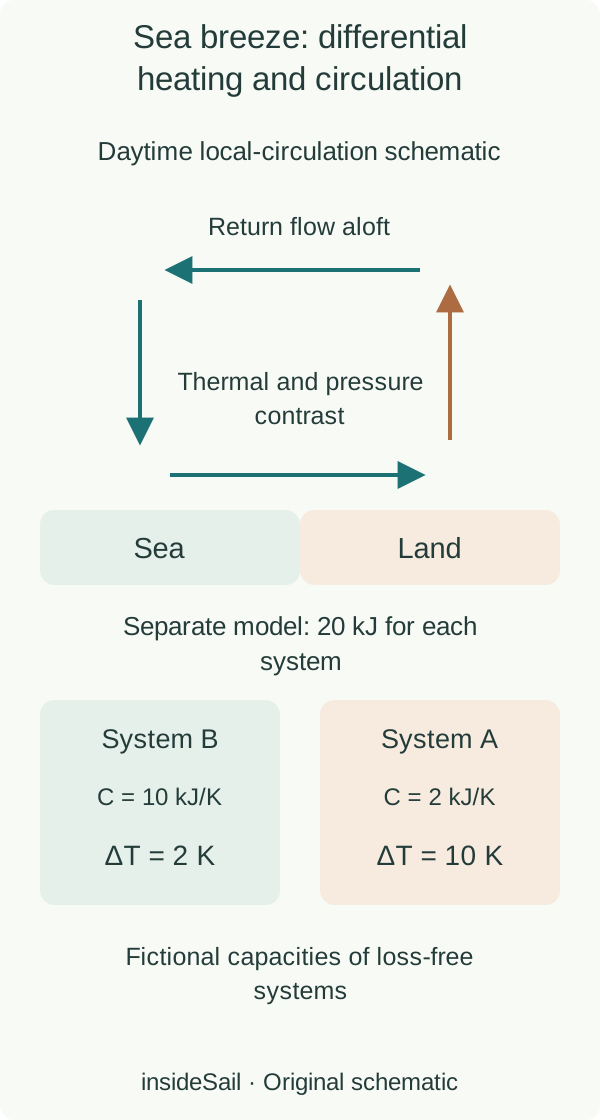
Original diagram with fictional data or an idealised process. Not a forecast or navigation decision.
insideSailOriginal insideSail artwork — all rights reservedEnlarge the diagram
Equal energy need not produce equal temperature
Ground and the body of water involved in heating do not respond identically. Heat storage, heated depth, mixing, evaporation and received energy matter.
Temperature of a very thin surface layer is not interchangeable with that of a water volume. The useful idea is thermal inertia: systems can change temperature at different rates without assuming that water never warms.
The relationship in numbers
ΔT = E / C
E in kJ; C in kJ/K; ΔT in K. Thermal model, not wind forecast.
If A represents a faster land response and B a slower marine response, the arithmetic shows how contrast can grow despite equal received energy. It does not determine air temperature, pressure difference or breeze strength.
Actual energy fluxes need not be equal and the participating layer changes. The analogy isolates one relationship to explain the mechanism without pretending to reproduce an entire coast.
Circulation is not a vacuum being filled
Heating changes air columns’ thermal structure and pressure distribution. In a favourable schematic, the near-surface horizontal pressure difference favours marine-to-land motion; air rises around convergence and there is a higher-level return flow.
Air still exerts pressure everywhere. Saying only that “warm air rises and leaves a vacuum” omits mass redistribution and differences between levels.
A sea-breeze front is a meeting zone between advancing marine air and land-side air. Direction, temperature or humidity may change.
Drawing a boundary fixes neither arrival time nor cloud or thunderstorm occurrence. Cloud formation also depends on moisture and vertical structure.
Circulation is three-dimensional; the figure’s cross-section selects only one view across a coastline.
Background wind participates too
Local circulation develops within a broader wind field. Background flow can reinforce, oppose or displace the pattern; terrain and coastline shape also alter how flows meet.
An arrow perpendicular to the coast is therefore a teaching simplification rather than a direction forecast for every beach. Nearby locations can have different configurations without contradicting the thermal mechanism.
When land cools and becomes relatively colder than water, a land breeze with an opposing near-surface component can develop. It is not an obligatory reversal at a set hour.
Our figure shows only a daytime sea-breeze schematic and the separate heat-capacity model. These processes help explain local differences; identifying a breeze does not decide departure, approach or manoeuvre.
- Thermal contrast can drive a circulation, not just a wind arrow.
- A system’s heat capacity is not a material’s specific heat.
- Local timing, strength and direction do not automatically follow from the schematic.
Sources and references
- What are the different types of wind? ↗
UK Met Office · Small-scale winds section: sea breeze, differential heating and near-surface pressure contrast.
Official page directly read. No global-circulation simplification, local breeze timetable, sea-state forecast or sailing decision imported.
Checked on - JetStream — The Sea Breeze ↗
NOAA National Weather Service · Differential heating, surface/return circulation, background-flow interaction and land-breeze overview.
Official page directly read. Only selected qualitative relationships; Florida numbers, fixed heights, temperature drops, thunderstorm prediction and source artwork excluded. Effective-capacity example is invented.
Checked on
Keep discovering
The next piece of the puzzle
Discuss this concept
Loading the conversation…