
Automated technical check · version 6 ·
STIX, AVS and stability
Technical indicators need context, configuration and documentation.
In this guide
Context travels with the indicator
Distinguish an angle, a standardised index and the condition assessed.
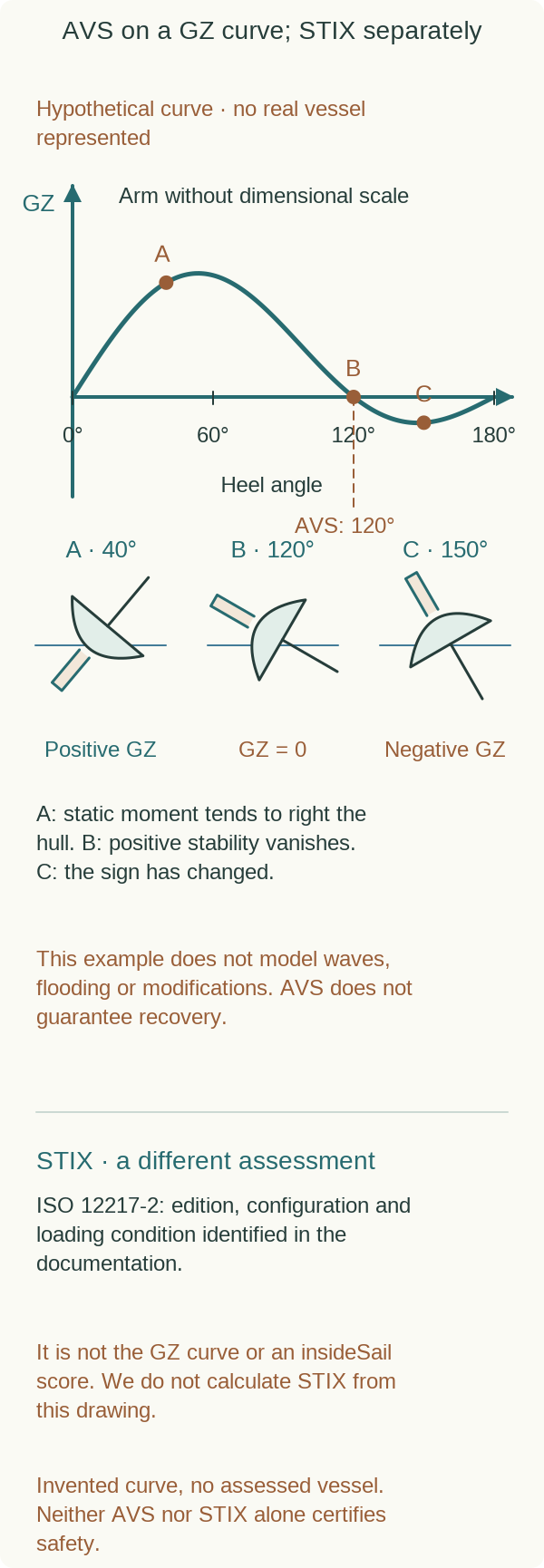
Invented curve, no assessed vessel. Neither AVS nor STIX alone certifies safety.
insideSailOriginal insideSail artwork — all rights reservedEnlarge the diagram
AVS · angle
Identifies where positive static stability vanishes on the assessed curve.
What it offers: Helps interpret technical stability documentation.
What to consider: The angle alone describes neither dynamic behaviour nor water ingress.
STIX · index
An index within a standardised stability assessment.
What it offers: Allows a figure to be linked to its supporting assessment and report.
What to consider: A figure without a report and configuration should not be automatically trusted.
Assessed condition
Loading, configuration and documentation are part of the result’s meaning.
What it offers: Helps ask whether the assessment matches the individual boat being considered.
What to consider: Modifications and actual condition do not disappear because an indicator exists.
Three things to remember
- AVS and STIX represent different concepts.
- A result belongs to a configuration and loading condition.
- We do not calculate them from a few catalogue dimensions.
In plain language
AVS is the angle where positive static stability vanishes on the assessed curve. STIX is an index calculated within a standardised stability assessment.
We calculate neither from a handful of dimensions.
How to interpret it
A result belongs to an identified loading condition and assessment. Figures without a report and context should remain unverified.
Why it matters
Documentation helps you ask better questions about stability, loading and operating limits.
Limitations
Dynamic conditions, water ingress, modifications and actual condition cannot be reduced to one figure.
In practice
In the comparator, these figures carry their own source and condition; they never receive an automatic safe label.
Further reading
ISO 12217-2:2022 — Stability and buoyancy assessment ↗
Keep discovering
The next piece of the puzzle
The concept in a few words
STIX, AVS and stability
Technical indicators need context, configuration and documentation.
Technical assessment, preparation and competence remain necessary.
Sources and references
- RYA Stability and Buoyancy ↗
Royal Yachting Association · Publisher catalogue / Product details: RYA G23, edition 2009, reprint 2026, 40 pages, ISBN 9781906435356. The book itself was not consulted; bibliography for further reading only.
Checked on - ORC — Stability ↗
Stability measurements, righting-arm curve and LPS/AVS. Do not adopt simplified static-language statements as a guarantee of real recovery.
Reference for insideSail educational figure ir26-stability-gz-avs-hull-positions.
Checked on - ISO 12217-2:2022 — Stability and buoyancy assessment ↗
ISO · Public Abstract / General information only: ISO 12217-2:2022, edition 4, December 2022. Scope covers sailing craft stability/buoyancy assessment in defined load/configuration. Paid normative text not consulted; no STIX formula or AVS threshold verified here.
Checked on
Loading discussion…