By insideSail
Automated technical check · version 2 ·
Tanks: capacity, indication and context
Litres in a specification and a display percentage answer different questions.
In this guide
Tank capacity appears to be a straightforward comparison: the larger one holds more. Yet that statement needs an identified tank, configuration and quantity.
An advertisement may add two reserves, a specification may quote a factory option, and a display may convert level into volume. Separate those records before estimating endurance.
Nominal capacity is a documentary starting point rather than confirmation of what exists, is available or can be used during a particular trip. A full-looking icon cannot independently establish the amount of liquid or its suitability for the intended use.
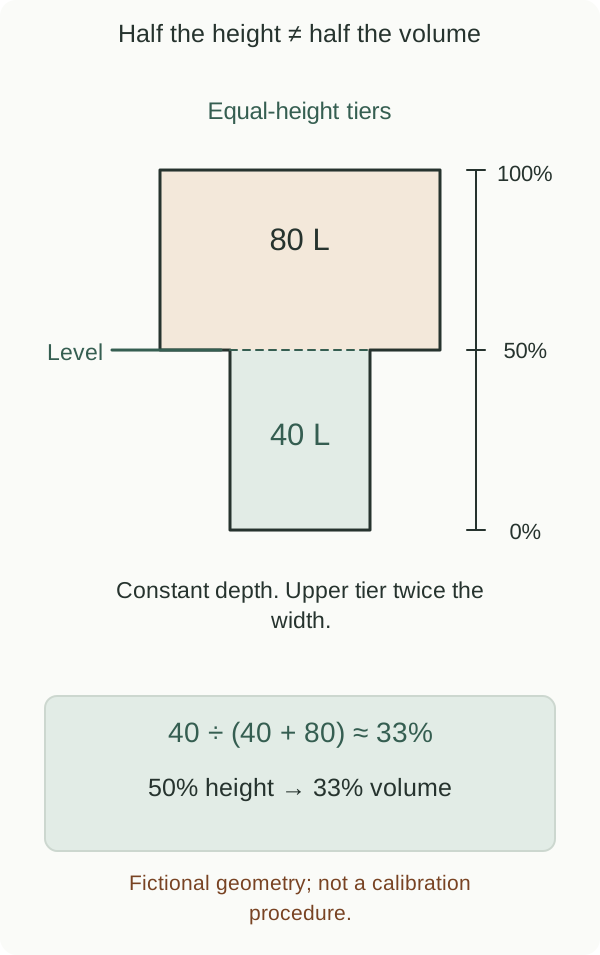
Fictional geometry; not a calibration procedure.
insideSailOriginal insideSail artwork — all rights reservedEnlarge the diagram
Height and volume do not always change together
In an ideal rectangular tank with constant base area, doubling liquid height doubles volume. A tank widening upwards holds more volume per centimetre in its upper portions.
Victron’s GX Tank 140 documentation explains the need to relate shape to sensor readings. We do not teach its configuration.
The distinction is geometric: half the height need not mean half the litres. Knowing the indication type and reference is more useful than assuming every display bar is a volume ruler.
Movement, signal processing and an undocumented setup can add further uncertainty without changing the stated tank capacity.
Adding reserves does not establish independence
Two freshwater tanks may share a distribution arrangement. Their declared total does not describe isolation, access, condition or dependencies.
Tanks carrying different fluids or serving different purposes cannot be added into a single useful reserve. Identify each unit and retain an aggregate only when the relationship is explained.
Asking whether two reserves exist differs from asking whether one shared failure affects both. That answer belongs to the documented individual installation.
The lesson helps identify the missing question without authorising valve operation or an experiment that empties a real system.
Available, usable and allocated have distinct scopes
A nominal figure may describe declared tank volume without establishing that the entire quantity is obtainable in the observed condition. Shape, installation and condition need their own evidence.
Apply no universal usable percentage and invent no inaccessible volume to complete a record. An amount someone chooses to retain is another decision, separate from physical capacity.
If a trip policy allocates a reserve, label it as a planning assumption rather than a manufacturer property. Water quantity also does not certify drinking-water quality, just as a fuel-volume indication does not assess fuel condition.
To interpret consumption, describe people, period and activities. Reports of 18 L and 36 L per day reveal no waste without knowing use, replenishment and how those values were obtained.
Litres per day can support an exercise but guarantee no remaining days. For fuel, power and operating hours likewise establish no actual consumption without conditions and engine information.
Combining an optimistic consumption estimate with unverified capacity merely produces a precise-looking endurance claim. Keep reported experience, model specification and calculation assumptions visible as different layers instead of treating their mixture as a measured result.
A record that makes the questions clear
Organise the record into four lines: declared capacity and source, identified configuration, indication origin and use context. In the real Oceanis 37.1 documentation, the manufacturer supplies separate fuel and water fields under its specification disclaimer.
That measures no used boat. If an owner added another unit, preserve it as an individual modification with its evidence.
A comparison improves when “undocumented” is a legitimate answer rather than when every field pretends to share the same certainty. The four-line record makes the next useful enquiry apparent without turning the lesson into installation, filling or treatment instructions.
- Level is not necessarily volume.
- Aggregate capacity proves neither availability nor independence.
- Consumption and reserves retain assumptions and context.
Sources and references
- GX Tank 140 — Configuration ↗
Victron Energy · Section 3.1: Volume unit, Custom shape, Averaging time; section 3.2 tank identity.
Selected section read in full. Only geometry, level/volume distinction and indication context used; no wiring, calibration steps, pump configuration or product endorsement.
Checked on - Oceanis 37.1 — variants, layouts and specifications ↗
BENETEAU · Available in 2 versions; Specifications disclaimer; Layout plans, 2 cabins/1 shower room and 3 cabins/2 shower rooms; Water Capacity/Fuel Capacity.
Official live sections read. Only existence of different documented layouts/configurations supports examples; US prices, marketing adjectives and inferred actual usable volume excluded.
Checked on
Keep discovering
The next piece of the puzzle
Discuss this concept
Loading the conversation…