By insideSail
Published without technical review · version 2 ·
Ten cloud genera: observe form and structure
A visual family map helps describe the sky without turning a shape into a forecast.
In this guide
The first lesson introduced cirrus, stratus and cumulus as entry points. The World Meteorological Organization’s International Cloud Atlas recognises ten genera, which we now organise on a visual grid.
Images are original symbolic drawings of key features rather than substitutes for reference photographs or automatic classification of an actual sky. The learning aim is to recognise useful questions about layers, elements, texture and development, retaining uncertainty when observation cannot distinguish them.
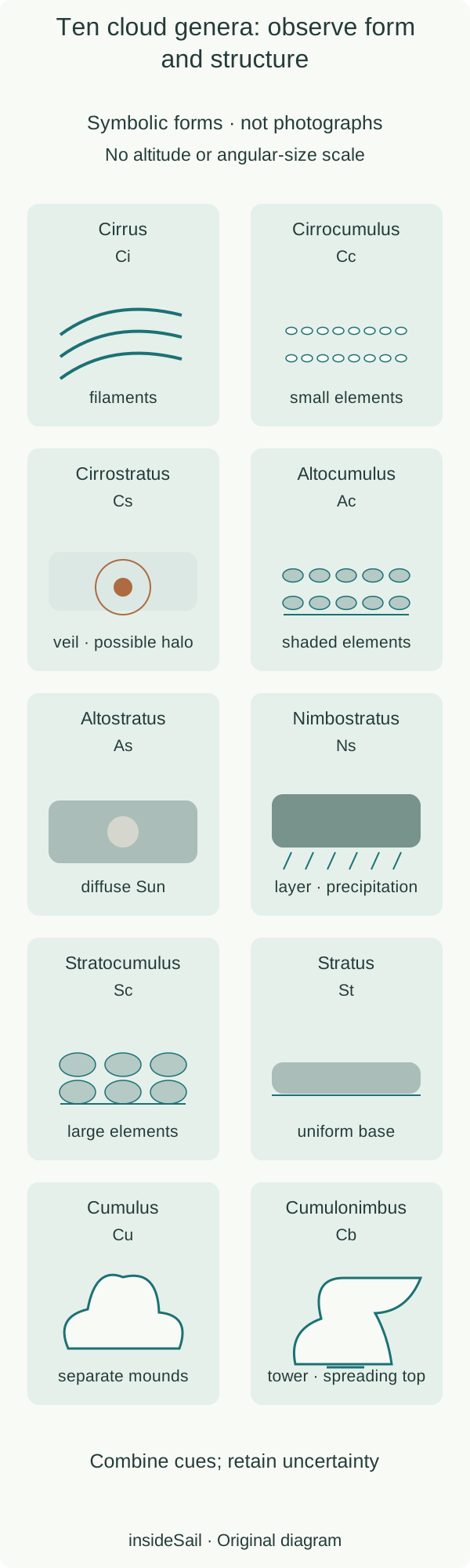
Original schematic. Fictional examples; symbolic visual identification without an operating forecast.
insideSailOriginal insideSail artwork — all rights reservedEnlarge the diagram
An international language for ten forms
| Genus | Concise visual cue |
|---|---|
| Cirrus — Ci | Fibrous-looking filaments or bands. |
| Cirrocumulus — Cc | Very small white elements, generally unshaded. |
| Cirrostratus — Cs | Thin veil, potentially producing a halo. |
| Altocumulus — Ac | Rounded elements or rolls, often with shading. |
| Altostratus — As | Layer; diffuse Sun as through ground glass. |
| Nimbostratus — Ns | Thick layer, precipitation-diffused, obscuring the Sun. |
| Stratocumulus — Sc | Large layered elements with darker parts. |
| Stratus — St | Low layer with a relatively uniform base. |
| Cumulus — Cu | Separate elements, distinct outlines and vertical growth. |
| Cumulonimbus — Cb | Deep vertical extent; top may spread into an anvil. |
Latin names and abbreviations remain recognisable across languages. Prefix matching is insufficient: nimbostratus is not simply any dark layer and altocumulus is not any cloud apparently at medium height.
Species, varieties and supplementary features refine classification within a genus. The table supports an initial reading rather than transcribing every formal condition in WMO definitions.
Compare texture, shading and apparent size
Cc, Ac and Sc can all show repeated elements, differing in features including apparent angular size and shading. For most regularly arranged small elements, the atlas describes apparent widths below 1° for Cc, between 1° and 5° for Ac and above 5° for Sc.
These are angles seen by an observer rather than cloud diameters in metres. Distance and perspective affect appearance; our small drawings have no angular scale, so those thresholds cannot be applied to the figure.
Cs can display a halo, but an observation without one does not automatically exclude the genus. As can reveal a diffuse Sun and lacks the typical Cs halos.
In St, a visible Sun can retain a defined outline; the atlas allows a halo exception at very low temperatures. These are combined cues rather than decisions based on one light or dark pixel.
Illumination and overlapping layers complicate observation.
Vertical development is not a thunderstorm timetable
Cu develops defined mounds and towers with extent varying by species. Cb has considerable vertical extent and an upper part that can become fibrous and spread.
An anvil is one possible Cb shape rather than its only appearance. Our drawing selects that case to make the comparison visible without implying that every cumulus becomes cumulonimbus or rain lies precisely beneath the illustrated centre.
Height, coverage and genus are different fields. A low layer can obscure a high one, and a low-based cloud can extend through several levels.
We assign no fixed European altitudes to the ten drawings. For deeper identification, consult definitions and authorised reference photographs at the atlas source.
On this platform, the language connects to humidity, fronts and stability mechanisms rather than an operating response to dangerous phenomena.
- Combine texture, elements, shading and structure cues.
- Angular size is not physical size.
- Record what was observed and retain uncertain identification where necessary.
Sources and references
- International Cloud Atlas — cloud classification summary ↗
World Meteorological Organization · 2017 online edition, §2.1.4, Table 2; ten genera.
Names and taxonomy only; no photographs, classifications of real sky or regulatory text copied.
Checked on - International Cloud Atlas — Cirrocumulus ↗
World Meteorological Organization · 2017 online edition, definition §2.3.2.1.
Definition actually read. Original concise interpretation and symbolic artwork, not a copied definition or photograph.
Checked on - International Cloud Atlas — Cumulonimbus ↗
World Meteorological Organization · 2017 online edition, definition §2.3.10.1.
Definition actually read. Original concise interpretation and symbolic artwork, not a copied definition or photograph.
Checked on - International Cloud Atlas — Cirrostratus ↗
World Meteorological Organization · 2017 online edition, definition §2.3.3.1.
Definition actually read. Original concise interpretation and symbolic artwork, not a copied definition or photograph.
Checked on - International Cloud Atlas — Nimbostratus ↗
World Meteorological Organization · 2017 online edition, definition §2.3.6.1.
Definition actually read. Original concise interpretation and symbolic artwork, not a copied definition or photograph.
Checked on - International Cloud Atlas — Altocumulus ↗
World Meteorological Organization · 2017 online edition, definition §2.3.4.1.
Definition actually read. Original concise interpretation and symbolic artwork, not a copied definition or photograph.
Checked on - International Cloud Atlas — Stratocumulus ↗
World Meteorological Organization · 2017 online edition, definition §2.3.7.1.
Definition actually read. Original concise interpretation and symbolic artwork, not a copied definition or photograph.
Checked on - International Cloud Atlas — Altostratus ↗
World Meteorological Organization · 2017 online edition, definition §2.3.5.1.
Definition actually read. Original concise interpretation and symbolic artwork, not a copied definition or photograph.
Checked on - International Cloud Atlas — Cirrus ↗
World Meteorological Organization · 2017 online edition, definition §2.3.1.1.
Definition actually read. Original concise interpretation and symbolic artwork, not a copied definition or photograph.
Checked on - International Cloud Atlas — Stratus ↗
World Meteorological Organization · 2017 online edition, definition §2.3.8.1.
Definition actually read. Original concise interpretation and symbolic artwork, not a copied definition or photograph.
Checked on - International Cloud Atlas — Cumulus ↗
World Meteorological Organization · 2017 online edition, definition §2.3.9.1.
Definition actually read. Original concise interpretation and symbolic artwork, not a copied definition or photograph.
Checked on
Keep discovering
The next piece of the puzzle
Discuss this concept
Loading the conversation…