By insideSail
Published without technical review · version 2 ·
Three ratios, one specification and a worked comparison
Calculate ballast/displacement, D/L and SA/D with consistent units and conditions.
In this guide
A ratio becomes more useful when you can reconstruct its calculation. Use a wholly fictional sailboat: displacement 6,000 kg, ballast 2,400 kg, waterline length 9 m and reference sail area 45 m².
These numbers belong to the same imagined configuration; they are not specifications for a Moody, Jeanneau or any catalogue model. Each formula compares different properties.
Loading can alter the calculated values without turning a boat into a different design. Keep the input condition visible throughout the exercise.
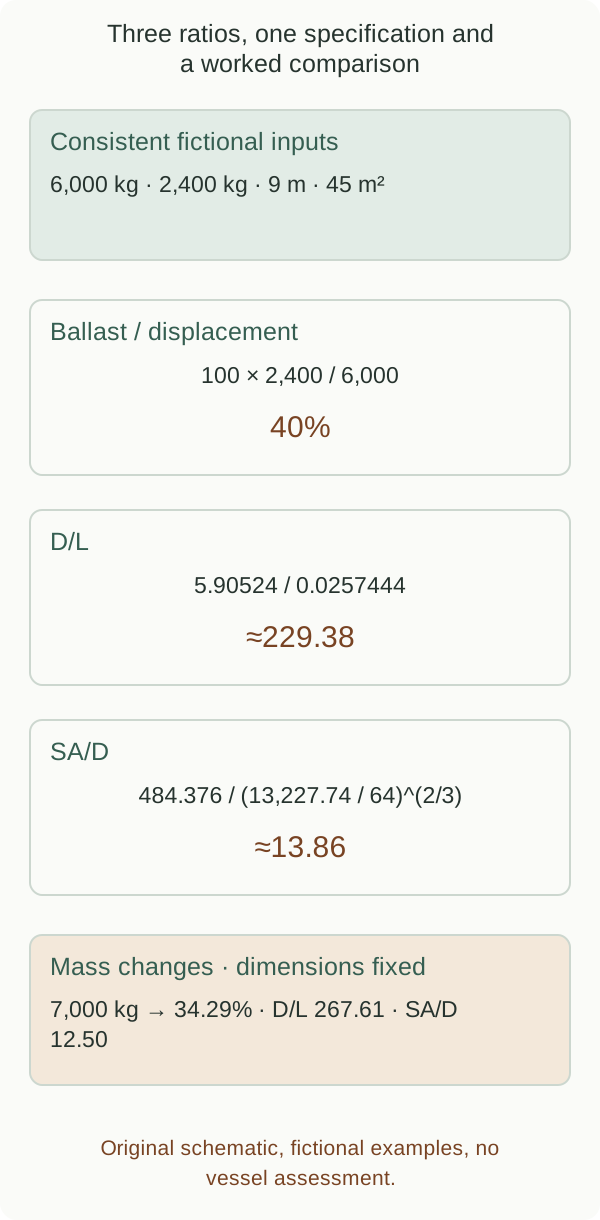
Original schematic, fictional examples, no vessel assessment.
insideSailOriginal insideSail artwork — all rights reservedEnlarge the diagram
Begin with ballast percentage
The relationship in numbers
B/D = 100 × 2,400 / 6,000 = 40%
Masses in kg for the same condition.
Displacement already includes ballast: do not add the 2,400 kg twice. The percentage identifies the fraction of declared mass described as ballast.
It does not locate that mass centre. Two assemblies with the same 40% can carry ballast at different depths, and have different hulls, rigs and loading.
The result opens a design question but does not calculate a stability curve or the force needed to heel the vessel. A missing ballast definition cannot be repaired by selecting a favourable percentage.
D/L uses its own customary units
The relationship in numbers
D/L = (D_lb / 2240) / (0.01 × LWL_ft)³
D in pounds; LWL in feet; 2,240 lb per long ton.
Convert 6,000 kg to approximately 13,227.74 lb and 9 m to 29.5276 ft. Dividing pounds by 2,240 gives 5.90524 long tons.
The denominator is (0.295276)³, approximately 0.0257444. Division gives D/L ≈229.38.
Entering 6,000 and 9 directly into this customary formula would produce an incomparable number. A metric tonne, short ton and long ton are different units.
Retain precision while calculating and round the final result. The index relates mass to the cube of the specified waterline length.
SA/D normalises area and a reference volume
The relationship in numbers
SA/D = SA_ft² / (D_lb / 64)^(2/3)
Area in square feet; 64 lb/ft³ is the customary density.
The 45 m² becomes approximately 484.376 square feet. The expression 13,227.74/64 provides customary volume in cubic feet; raising it to two-thirds creates an area quantity.
The result is SA/D ≈13.86. Do not replace reference area with actual main-plus-genoa area on only one boat.
That mixes conventions. Do not add a spinnaker outside the declared sail set either.
A specification labelled simply “sail area” needs clarification before comparison. More digits cannot compensate for an undefined input basis.
For an actual model, retain keel version, mass condition and sail-area definition. Show any unverified input as a gap.
In a comparison, higher D/L indicates greater relative mass while higher SA/D indicates more area for customary displacement volume. Neither alone determines light-air speed, comfort or offshore suitability.
Once the arithmetic is complete, return to the conditions and questions still unanswered. Consistent calculation is one layer of evidence, separate from editorial interpretation and owners’ experience.
Sources and references
- Sails — measurement and rated area ↗
Offshore Racing Congress · Area measurement and sail-category introduction.
Official page consulted for measured sail area versus geometric reference fields, without importing a rating procedure.
Checked on - Ratio rationale — Rob Mazza, naval architect ↗
Good Old Boat · Original Issue 93, November/December 2013; D/L, SA/D and Capsize Screening Formula sections; web republication 28 May 2026.
Original naval-architect explanation directly consulted. Formula conventions and limited factual summary only; no copied prose, classifications, photographs or source diagrams.
Checked on
Keep discovering
The next piece of the puzzle
Discuss this concept
Loading the conversation…