By insideSail
Automated technical check · version 2 ·
Beaufort, mean wind and gusts
A wind class does not contain the whole sea description.
In this guide
The Beaufort scale expresses wind force through numbered classes. It can now be related to speed intervals alongside its observational origin.
A class is not an infinitely precise measurement: different winds within one interval may receive the same number. Nor is it a sailboat safety scale.
Behaviour and use depend on boat, crew, sea and context.
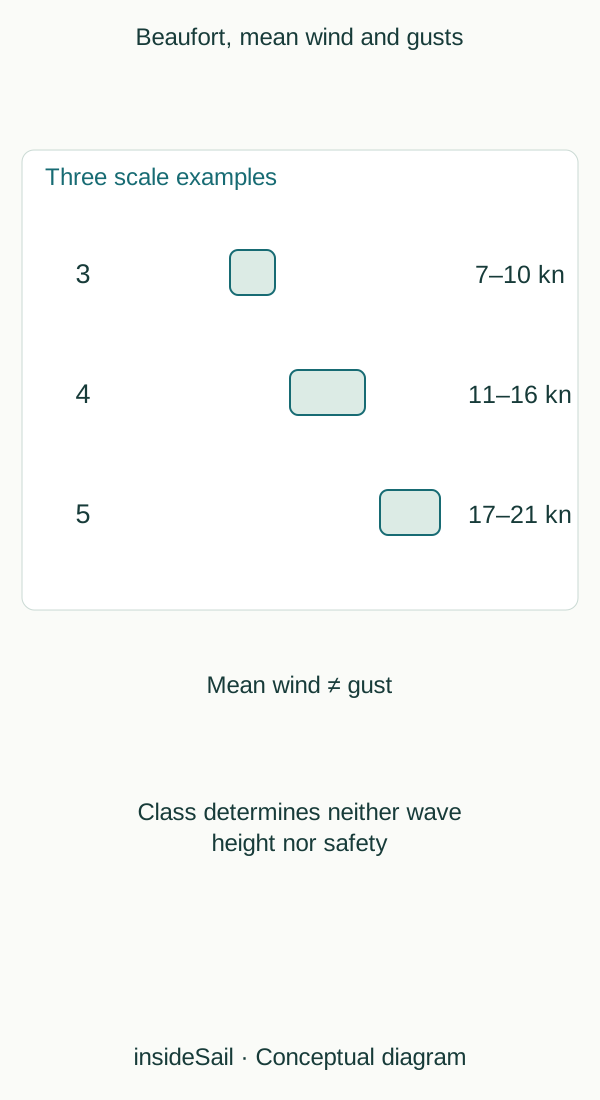
Conceptual schematic not to scale; no local forecast or operational decision.
insideSailOriginal insideSail artwork — all rights reservedEnlarge the diagram
Interval and value type
| Force | Interval in knots |
|---|---|
| 0 | <1 |
| 1 | 1–3 |
| 2 | 4–6 |
| 3 | 7–10 |
| 4 | 11–16 |
| 5 | 17–21 |
| 6 | 22–27 |
| 7 | 28–33 |
| 8 | 34–40 |
| 9 | 41–47 |
| 10 | 48–55 |
| 11 | 56–63 |
| 12 | ≥64 |
The table gives all thirteen classes and factual knot intervals from the Met Office reference. The diagram highlights three scale examples.
Numbers are class limits rather than thresholds for departure, reefing or boat choice. “Mean wind” refers to averaging over a defined interval, while “gust” describes a short variation under the product’s method.
Averaging period and gust definition belong to source documentation and should not be silently assumed.
The water surface responds to wind over generating time and distance. Swell formed elsewhere may be present, or recent wind may not yet have produced the sea of prolonged wind.
The reference itself qualifies well-developed open-sea waves and delayed response. We therefore do not transfer Beaufort-table wave heights into mandatory forecasts for a bay or passage.
Units need attention too. One knot is exactly one nautical mile per hour; the exact conversion to metres per second is 1852/3600.
A rounded class indication does not justify conversion with many significant figures. Retaining variable identity, unit and time context is more useful when comparing products.
Consider four fictional values of 10, 12, 14 and 20 knots. Arithmetic mean is 14 knots and the largest value 20.
Changing the last to 16 lowers the mean to 13 without changing the other three. This small set represents no weather service’s method; it simply explains why mean and maximum contain different information.
Duration and sampling frequency are needed to relate the idea to an actual product.
Classes are ordered intervals. Moving from force 3 to 4 does not mean the same speed factor as moving from 4 to 5.
Class number is not a linear velocity unit. Physical means therefore cannot be obtained by averaging Beaufort numbers without understanding the procedure.
For quantitative speed comparison, use the variable with its declared unit and method.
- Beaufort classifies wind, not safety.
- Mean and gust are not interchangeable.
- A class alone does not predict the existing sea.
The concept in a few words
Beaufort scale
Wind-force classes related to speed intervals; not safety classes.
Sources and references
- Beaufort wind force scale ↗
Met Office · Specifications/equivalent wind-speed intervals, forces 0–12; notes on well-developed open-sea waves.
Factual numeric force/wind intervals only; sea-state descriptions, wave-height columns and protected imagery not reproduced.
Checked on - Waves — Currents Tutorial ↗
NOAA National Ocean Service · Wind speed, duration and fetch; wave approach to coast.
Physical generation factors only; no surf-zone operating rule.
Checked on
Keep discovering
The next piece of the puzzle
Discuss this concept
Loading the conversation…