By insideSail
Published without technical review · version 2 ·
Comfort Ratio and CSF: calculate them and inspect their blind spots
Two simple indices do not measure sea motions or actual capsize resistance.
In this guide
Continue with the fictional 6,000 kg boat: LOA 10.5 m, LWL 9 m and beam 3.2 m. Comfort Ratio is an empirical index associated with Ted Brewer.
Capsize Screening Formula, or CSF, combines beam and displacement. Both can be reconstructed from specification fields.
This lesson also examines what their inputs omit. Correct arithmetic can still answer the wrong question about life at sea.
No plotted curve represents observed vessel motion or a measured capsize response.
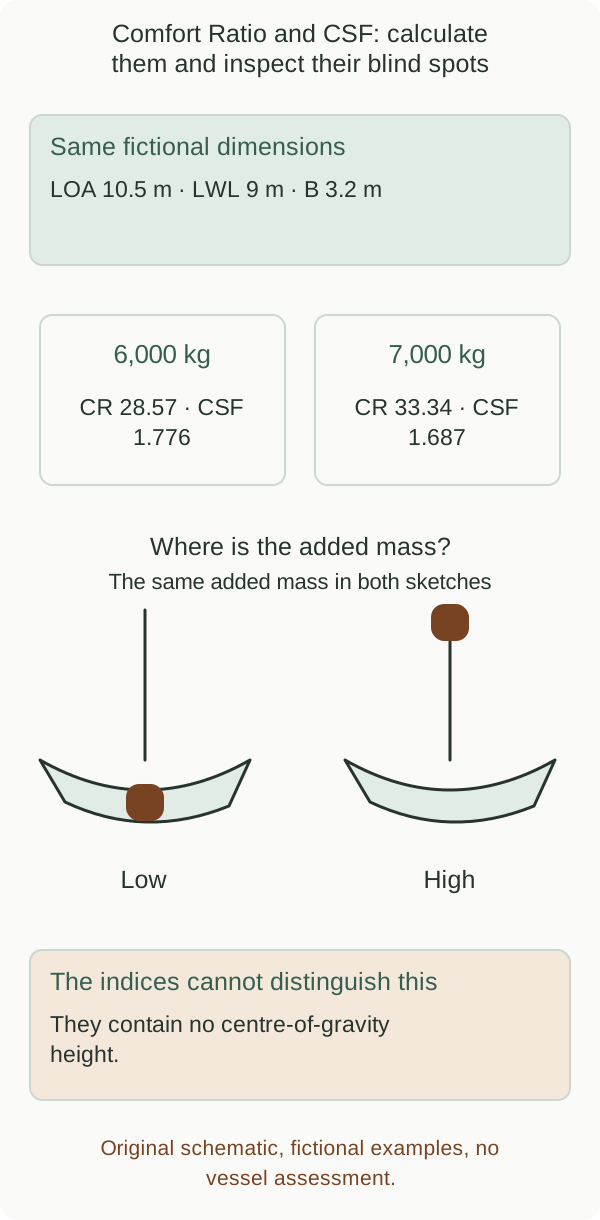
Original schematic, fictional examples, no vessel assessment.
insideSailOriginal insideSail artwork — all rights reservedEnlarge the diagram
The Comfort Ratio convention
The relationship in numbers
CR = D_lb / [0.65 × (0.7LWL_ft + 0.3LOA_ft) × B_ft^1.333]
Mass in pounds; lengths in feet; empirical index.
After conversion use 13,227.74 lb, LWL 29.5276 ft, LOA 34.4488 ft and beam 10.4987 ft. The weighted length is approximately 31.0039 ft.
Multiply it by 0.65 and beam to the power 1.333, then divide mass by that denominator: approximately 28.57. We retain the customary 1.333 exponent used in the comparator.
Exact four-thirds or another convention changes the number slightly. This empirical index is not acceleration, roll period or a comfort percentage.
Its numerical convention must accompany the value.
CSF uses different inputs and a different question
The relationship in numbers
CSF = B_ft / (D_lb / 64)^(1/3)
Beam in feet; D in pounds; customary density 64 lb/ft³.
The cube root of 13,227.74/64 is approximately 5.9125 ft. Divide 10.4987 ft beam by it to obtain CSF ≈1.776.
There is no vertical centre of gravity, flooding opening or stability curve in the formula. A value below a historical threshold is consequently not an offshore certificate.
Applying it to a multihull or substantially different geometry without establishing its scope also produces a misleading comparison. “Screening” describes a limited index rather than an actual capsize test of the boat.
A sensitivity exercise revealing the limitation
Experienced motion also depends on hull shape, mass distribution, sea state and the encounter between speed, heading and waves. The same boat can feel different on two days while a static catalogue index remains unchanged.
An owner’s account can illuminate particular conditions, provided it remains identified as experience. Neither the account nor the index replaces technical assessment of the individual boat.
Avoid converting a tendency into a promise that every person will be comfortable in every sea.
Use the values to organise questions between boats of similar size and design intent. Then inspect input condition, architecture and evidence relevant to intended use.
Do not add Comfort Ratio and CSF into a safety score: different origins and directions do not gain validation through addition. An editorial comparison should explain its criteria and preserve limitations instead of calling the boat with a pleasing number “safer”.
Ask which missing property could reverse the apparent conclusion.
Sources and references
- The Comfort Ratio — Ted Brewer ↗
Ted Brewer / Good Old Boat · Original Issue 32, September/October 2003; Mass is displacement and limitations; republication 14 September 2026.
Primary explanation by the index creator directly read. Only the empirical formula and scope are used; no historical boat comparison or protected artwork reused.
Checked on - ORC — Stability ↗
Righting arm curve, vertical centre of gravity, LPS/AVS and declared measurement trim.
Official selected explanation directly read; no inclining-test instructions or race eligibility claims.
Checked on - Ratio rationale — Rob Mazza, naval architect ↗
Good Old Boat · Original Issue 93, November/December 2013; D/L, SA/D and Capsize Screening Formula sections; web republication 28 May 2026.
Original naval-architect explanation directly consulted. Formula conventions and limited factual summary only; no copied prose, classifications, photographs or source diagrams.
Checked on
Keep discovering
The next piece of the puzzle
Discuss this concept
Loading the conversation…