By insideSail
Published without technical review · version 2 ·
Consumption and range: a worked ledger with current
Separate available fuel, running time and distance over ground.
In this guide
A 100-litre tank does not automatically provide 100 litres for a passage. Unusable volume, uncertain level and planned reserve may affect availability.
Hourly consumption also needs a condition and measurement. Work through a wholly fictional ledger to relate fuel, time and distance.
This is not a reserve recommendation or passage plan for an actual boat; none of the values describes a catalogue model. The exercise separates declared assumptions so that changing one does not silently change another.
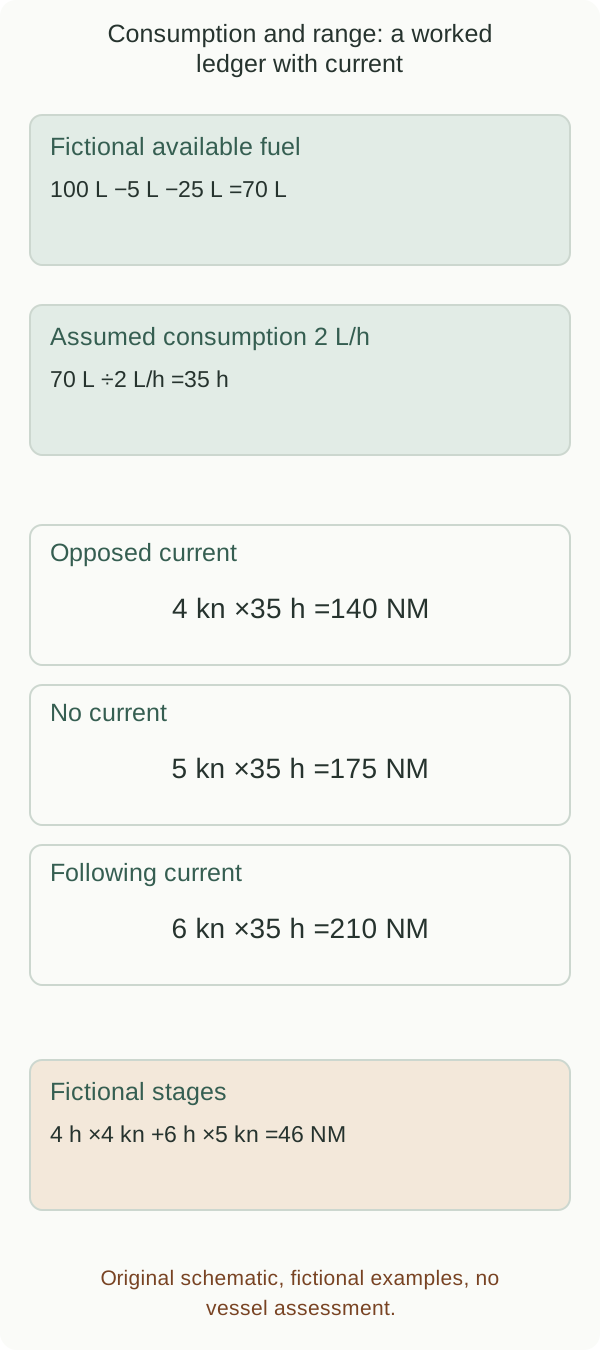
Original schematic, fictional examples, no vessel assessment.
insideSailOriginal insideSail artwork — all rights reservedEnlarge the diagram
Define fuel used in the calculation
The relationship in numbers
Hours = available fuel / hourly consumption
L / (L/h) = h.
At fictional constant consumption of 2 L/h, 70/2 gives 35 hours. Rated power did not provide that consumption: an appropriate measurement or curve would be needed.
At 2.5 L/h the time becomes 28 hours. Division demonstrates sensitivity without predicting future conditions.
Heaters, generators or other consumers using the tank require separate accounting; engine-only consumption does not cover them. A precise quotient is still uncertain when tank availability and consumption are uncertain inputs.
Convert hours into distance
The relationship in numbers
Distance = speed over ground × time
Knots × hours = nautical miles.
Assume constant through-water speed of 5 knots. Without current and ignoring other changes, 35 h corresponds to 175 nautical miles.
With uniform 1-knot current exactly opposed, speed over ground is 4 knots and the distance 140 miles. With 1-knot current exactly following, it is 6 knots and 210 miles.
Wind cannot be subtracted as if it were current; wind and waves can change through-water speed and consumption themselves. Non-aligned current requires vector treatment rather than scalar addition.
A stage ledger keeps arithmetic visible
| Fictional stage | Time | SOG | Distance | Fuel |
|---|---|---|---|---|
| A: opposed current | 4 h | 4 kn | 16 NM | 8 L |
| B: no current | 6 h | 5 kn | 30 NM | 12 L |
| Total | 10 h | No simple speed mean | 46 NM | 20 L |
Average speed over ground is 46/10=4.6 knots because intervals have different durations. After the stages, 50 L remains from the 70 L allocated under the assumptions.
The ledger contains no harbour, forecast, traffic or refuge alternative, so it is not an operational passage plan. It demonstrates how retaining times, consumption and speed references makes reasoning reconstructable and omissions visible.
Averaging 4 and 5 arithmetically would conceal the unequal durations.
For an actual specimen, retain measurement origin, hull condition, loading, rpm, conditions and observation interval. Do not present estimated range as a guarantee.
An owner report can be valuable with clear conditions but remains a report. Keep documented capacity on the theoretical model page and explicit assumptions and gaps in tools.
Distinguishing time from distance prevents litres turning into an apparently certain mileage. Neither a tank specification nor nominal horsepower alone provides actual endurance.
Sources and references
- 3YM20 technical data sheet ↗
YANMAR Marine · EN_DS3YM20_0417, two pages: named power, torque, propeller-demand and fuel axes; unit note.
Official PDF text directly read through browser. Historical document, not a verified specification of the current engine. No graph value digitised; only curve types and unit conventions are used.
Checked on - Use of model-based techniques for marine engine development ↗
YANMAR · 27 July 2016, sections 2.3 and 3: vessel resistance, gear ratio, propeller and variable load conditions.
Original engineering account directly read. No demand coefficient or source curve transferred to a sailboat.
Checked on
Keep discovering
The next piece of the puzzle
Discuss this concept
Loading the conversation…