By insideSail
Published without technical review · version 2 ·
From engine to propeller: power, curves and transmission
Horsepower per tonne is a simple calculation within a much larger system.
In this guide
Two sailboats advertised with “30 hp” can respond differently under power. The number identifies power at a declared point without establishing propeller demand, transmission or hull resistance.
Ask where output was measured, at which speed and in which unit. Then follow the mechanical path to the water.
This explanation organises those elements using fictional numbers rather than selecting an engine for an actual boat. Installed condition and vessel loading remain separate from original manufacturer specifications.
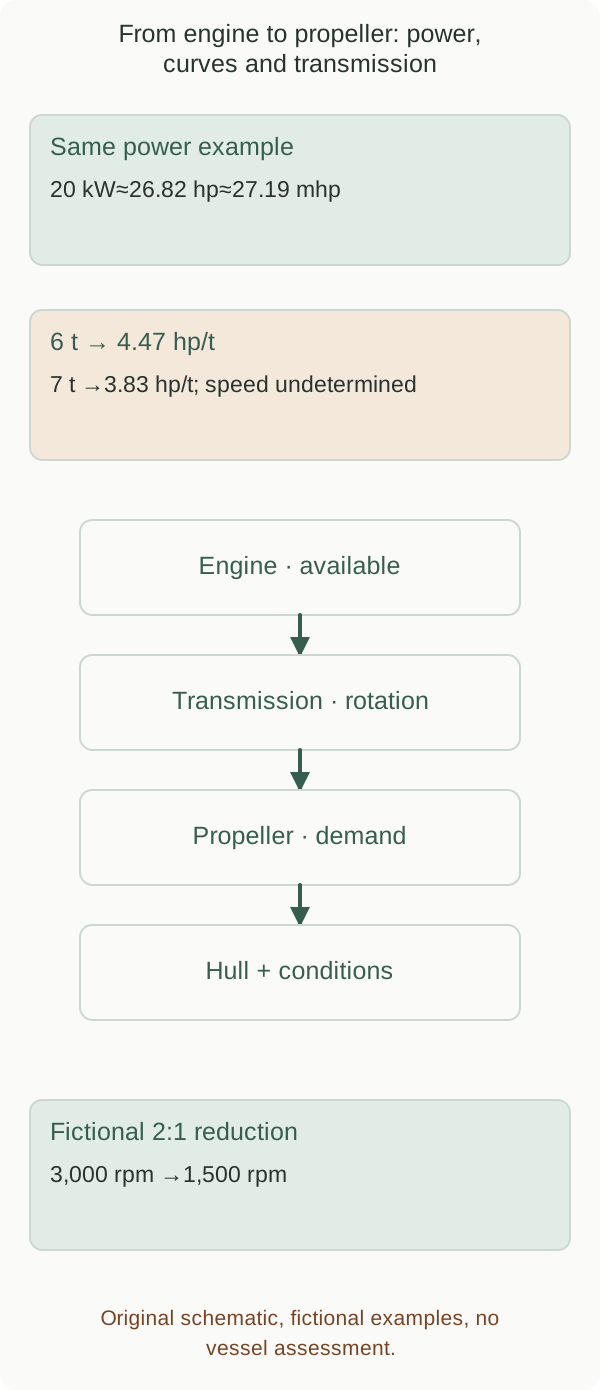
Original schematic, fictional examples, no vessel assessment.
insideSailOriginal insideSail artwork — all rights reservedEnlarge the diagram
Identify the unit
The relationship in numbers
hp/t = P_hp / (D_kg / 1000)
Mechanical hp and metric tonnes; do not mix with mhp/PS.
At 7,000 kg with nominal output unchanged, the index becomes approximately 3.83 hp/t. That does not calculate speed loss; other relationships are needed.
Rated output also does not describe the whole operation. Available power and torque vary with engine speed, and manufacturer curves identify behaviour under declared conditions.
Do not read 20 kW as constant output at every rpm or guaranteed useful propulsion in the water. The arithmetic ratio is one catalogue comparison, not an engine-sizing result.
Available output and demanded load
Maximum available output, output after transmission and propeller demand are separate curves. Fuel information introduces another unit, commonly litres per hour or a specific-consumption quantity.
A historical YANMAR data sheet labels these families separately. Read axis names and conditions before seeking the largest number.
A generic propeller demand curve does not establish the load of a different propeller installed in another hull. Resistance and interaction depend on actual vessel characteristics and the surrounding conditions.
Shaft and saildrive: follow the components
In a shaft installation, transmission passes rotation to the shaft and propeller through installed components. A saildrive uses its own unit architecture through the hull.
Neither label alone determines efficiency, noise or cost. Reduction ratio, alignment where applicable, sealing, materials and maintenance require product documentation.
In the diagram, a fictional 2:1 reduction changes 3,000 engine rpm to 1,500 shaft rpm; it does not double power. Losses and operating limits have not been calculated in that illustration.
A propeller connects rotation with water forces; diameter, pitch, geometry and condition belong to the system. Three blades is not a summary of those variables.
This lesson does not recommend changing pitch, rpm or transmission. In a comparison, ask whether evidence describes a coherent system and whether measurements exist for intended loading.
An individual boat may have a repower and different propeller from the original model. Those records belong to the specimen and retain their own provenance.
Sources and references
- 3YM20 technical data sheet ↗
YANMAR Marine · EN_DS3YM20_0417, two pages: named power, torque, propeller-demand and fuel axes; unit note.
Official PDF text directly read through browser. Historical document, not a verified specification of the current engine. No graph value digitised; only curve types and unit conventions are used.
Checked on - Marine Engine Search — rated output and speed ↗
YANMAR Marine · Rated output in mhp/kW and rated engine speed fields.
Official fields directly consulted. Manufacturer metric horsepower is explicitly distinguished from mechanical hp; no actual-model power or consumption is inferred.
Checked on - Use of model-based techniques for marine engine development ↗
YANMAR · 27 July 2016, sections 2.3 and 3: vessel resistance, gear ratio, propeller and variable load conditions.
Original engineering account directly read. No demand coefficient or source curve transferred to a sailboat.
Checked on
Keep discovering
The next piece of the puzzle
Discuss this concept
Loading the conversation…