By insideSail
Published without technical review · version 2 ·
GZ curve, AVS and STIX: three different questions
Read a stability curve and request the documents giving indices their context.
In this guide
A static stability curve relates heel angle to the righting arm, usually GZ. Imagine weight acting vertically through the centre of gravity and buoyancy vertically through the centre of buoyancy.
Separation between their lines of action creates a moment. The arm represents that separation with a sign under the declared convention.
The construction belongs to specified mass, centre-of-gravity and geometric conditions; it is not a recording of recovery from a wave. Start by identifying those conditions before interpreting a curve.
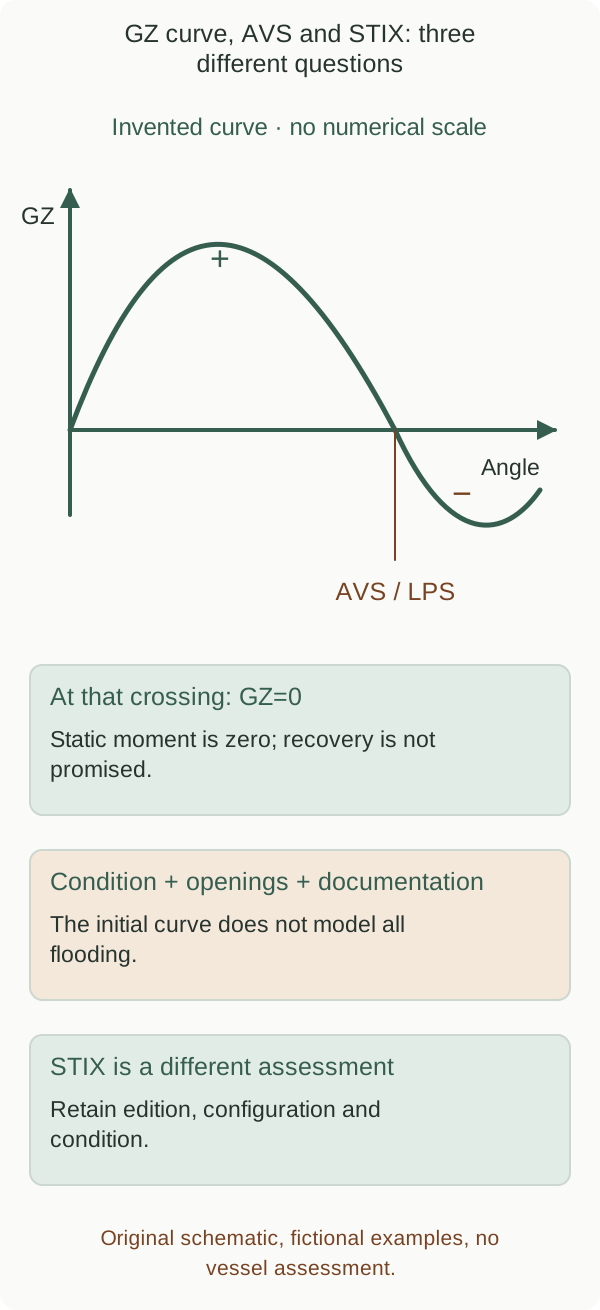
Original schematic, fictional examples, no vessel assessment.
insideSailOriginal insideSail artwork — all rights reservedEnlarge the diagram
What does the sign mean?
In the teaching drawing, positive GZ corresponds to a moment tending to reduce heel. At the next axis crossing following the positive region, that static moment is zero; beyond it, the depicted sign tends to increase heel.
AVS denotes the angle at which positive stability vanishes within the curve’s scope. Other sources may label it LPS.
A larger angle alone does not describe every accident mechanism or guarantee dynamic recovery. The drawing is invented, with no measured angles or arms and no actual boat represented.
The relationship in numbers
Static moment = mass × g × GZ
Mass in kg; g in m/s²; GZ in m; moment in N·m.
A downflooding angle is another limitation
A non-watertight opening may allow water in before the calculated AVS. Ingress changes assumptions: mass, free surfaces and lost buoyant volumes need not match the initial curve.
Reading a curve without establishing how openings were treated is incomplete. Heel is also different from longitudinal trim.
Inspect declared loading, openings and the precise meaning of each reported angle. A drawn positive region cannot promise watertightness or establish how a particular modified boat responds once water is aboard.
STIX needs its assessment context
STIX is a stability index within ISO 12217-2; we do not calculate it from LOA and displacement. The public 2022 abstract does not contain the full normative method.
Inventing factors or thresholds from it would be inappropriate. Assessment documentation should identify edition, application, configuration and reported conditions.
The public IMCI checklist requests STIX and AVS information for minimum operating and loaded arrival conditions. Unlabelled numbers may therefore belong to different conditions.
Public scope information does not substitute for the normative assessment.
On the platform retain a documented value alongside its source and condition. If documentation is unavailable, leave the field unverified.
A repower, new keel or substantial deck load does not automatically inherit the original specimen’s index. CE category is a classification within requirements and conditions rather than permission for every voyage.
Ask what was assessed, for which configuration and with which limitations before asking which number is larger. Individual condition and intended use still require competent assessment.
Sources and references
- Owner manual checklist — ISO 10240 ↗
International Marine Certification Institute · Document dated 240408; PDF p.76 / printed ISO 10240 checklist p.5 of 8, item 66 on reported STIX and AVS in minimum operating and loaded arrival conditions.
Public assessment-body checklist consulted for the data to request, not a certification of a model.
Checked on - ORC — Stability ↗
Righting arm curve, vertical centre of gravity, LPS/AVS and declared measurement trim.
Official selected explanation directly read; no inclining-test instructions or race eligibility claims.
Checked on - ISO 12217-2:2022 — Stability and buoyancy assessment ↗
ISO · Fourth edition, December 2022; abstract, applicability and lifecycle. A successor draft is displayed separately.
Only the public abstract/status consulted. Full paid normative text was not obtained; no STIX equation, thresholds or conformity assessment fabricated.
Checked on
Keep discovering
The next piece of the puzzle
Discuss this concept
Loading the conversation…