By insideSail
Published without technical review · version 2 ·
Hull speed: understand the square root without inventing a speed limit
Wavelength, waterline length and speed help interpret this reference.
In this guide
A specification listing hull speed as 7.3 knots does not mean the boat can never exceed it. It is a customary reference associated with waterline length and waves around a displacement hull.
Reconstruct the calculation, separating speed through water, speed over ground and the geometric input. These distinctions make a comparison more useful than a single number.
A calculation using one published length remains a calculation, not a measured speed or a cruising guarantee.
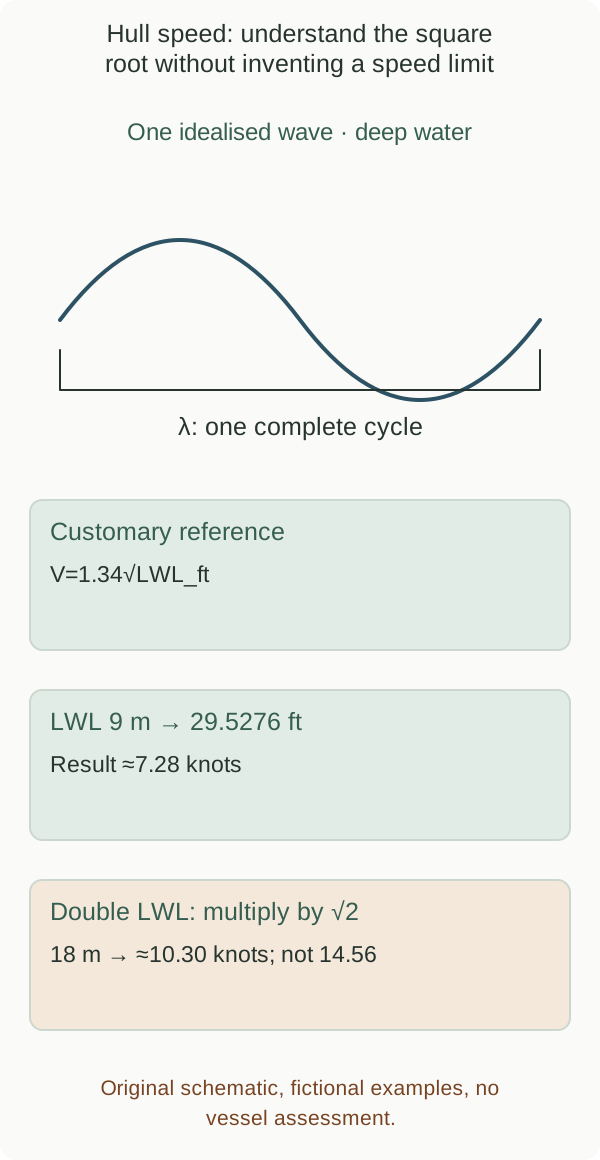
Original schematic, fictional examples, no vessel assessment.
insideSailOriginal insideSail artwork — all rights reservedEnlarge the diagram
Work through the formula
The relationship in numbers
V_ref = 1.34 × √LWL_ft
LWL in feet; result in knots.
For the fictional 9 m waterline divide by 0.3048 to obtain approximately 29.5276 ft. Its square root is about 5.434.
Multiplying by 1.34 gives 7.281 knots, rounded to 7.28. Do not substitute 10.5 m LOA: a bathing platform does not automatically belong to the waterline.
When the source lacks LWL, subtracting an imagined platform length does not verify it. Check whether a figure represents design, measured or sailing waterline before combining it with another source.
Why is there a square root?
For a gravity wave in sufficiently deep water, phase speed is related to the square root of wavelength. The historical reference approximates a situation in which a motion-associated wavelength is comparable to waterline length.
That explains the mathematical form without implying that a hull has only one surrounding wave. Actual wave patterns include different origins, interference, depth and geometric effects.
The customary coefficient does not describe every contribution. The drawing shows the idealised relation rather than a measured wake or a universal resistance curve.
Increasing resistance is not a wall
For a conventional displacement hull, increasing speed can make wave-making resistance more important. Additional power for a small speed increase can become substantial.
The relationship still depends on shape and other conditions. Slender hulls and vessels planing or surfing demonstrate why the expression is not a universal ceiling.
Performance prediction requires more information than LWL. A narrow multihull hull and a broad cruising monohull cannot be judged equivalent merely because their waterline lengths produce the same reference.
An 8-knot GPS reading in favourable current does not demonstrate that the hull exceeded a through-water reference. Distinguish SOG from water-relative speed and establish the observed interval.
Choosing an engine cruising speed also involves consumption, noise, vibration, sea state, loading and operating curves. Hull speed organises a design question; actual use needs measurements and conditions.
Retain that modest role wherever the value appears in a specification, rather than treating theoretical reference speed as a target to reach.
Sources and references
- Western Region Sea State and Surf Forecaster’s Manual — WR-51 ↗
US Weather Bureau / NOAA archive · WBTM WR-51, July 1970; section IV, PDF p.16 / printed p.9, equations 1–5.
Selected physical wave equations directly read; historical forecast procedures and regional voyage recommendations not used.
Checked on - NOAA Sea Grant — calculating hull speed ↗
NOAA · Historical publication, Appendix 1, PDF p.31 / printed p.25: square-root LWL convention.
Selected appendix directly read. The historical theoretical-maximum wording is not adopted as a universal physical speed limit; new examples are fictional and original.
Checked on
Keep discovering
The next piece of the puzzle
Discuss this concept
Loading the conversation…